Week of December 1-7, 2024
I don't know why, but I always miss the planet Jupiter when it's not in our evening sky. Sure, we've now got dazzling Venus lighting up our western sky at dusk, and the planet Saturn appears in the south-southwestern sky. But to me, the sky just never seems complete unless Jupiter is there.
Jupiter behaves like every other planet, of course. It revolves around the sun, and that means that sometimes it appears in the pre-dawn sky and sometimes after sunset. And I couldn't be happier that Jupiter returns to the evening sky this week.
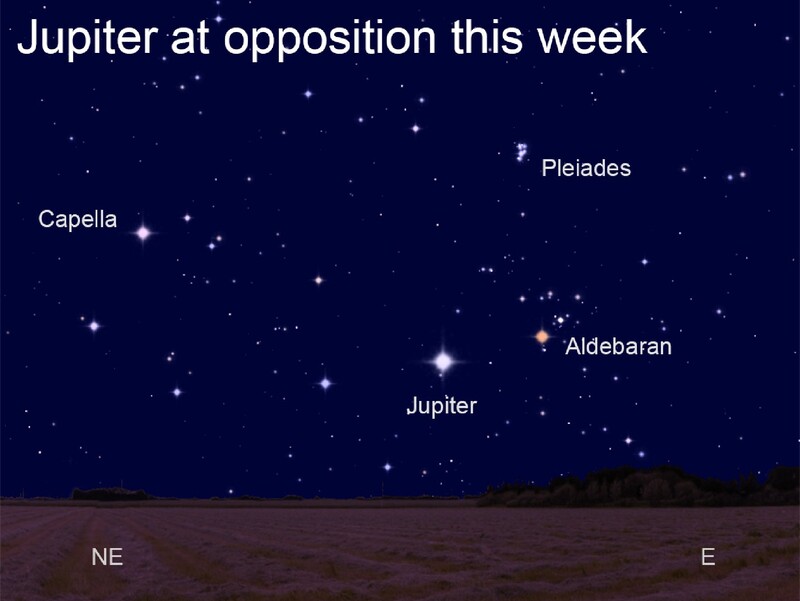
It reaches its official opposition point on Dec. 7. The word "opposition" is one that astronomers throw around without realizing that most beginners don't know what it means, but it's quite simple.
When a planet lies at opposition, it appears in our sky opposite the sun. In other words, the Earth lies between the sun and the planet. It's the time when — for a few weeks — the planet rises in the east around sunset and can be seen all night long. This is also the time when the planet reaches its closest point to the Earth, therefore appearing at its largest and brightest.
If you've got a small backyard telescope, this is the time to dig it out of the closet and dust it off. Jupiter, always impressive to view through a small telescope, will be especially stunning over the next month or so.
Here's a world that's 11 times the diameter of Earth, yet it spins on its axis once every 10 hours or so. This means its Earth-facing side changes completely in just five hours and, with patience, skywatchers viewing through a telescope can easily watch its pastel cloud bands and, sometimes, its Great Red Spot move completely past our view in just one long evening of stargazing.
One of the most enjoyable parts of watching this planet is keeping track of its four largest moons. At last count, Jupiter has 95 known moons, but it's these four — Io, Europa, Ganymede and Callisto — that we know as the Galilean satellites because it was the Italian astronomer Galileo who discovered them and their movements some four centuries ago.
Even the smallest of telescopes allows us to watch them swing around the Jovian disk from night to night, occasionally vanishing behind the planet or slipping in front of it while casting their shadows onto the giant world's cloudtops. And sometimes, if two moons are passing one another or approaching or receding from the planet's disk, a sharp-eyed observer can see their movements in only a few minutes.
Much of the fun of watching these moons is knowing which moon is which. You can identify them by finding an app for your smartphone or tablet, or by visiting shallowsky.com/galilean/ and selecting your date and time.
If you don't have a telescope, contact your local astronomy club or science museum to learn when they'll be hosting their next free "star party" so you can get a close-up look at this exciting giant planet.
With or without a telescope, it's going to be a terrific winter of Jupiter-gazing!
Visit Dennis Mammana at dennismammana.com. To read features by other Creators Syndicate writers and cartoonists, visit the Creators Syndicate website at creators.com.







View Comments