Week of Aug. 23-29, 2026
On the evening of Thursday, Aug. 27, the full moon will rise in the east as it does just about every month. It won't take long, however, for it to begin looking a little strange.
Regular readers of this column know that the full moon occurs when the moon lies on the opposite side of the sky from the sun. When this happens, it also finds itself near the shadow being cast into space by our planet.
Just about every six months or so, the moon will drift into this shadow and produce a lunar eclipse. If it passes entirely into the shadow, it creates a total eclipse, but if it skims only partly through it, a partial lunar eclipse is the result.
We don't see an eclipse every six months, though, since this shadow passage may occur when the moon isn't above our horizon. On Aug. 27, however, it will be, and that night we in North America will be treated to a deep partial lunar eclipse.
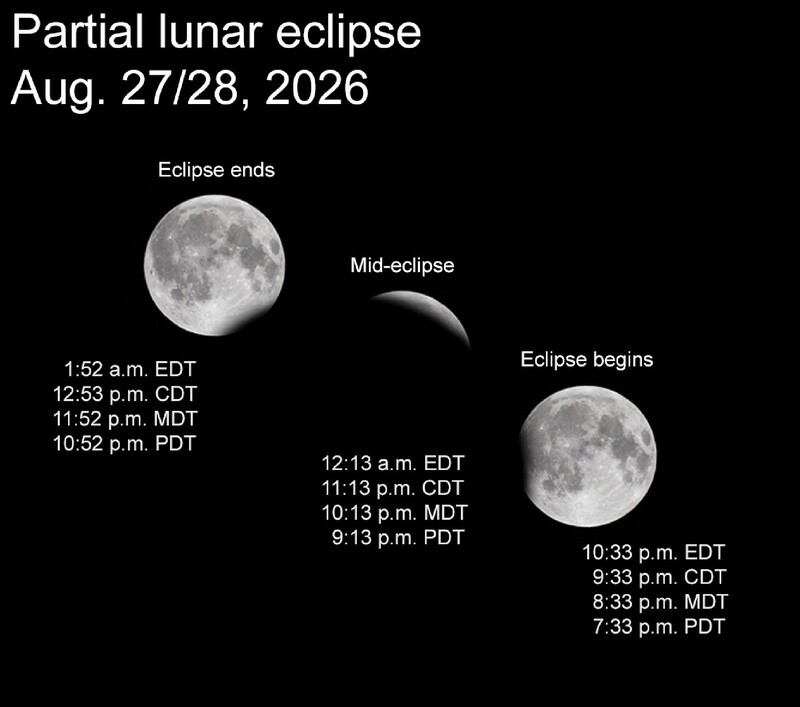
Watch for the moon's eastern edge to begin entering into the Earth's dark inner shadow (the "umbra") at 10:33 p.m. EDT (7:33 p.m. PDT). Skywatchers in western North America will see the moon quite low in the eastern sky when the eclipse begins.
Over the next hour and a half or so, the eclipse will progress as the moon drifts deeper into the Earth's shadow, until around 12:13 a.m. EDT (9:13 p.m. PDT) when it will be about 93% obscured.
From this time on, the moon will begin leaving the shadow and will exit entirely — its "last contact" — around 1:52 a.m. EDT (10:52 p.m. PDT).
Unlike a solar eclipse, an eclipse of the moon is perfectly safe to view without protective filters — it is, after all, only the moon. All you need is your eyes, though viewing with binoculars or a small telescope can be fun as well. And, unlike many fainter celestial phenomena, you'll be able to watch this event from a city.
If you can get away from city lights to view from a dark, non-light-polluted environment, however, you'll see even more of the show. Though it won't be a total eclipse, the darkened portion of the moon may still take on a deep, coppery color as reddened sunlight streams through the Earth's atmosphere and falls onto the shadowed lunar surface.
Those viewing from under dark skies will also see the moon suspended eerily among the stars during maximum eclipse — something city viewers will miss.
To learn more about this partial lunar eclipse, get exact timings for your location, and even watch it being livestreamed, visit timeanddate.com/eclipse/lunar/2026-august-28. And if you'd like to try your hand at photographing the sky show, visit Fred Espenak's great webpage mreclipse.com/Special/LEprimer.html, or do an online search for "how to photograph a partial lunar eclipse".
After the eclipse, be sure to visit spaceweather.com to see some terrific photos shot from around the world.
Here's hoping for clear skies where you are, but if you miss it, the next lunar eclipse visible from all of North America will be only a very small partial eclipse in January of 2028.
Visit Dennis Mammana at dennismammana.com. To read features by other Creators Syndicate writers and cartoonists, visit the Creators Syndicate website at www.creators.com.
On Aug. 27, a deep partial lunar eclipse will occur.







View Comments