Week of July 14-20, 2024
It was 55 years ago this month that humans first set foot on the moon. I'd been excited about this since I saw in our local newspaper a closeup photo of the lunar crater named Alphonsus, captured by the approaching robotic Ranger 9 spacecraft in 1965.
I peered at the moon — and the crater Alphonsus — as often as I could through my small backyard telescope, and I even had a board game called "Melvin the Moon Man" that was my absolute favorite! But none of this could compare to events I hoped would one day become reality.
And then, on the evening of July 20, 1969, it finally happened. Apollo 11 Commander Neil Armstrong became the first human to step onto the powdery lunar surface, followed soon after by lunar module pilot Edwin "Buzz" Aldrin.
I remember it vividly. I had just completed a cross-country drive with a friend and arrived home only minutes before the historic moment. How exciting it was to watch it on TV as the words "live from the moon" appeared across the screen.
NASA had been preparing for this moment for nearly a decade — first with the Mercury spacecraft that carried one astronaut to learn if humans could function well in space. Then came the Gemini program, which teamed two astronauts to test out rendezvous and docking maneuvers.
Finally came the Apollo program, which flew three astronauts to test the equipment and procedures necessary to make a lunar landing and safe return to Earth.
After the Apollo 11 flight, five other missions landed on the moon. Apollo 13, of course, suffered an oxygen tank explosion while the astronauts were 200,000 miles from home and never landed on the moon. The astronauts made it home safely, but not before enduring some remarkable tests of human bravery and engineering.
This terrifying story was told dramatically in Ron Howard's 1995 award-winning film "Apollo 13." If you've never seen it, drop everything and watch it. It will leave you breathless!
Decades have passed since those inspiring years of lunar exploration. Unfortunately, we no longer have the technology to return humans to the moon — it's coming soon, I hope — but there's still a way to relive those exciting Apollo missions. All we need to do is break out the binoculars or a small telescope on the next clear night and have a look at our nearest cosmic neighbor.
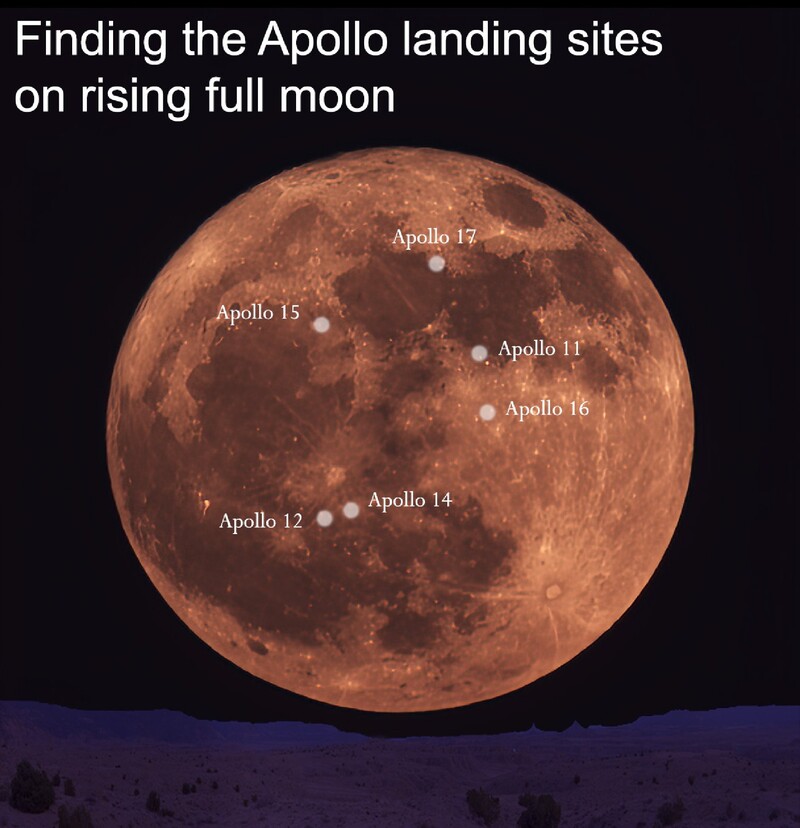
There we can find the places where each of the Apollo missions landed. Of course, we can't see the actual landing sites or the landers, rovers or flags left behind — these are much too small for even the largest of telescopes to see from Earth — but we can see the areas where astronauts have visited.
This is a good week to do this project. The moon is now in its waxing gibbous phase and will be full on the night of July 20. You can use the accompanying image to check out each of the landing areas as the moon rises in the east just after sunset.
And if you happen to spot Melvin cavorting on the lunar surface, give him a smile and wave for me!
Visit Dennis Mammana at dennismammana.com. To read features by other Creators Syndicate writers and cartoonists, visit the Creators Syndicate website at creators.com.
Photo courtesy of Dennis Mammana






View Comments