Week of May 12-18, 2024
If you've been reading my column for a while, you know there are many kinds of critters represented among the ancient constellations. Today I'd like to share with you the story of one of the newer constellations: Hydra, the water snake.
During the late spring of each year, Northern Hemisphere stargazers can spot Hydra snaking its way across our southern sky. With a length of some 100 degrees, this constellation spans more than 1,303 degrees of celestial real estate, making it the largest of all.
As large as it is, Hydra is tough to see. It contains only one significant star that marks the heart of the water snake. It's an orange giant about 177 light years away and appears only about as bright as the North Star. The 16th-century Danish astronomer Tycho Brahe named it Cor Hydrae, meaning "the Hydra's Heart," but today we know it as Alphard, which comes from the Arabic phrase Al Fard al Shuja, meaning "The Solitary One in the Serpent."
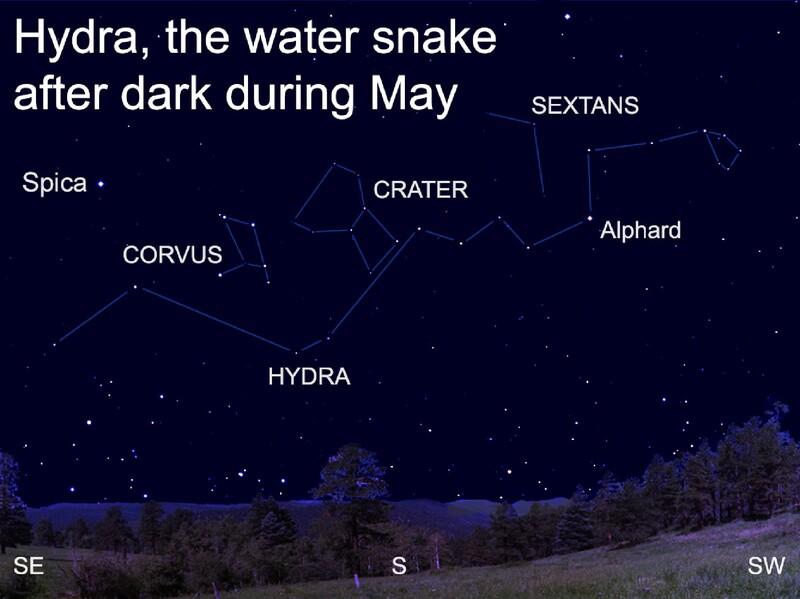
To find Hydra, you'll need a fairly dark sky. First, locate the bright star Spica in the southeast, then look for Alphard in the southwestern sky. To its right, you might be able to make out the tiny ring of faint stars that form the snake's head. To the left of Alphard, try to trace the snake's long, sinuous body to a point just below Spica.
This week, moonlight will be pretty bright, so it'll be tough to find many of the stars of Hydra, but it might be worth trying anyway. If you have trouble, wait until the last week of May, when the moon will be gone from our early evening sky.
In Babylonian times, Hydra was known as Tiamat, the dragon of Chaos. To the ancient Greeks, Hydra represented the terrifying seven-headed monster killed by Heracles as the second of his Twelve Labors. This beast was reportedly so hideous that people died of fear just from looking at it.
Greek mythology tells that one day Apollo, son of Zeus, sent a crow to fetch him a cup of cool drinking water. Having spent his time goofing off rather than following directions, the crow returned with a water snake as an excuse for being late. Apollo tossed them all into the same region of the sky where Hydra, the water snake, was guarding the cup of water from the perpetually thirsty crow.
This story of Hydra is ancient, but the constellations we see there are not. And, believe it or not, this star grouping was once even larger than it now is. Over the ages, various stellar cartographers, including the famous 17th-century astronomers John Flamsteed and Johannes Hevelius, divided it into several pieces. Out of its stars, they created the constellations Corvus (the crow), Crater (the cup) and an even more obscure grouping we know today as Sextans (the sextant). And, of course, the new Hydra "lite".
Even a little-known French astronomer got into the act, creating a constellation he named Felis, the little cat. Astronomers never adopted Felis as one of the official 88 constellations, however, so it remains just a historical curiosity.
Visit Dennis Mammana at dennismammana.com. To read features by other Creators Syndicate writers and cartoonists, visit the Creators Syndicate website at creators.com.
Photo courtesy of Dennis Mammana







View Comments