By Athena Lucero
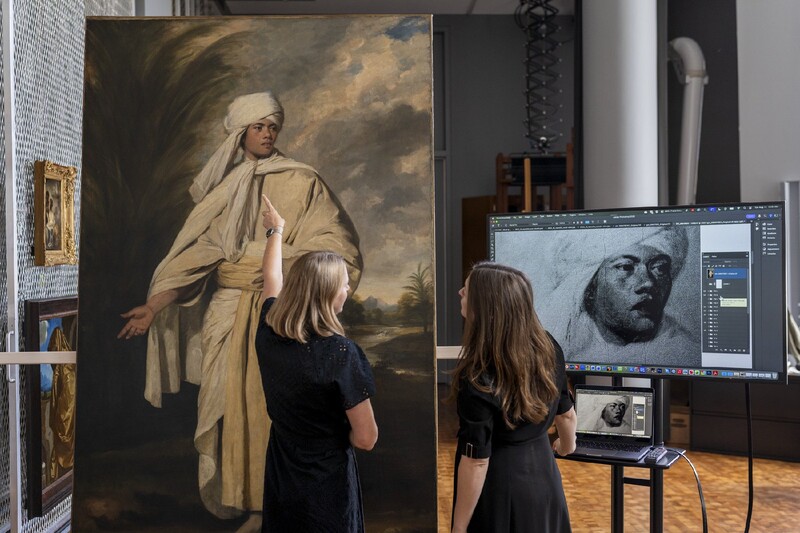
The Getty Museum's Italian travertine campus in Los Angeles was the dramatic hilltop setting for the world-class institution's introduction of "Mai" to America — not in person but by way of his stunning likeness in a 7-foot-tall portrait by Sir Joshua Reynolds, preeminent English portraitist of the 18th century. "Portrait of Mai" broke barriers in a time when paintings this size were saved for nobility and aristocrats.
The debut of the rare noncommissioned piece depicts the first Polynesian and person of color to visit Great Britain — 20-year-old Mai, a "common man" with tattooed hands wearing a turban and ceremonial robe resembling tapa cloth traditionally worn by Polynesian nobility. It is considered Reynolds' finest work, Britain's most culturally important art piece and the most significant contribution to the history of portraiture. Reynolds never sold this personal project but kept it in his private studio until his death in 1792.
Who was this larger-than-life figure?
Fearless and charismatic Mai came from a land-owning family. Around 1763, when he was only 10, his father was killed during a war between the islands of Bora Bora and Raiatea, Mai's birthplace. To save their lives, Mai and his surviving family fled to Tahiti.
Mai's odyssey began 10 years later, when he convinced Capt. James Cook to let him join the British explorer's return voyage to London in 1774. Driven to avenge his father's death and to take back his island, his purpose was to ask King George III for assistance and weapons. During his two years there, Mai became a celebrity in London's high society, where he was known as "Omai." His life was cut short when approximately two years after his return to Tahiti, he died from an illness.
Reynolds' provocative masterpiece — never seen by the public — remained in private collections in Britain for more than 250 years. In 2023 the painting's owner, an Irish horse breeder, decided to sell it. In a historic joint acquisition, the National Portrait Gallery in London and the J. Paul Getty Museum in Los Angeles purchased "Portrait of Mai" for $62 million so that, as noted in The Telegraph, it could be "saved for the nation" and shared by both countries.
After the sale, the portrait's first public tour took place in London in June 2023. That was followed by a national tour (Bradford, Cambridge and Plymouth) that finished in June 2026. Now in the United States, the treasured painting's debut on the West Coast is a homecoming of sorts.
Samantha Bonet-Tirao, minister of education, higher education and culture for French Polynesia and speaking on behalf of French Polynesia's president, Moetai Brotherson, said, "I feel privileged to be part of this historic event celebrating the return of the 'Portrait of Omai.' Mai, as we call him in our language, has traveled all the way from London to Los Angeles, bringing him a little closer to the place where he originally came from. He has returned in the form of this iconic portrait — as a representative of Tahitian culture and history and an invitation for people to learn about our cultural heritage."
Bonet-Tirao went on to say that in a way Mai has become an ambassador for her country — not seeking revenge but rather bringing the past to life for everyone.
Timothy Potts, director of the Getty, shared that in addition to the importance of the artistic qualities of the painting, it is also a reminder of the fascinating intersection of "European and Polynesian world views — historical, cultural and ideological — that have made it so compelling but also contested." Mai's tattooed hands and bark cloth robe identify his Polynesian roots, he said, but his pose is that of Greek or Roman sculpture. He had a noble demeanor and a surprising command of English.
Mai's premature death, however, left unanswered questions. More importantly, Potts remarked, was the need to ensure conservation, research, education and public engagement at both the National Portrait Gallery and The Getty "to have the greatest impact on our audiences."
Robert Lovelace, chair of the J. Paul Getty Trust, added that the innovative collaboration of the two museums in acquiring the masterpiece in superb condition is an opportunity of a lifetime.
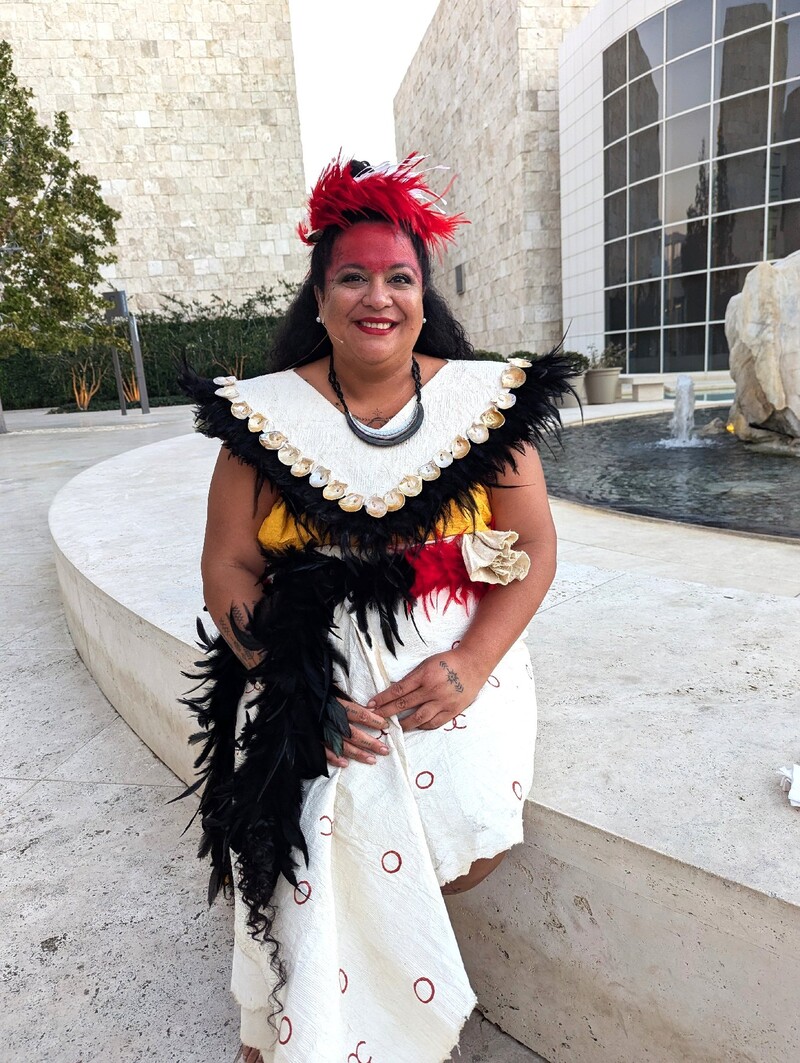
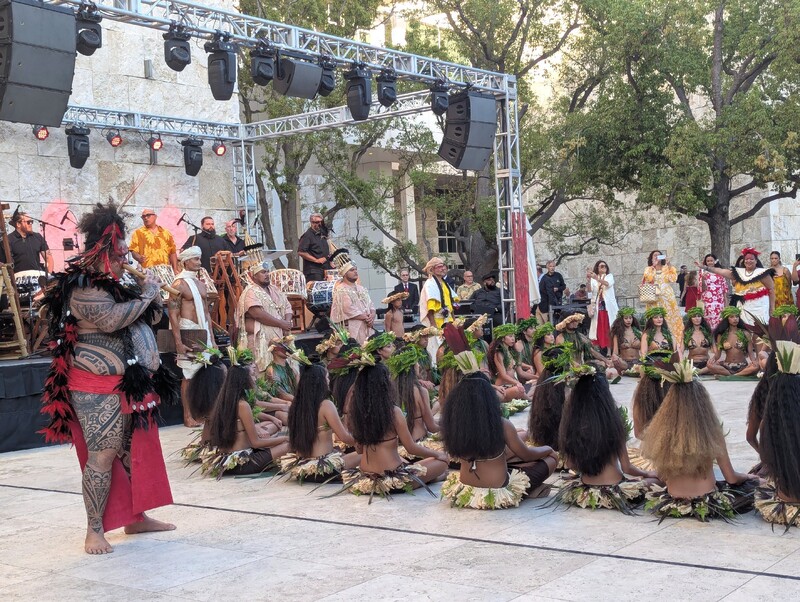
Hinatea Colombani, artistic director of Te Ara O Mai, SARL 'Arioi Experience in collaboration with Tavake Rereata Polynesian Dance Company of Orange County, California, captivated guests with the grace and depth of a Tahitian blessing ceremony and original music and song composed for this profound occasion. Master artists demonstrated living traditions of tapa (barkcloth) that is among the oldest artistic practices of Oceania and the art of Tatau (tattooing), a cultural language that shares a person's identity, spirituality and genealogy.
"My husband and I revitalized 'the tapas' in the archipelago of Tahiti," said Colombani. "We designed and crafted the (troupe members') outfits," she said, emphasizing the word "outfit."
"It is not a costume," Colombani corrected me. "This is a concept we want to teach. We embody the tapa cloth. It is our commitment to carry the knowledge of our ancestors."
Tapa is the inner bark of the mulberry tree that for generations has been used for making traditional fabric through harvesting, peeling, soaking and arduous rhythmic beating. The cloth represents strength and cultural survival.
"Our colors are like the portrait: tapa, yellow and red that we wanted to emphasize because the colors link to the statue of Mai. That is why we created the outfits. It's all about him."
MORE INFORMATION:
"Portrait of Mai" will be at the Getty Museum until March 14, 2027, when the museum will close temporarily until March 2028. During this time, the portrait may be enjoyed at the Getty Villa in Pacific Palisades, California, for approximately six months. The portrait will return to the Getty Museum in time for the 2028 Summer Olympic Games in Los Angeles — for the enjoyment of international visitors.
The Getty Museum: https://www.getty.edu/museum/
Getty Villa: https://www.getty.edu/visit/villa/
Travel to Tahiti: https://www.tahititourisme.com/
Athena Lucero is a freelance writer. To read features by other Creators Syndicate writers and cartoonists, visit the Creators Syndicate website at www.creators.com.
The Getty Museum's special event was an ancestral celebration honoring the arrival of "Portrait of Mai." Photo courtesy of Athena Lucero.







View Comments