Week of December 7-13, 2025
Next weekend will be a great time to get away from city lights to enjoy the night sky and the annual Geminid meteor shower.
Meteors are also known as falling, or shooting, stars because they appear to be stars that, well, fall or shoot across our sky. But these descriptive names are where the similarities end.
Stars, you may recall, are thermonuclear furnaces millions of times larger than the Earth. They are the last things we want plunging out of our sky!
No, meteors are simply random specks of interplanetary dust that fall into our atmosphere and burn up. And, at times like next weekend, when the Earth plows into the dusty debris scattered around the orbit of the asteroid Phaethon, we experience a meteor shower.
While most of these dust particles are no larger than sand grains, it is their fiery deaths some 50 to 60 miles up that we see as dramatic meteors. And the Geminid meteor shower is, at least in my opinion, the most spectacular of the year, so it's not one to miss.
Astronomers predict that this year, the Geminids should reach their peak during the pre-dawn hours of Sunday, Dec. 14, but you can expect to see quite a few on Saturday night as well.
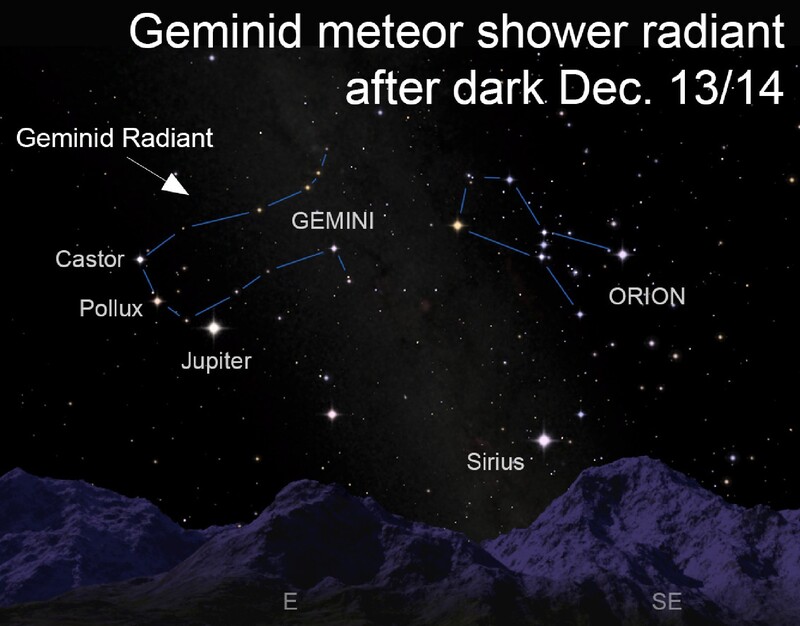
The shower is named for the constellation Gemini, from which all its meteors seem to originate. This week, you'll find Gemini low in the eastern sky after dark, and around midnight, it'll appear nearly straight overhead. Don't expect to see many meteors in its direction, though; they will, instead, appear all around the sky. But if you trace their paths backward, those that come from this particular meteor swarm will seem to radiate from a point (the "radiant") that lies not far from the bright star Castor.
You will undoubtedly hear reports this week that the Geminids will "light up the sky." That sounds like a wild night of celestial activity, but the description is grossly overblown. It is true that this shower can produce some brilliant "fireballs." These can cast a shadow and sometimes leave behind smoky trails that you can watch with binoculars as they twist and turn in upper atmospheric air currents.
We expect about 120 meteors will fall per hour under ideal conditions, but let's think about this realistically. This number of meteors would produce, on average, only one every 30 seconds; unless they're bright enough and fall in the direction you're looking, you probably won't see this many. But those you do see will be quite exciting.
Watching the meteor shower is not difficult and requires no fancy equipment. Here are my recommendations for a fun night of meteor shower viewing. First, dress warmly and have on hand a thermos of hot chocolate or soup, for example, to make the night even more enjoyable. Second, observe from a dark location far from the blinding lights of cities. Third, lie back on a warm sleeping bag or lawn chair with a blanket, and scan the entire heavens with your eyes.
And, finally, keep your eyes open. I shouldn't have to say this, but only those who remain awake will enjoy the show!
Visit Dennis Mammana at dennismammana.com. To read features by other Creators Syndicate writers and cartoonists, visit the Creators Syndicate website at www.creators.com.
The Geminid meteor shower is one of the most spectacular of the year.







View Comments