Week of January 4-10, 2026
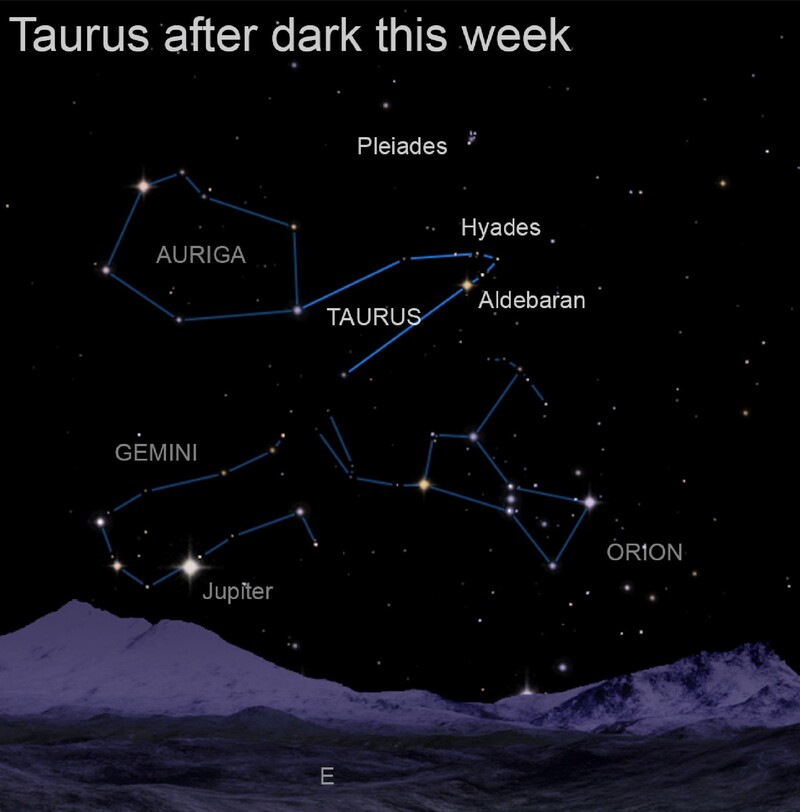
One of the most famous of all constellations to grace the wintertime sky — and one which looks little like its namesake — is Taurus, the bull. During early January, you can find it midway up in the eastern sky after dark.
Stargazers with a vivid imagination might be able to connect its stars with imaginary lines to outline the letter "V" (aka, the Hyades) that supposedly forms the bull's head. There you will spot the bright reddish-orange star Aldebaran that marks his fiery red eye, glaring downward toward Orion.
Aldebaran, along with the bright stars Antares (in the summertime constellation of Scorpius, the scorpion), Regulus (in the springtime constellation of Leo, the lion), and Fomalhaut (in the autumn constellation of Piscis Austrinus, the southern fish), was one of the four "Royal Stars" of ancient Persia. In various cultures, it was connected with the spirits or gods of the rain, and with the fertility of the Earth itself.
Appropriately, Aldebaran is surrounded by the Hyades, which, in ancient lore from Greece all the way to China, has been associated with wet and stormy weather; even its name is said to come from an archaic Greek word meaning "to rain."
At a distance of only 150 lightyears from Earth, the Hyades forms the nearest open star cluster to Earth and may be only about 660 million years old. While it appears that Aldebaran is part of this cluster, it's actually less than half that distance from us and just appears along the same line of sight.
Higher in the sky, on the back of Taurus, rides the Pleiades, more commonly known as the "Seven Sisters." This star cluster is less than 400 lightyears away and may be only between 50 million and 100 million years old — a veritable cosmic youngster.
On the next clear night, look carefully at the Pleiades to see how many stars you can count. Most stargazers can find six, so its name "Seven Sisters" remains a mystery. Was there a seventh star that was brighter during ancient days, or perhaps one that appeared more easily because of no light pollution back then? To this day no one knows.
If you do your stargazing where artificial lights obliterate faint stars, you may find it tough to see the Pleiades clearly, but you can almost always spot it by casting your gaze slightly to the side of the cluster. This will make it much more visible than if you stare at it directly.
As faint as it seems, this star cluster appears frequently in broad daylight. It's true! Just walk around a parking lot one day, find a Subaru, and check out its emblem. Yep, it's the Pleiades! And why not ... the name Subaru comes from historical Japanese sky lore and represents this beautiful star cluster.
Here's one more tidbit about the celestial bull. The star that connects one of the horns of Taurus and Auriga — known as Elnath — is one of only two that is shared with a neighboring constellation.
Get out to explore this region of the sky on the next clear night, and I'll bet you, too, will become bullish on Taurus!
Visit Dennis Mammana at dennismammana.com. To read features by other Creators Syndicate writers and cartoonists, visit the Creators Syndicate website at www.creators.com.
Taurus is one of the most famous wintertime constellations.







View Comments