Week of October 18-24, 2026
The moon shines brightly in our night sky this week.
Stargazers have been known to curse those nights when moonlight blots out fainter, more distant and "interesting" stars, clusters, nebulae and galaxies. Most of us, however, rarely pay attention to its monthly cycle and orbit that carries it around its parent planet.
This week offers a great opportunity to watch the moon's movement across the heavens. The week begins with the moon appearing in its first quarter phase due south at dusk. The sun (lying below the western horizon not long after dark) illuminates its spherical body from the west and gives it this characteristic shape.
As the week progresses, however, the moon will appear to drift toward the east, and its face will begin to fill out as sunlight shines more on its "front" side. You can watch this progression of the moon orbiting the Earth by comparing the moon's position at the same time each night.
There's nothing unusual about this movement. It occurs because the moon circles the Earth just about once a month. To complete its 360-degree circuit around our planet every 29.5 days, the moon must drift about 12 or 13 degrees eastward every night, and you can easily guess roughly where it will appear on successive nights.
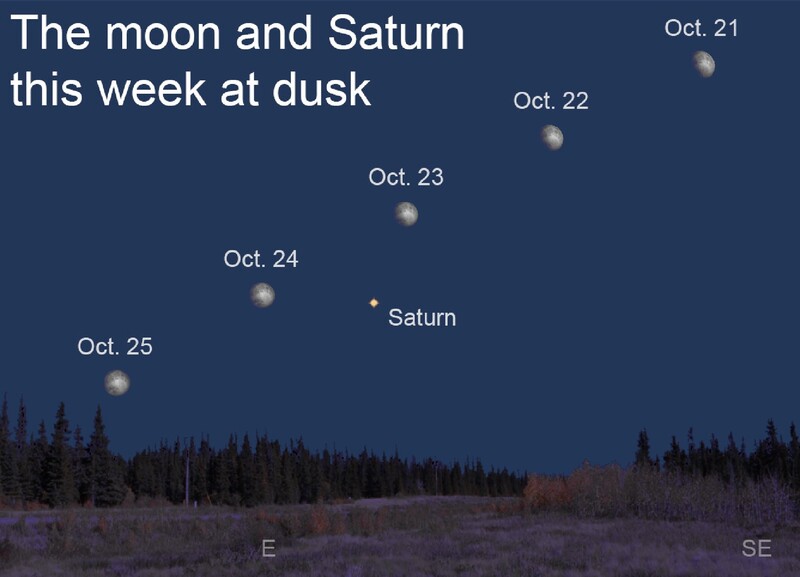
By the nights of Oct. 23 and 24, the moon will be in its waxing gibbous phase and will visit the ringed planet Saturn on those nights. Well, OK, it won't exactly "visit" it; after all, Saturn is 3,400 times farther than the moon this week. But the pair will appear along a similar line of sight that makes it seem like they are near each other. Check out the accompanying illustration to see how the moon's orbital path carries it past Saturn this week.
You may recall that I wrote about this ringed planet a few weeks ago. It lies in a great celestial location right now, being closer and brighter than it appears during most of the year. You'll have a hard time missing it, even from under the lights of a large city, since it's the brightest object in the eastern sky after dark.
Telescopic viewers will have a great time viewing the moon early this week. Being located at nearly a right angle to the sun, its craters, valleys and mountains will cast stark shadows across the lunar surface, revealing a stunningly dramatic moonscape. As the moon drifts farther to the east, however, it becomes illuminated more nearly face-on by sunlight, making detail on the lunar surface appear rather flat.
Saturn, on the other hand, is in prime position for telescopic viewing right now. Its rings appear spectacular in even the smallest of telescopes; of course, the larger the scope we use, the more dramatic they will appear.
We know that Saturn has 293 confirmed moons, but we can see only a few through a small telescope. On most nights, Titan — the largest moon in the Saturnian system — appears as a bright yellowish-orange dot near the planet.
I wish you clear skies so you can enjoy this close visit between the moon and the ringed wonder Saturn!
Visit Dennis Mammana at dennismammana.com. To read features by other Creators Syndicate writers and cartoonists, visit the Creators Syndicate website at www.creators.com.
This week, the moon's orbital path will carry it past Saturn in the night sky.






View Comments