Week of September 27 - October 3, 2026
Suppose I were to ask you which of our solar system's planets is the most beautiful. Think about it.
Is it the sparkling planet Venus, which has adorned our dusk sky for the past few months? Or perhaps the Red Planet Mars, with its ominous ruddy hue. Or maybe Jupiter, which, through a telescope, displays its amazing cloud system and ever-changing moon system.
I suspect astronauts who have orbited the Earth or ventured to the moon would say our world is the most stunning, with its glistening white clouds, blue oceans and green and brown continents. And I would have to agree, but not completely.
Get one glimpse of the ringed planet Saturn and you'll understand why. I saw Saturn this week for the first time in nearly a year, and I've got to tell you I nearly fell off my observing chair.
Everyone's first telescopic view of this world elicits a gasp of wonder, as this remarkably three-dimensional ringed world appears hanging in the blackness of space. I've been viewing Saturn now for more than 60 years, and I'm still astonished!
Yes, I have a great reason to call Saturn "Lord of the Rings"!
Even the smallest of backyard telescopes with a magnifying power of only 30x or so will easily show this ring system. Of course, if you have a higher-magnification eyepiece to attach, along with a night of steady air, you'll be treated not only to Saturn's ring system but also the major separation within known as the Cassini Division.
Often one can even spot some of the planet's pastel cloud bands, but they are pretty subtle and need excellent conditions and optics to become visible. If that's not enough, Saturn's largest and brightest moon Titan also frequently appears with even the smallest of instruments, as do several of its smaller moons.
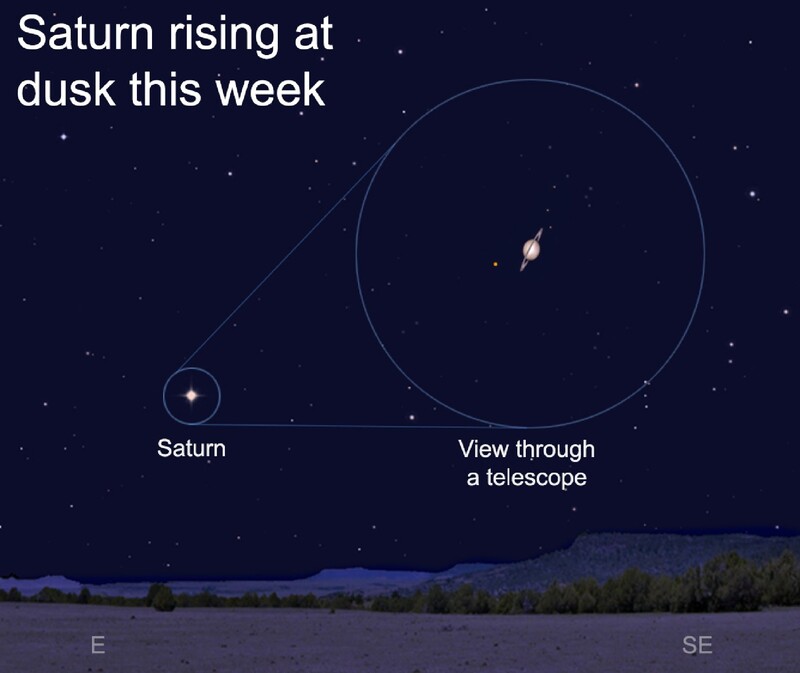
Now is a perfect time to view Saturn. It reaches its annual opposition point on Sunday, Oct. 4, when it appears in our sky opposite the sun, rising in the east at sunset and shining all night long. It's easy to find right now, because it's the brightest "star" in that part of the sky.
Not only does Saturn's opposition mean that it lies opposite the sun in our sky, but it also means it's closest to the Earth. This week Saturn lies only about 784 million miles from us, so the view becomes even more spectacular.
Making the sight even more breathtaking is an appreciation of what we're actually seeing. As you gaze at Saturn, keep in mind that it's a world made almost entirely of gases, with a diameter about 9.5 times greater than the Earth's.
Its rings — if brought here — would fill much of the space between the Earth and our moon. Though they appear solid to the eye, they are really composed of billions of individual ice chunks — ranging in size from dust grains to boulders to mountains — and all revolving about Saturn at tens of thousands of miles per hour.
One glimpse at this stunning ringed world will make it easy for you to agree that it is arguably the most astonishingly beautiful planet!
Visit Dennis Mammana at dennismammana.com. To read features by other Creators Syndicate writers and cartoonists, visit the Creators Syndicate website at www.creators.com.
Now is the perfect time to view Saturn, perhaps the most beautiful planet in our solar system.





View Comments