Week of Aug. 9-15, 2026
August has become one of my favorite months for several reasons.
For one thing, the blistering heat of the desert where I live is nearing an end. Thankfully! Another reason is that the Milky Way appears to arch beautifully overhead after dark. And finally, I get to watch one of the two best meteor showers of the year as it reaches its peak this month.
I'm referring, of course, to the famous Perseid meteor shower.
It's been a couple of years since we've had a Perseid display without interference from bright moonlight, so I'm especially looking forward to this one.
The Perseid shower occurs each August when the Earth slams into dusty debris expelled by the ancient Comet Swift-Tuttle. As this cometary litter falls into our upper atmosphere, it is incinerated and produces the phenomena we know as meteors (aka "shooting stars" or "falling stars").
Most meteors are specks of interplanetary dust (known as "meteoroids") no larger than a grain of sand. They slam into our atmosphere at more than 100,000 miles per hour and are extinguished in a dramatic burst of light. When this happens, we call it a "meteor." The Perseid shower can produce as many as one or two meteors every minute.
So when and where should we look? The "when" part is easy to answer: Astronomers expect this year's shower to reach its peak during the predawn hours of Thursday, Aug. 13.
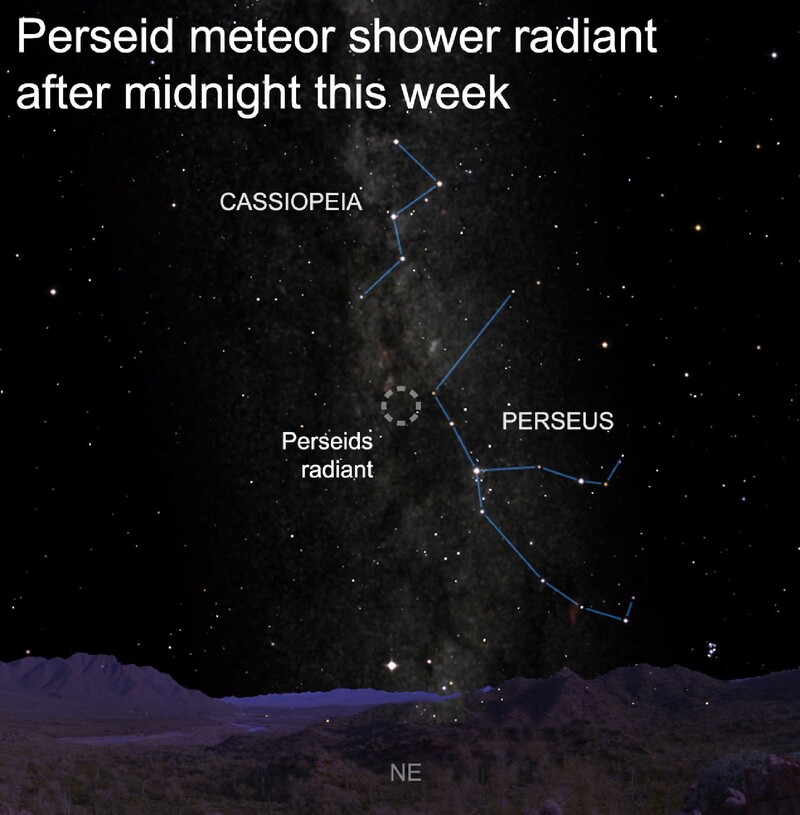
Where to look is another matter altogether. Meteors will appear to fall all around the sky, but if you watch carefully and trace their paths backward, you'll discover that most appear to radiate from one general area in the sky.
This spot is known as the shower's "radiant" and is often named for the constellation against which it appears. That's why this month's shower is known as the Perseids; its radiant lies in the constellation of Perseus. Any meteors that seem to come from elsewhere are called "sporadic" meteors and are flecks of dust not part of the Swift-Tuttle swarm.
To get the best view, drive away from city lights to the mountains, deserts or countryside. No equipment is required; all you need to enjoy the sky show is your eyes, but binoculars could be helpful to check out long smoke trails left behind by any exploding fireballs. You may also wish to take a lawn chair or sleeping bag, and a blanket or hot chocolate to keep warm — yes, even in the summer — so you can gaze skyward comfortably. Your biggest challenge will be just to stay awake!
Can't we go out during the evening to watch the show? Of course, but we won't see much. Since the Earth is plowing into this cloud of dusty debris, our best view of the shower usually comes when we're peering out the Earth's "front window," and that occurs just before dawn.
Few sights are as thrilling as the fiery spectacle known as a meteor, and one of them is enjoying a shower of them. I hope you'll make the effort this week to get away from city lights to enjoy one of nature's most amazing spectacles: the Perseid meteor shower.
Visit Dennis Mammana at dennismammana.com. To read features by other Creators Syndicate writers and cartoonists, visit the Creators Syndicate website at www.creators.com.
The Perseid meteor shower is expected to peak during the predawn hours of Thursday, Aug. 13.







View Comments