Week of June 30 - July 6, 2024
If you find yourself in a dark, un-light-polluted area anytime soon, be sure to glance around the sky with binoculars. Along the hazy band of the Milky Way and elsewhere, you're sure to find plenty of hazy splotches of light that astronomers know as "faint fuzzies."
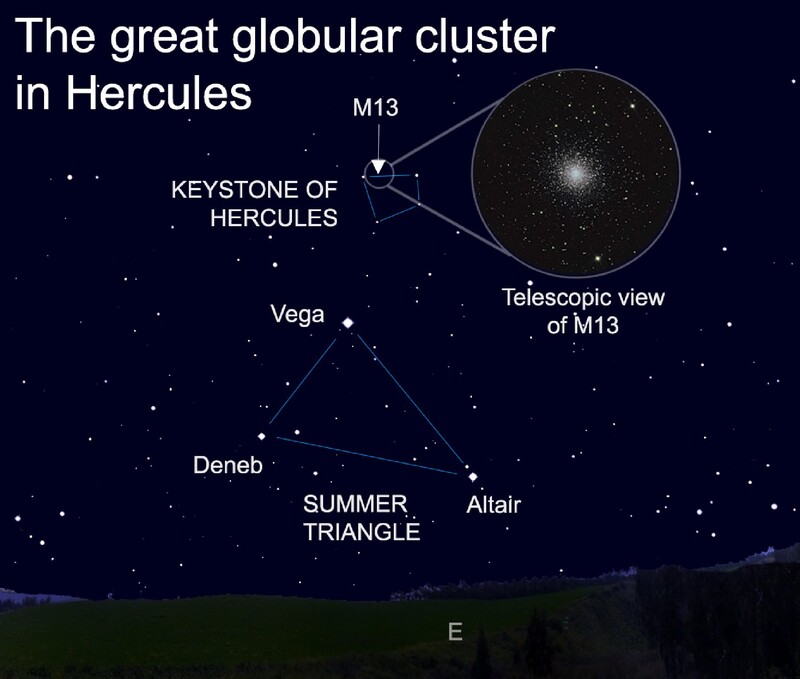
Some of these are immense families of stars born from the same interstellar clouds millions or billions of years ago. One of the most famous of such star clusters lies in the direction of the constellation Hercules (the strong man) and is known as M13 or the Great Globular Cluster of Hercules.
Hercules is the fifth-largest constellation in the heavens and now appears very high in the eastern sky — nearly overhead — just after dark. Because it contains no particularly bright stars, it's not very prominent except for its four equally bright stars that form a distorted square or "keystone." This supposedly outlines the body of the strong man, but finding his head or appendages will require some vivid imagination.
It is among these stars that we can find M13. To do so, look nearly overhead in the eastern sky after dark, identify the keystone, and look about one-third of the way between the two westernmost stars.
If you have excellent vision and a clear, dark sky, you may see it as a fuzzy star. It may not be visible at first; instead of staring directly in its direction, glance slightly off to the side of it. This "averted vision" technique is one that astronomers use quite frequently when searching for such faint objects.
Once you find it, check it out with binoculars and you'll see it's not just a fuzzy star but something considerably larger. And if you've got a small, backyard telescope that you can aim in its direction, you'll be amazed by what appears in the eyepiece.
At a distance of 22,000 light-years, M13 contains some 300,000 stars held together by gravitation into a spherical volume about 170 light-years across. With so many stars in this cluster, might some be home to planets of technologically advanced civilization?
It was with this very thought that, 50 years ago this year, astronomers broadcast in the direction of M13 a three-minute message from the newly dedicated 1,000-foot-diameter radio telescope in Arecibo, Puerto Rico. This cryptic signal carried into the heavens the story of our planetary system, our species and our understanding of the cosmos.
Of course, no one expects a reply. Even traveling at the speed of light, the radio message would require 220 centuries just to arrive there. No, the signal was intended only as a message in a bottle, tossed by the human race to the cosmic ocean. It said, in essence, "We are here." And, while we may never know its fate, this message might one day let other beings know that they are not alone.
Pretty remarkable stuff! Equally remarkable is that we can see this very star cluster with our own eyes on any clear, dark night — if we know just where to look.
To learn more about the message itself, go to any internet search engine and search for "Arecibo message."
Visit Dennis Mammana at dennismammana.com. To read features by other Creators Syndicate writers and cartoonists, visit the Creators Syndicate website at creators.com.
Photo courtesy of Dennis Mammana







View Comments