Week of May 10-16, 2026
Skywatchers of ancient times recognized the night sky as a way to measure time. Not only does it seem to revolve around the Earth every night, but it also appears to change gradually over the seasons.
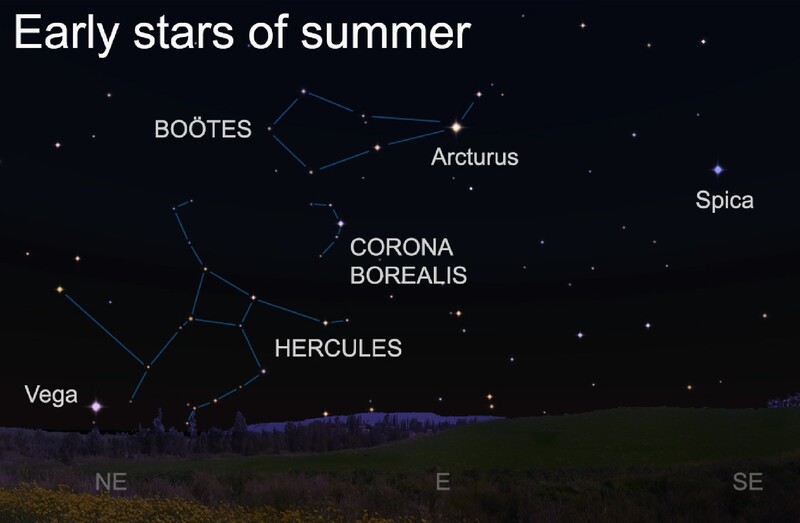
The stars and constellations of winter are now vanishing in the west as those of springtime shine overhead. But a look toward the eastern sky after dark will give a preview of the early stars of summer. And that's one season of stargazing I always look forward to every year.
One of my favorite star groupings shines high in the east just after dark. It's named Bootes (pronounced boh-OH-teez), after the herdsman who eternally shepherds the polar stars in their daily and annual revolutions around the North Celestial Pole.
This constellation is marked by the yellowish-orange star known as Arcturus — the fourth brightest in all the heavens. It's the most brilliant in the northern half of the sky. Located 37 lightyears away (about 220 trillion miles), and some 27 times the diameter of our sun.
Now, you can scour this area for a herdsman if you like, but to me, Bootes looks much more like a traditional kite, with Arcturus forming its base where a tail streams nicely off to the side. Or, if the night is particularly warm, you might imagine it as an ice cream cone lying on its side, with Arcturus at its pointy base and a single scoop outlined by the arc of stars on its left side.
To the east of Bootes, and appearing just above the northeastern horizon after dark at this time of year, lies Hercules, the strong man, famous in ancient Greek mythology for his 12 labors.
Hercules outlines the fifth-largest constellation in the sky, but it contains no really bright stars, so it's not terribly prominent. You'll probably be able to locate its central "keystone" of stars without too much trouble, however — something this native Pennsylvanian enjoys spotting each year.
Between these two star groupings, we find one of the most delicate of all constellations, Corona Borealis, the northern crown. Personally, I tend to think of it as a second scoop of ice cream that fell off the tilted cone above it!
However you choose to view it, Corona Borealis is one of the smallest constellations in the heavens; in size, it ranks 72nd out of 88 constellations, and its brightest star (Alphecca) isn't terribly bright at all, even fainter than Polaris, the North Star.
You may remember that I wrote in 2024 about a nova that astronomers expected to appear here (the "Blaze Star"). ... Well, we're still waiting. The latest guess is that it might erupt around the end of June. Or not.
Finally, quite low in the northeast, look for the sparkling jewel known as Vega, the brightest star of Lyra, the harp, rising just after dark at this time of year. Before long, it'll be followed by Deneb and Altair, which complete the Summer Triangle.
One thing is certain. Once we see Vega appearing in the early evening sky, summertime — and an amazing new collection of stars to explore — is not that far behind.
Visit Dennis Mammana at dennismammana.com. To read features by other Creators Syndicate writers and cartoonists, visit the Creators Syndicate website at www.creators.com.
As the prominent winter stars and constellations vanish from view, the early stars of summer are now appearing in the eastern night sky.





View Comments