Week of April 20-26, 2025
When I was in grade school I was fascinated by the world's largest telescope: the 200-inch-diameter Hale Reflector on California's Palomar Mountain. What a behemoth! At the time I enjoyed using a 4.25-inch telescope in my backyard, and it's stunning to realize that I would have needed more than 2,200 similar telescopes all working in synch to match the light-gathering power of the Palomar giant.
Over the years, larger telescopes have been built, thanks to computers, lasers and innovative mirror-building technologies. As a result, the massive Palomar reflector has dropped out of the top 20 largest telescopes. Though it's still a world-class instrument, it will soon drop even lower when the 1,181-inch and 1,535-inch telescopes are completed by the end of this decade.
As amazing and valuable as these are, they all share one common problem. They view the heavens from beneath a thick ocean of turbulent air that blurs everything above them. While this can be reduced to some degree, it would be wonderful to view through no atmospheric distortion at all.
Enter the Hubble Space Telescope, which was launched into Earth orbit 35 years ago this week (April 24) aboard the Space Shuttle Discovery. With a diameter of "only" 94 inches, it's hardly the largest telescope around. What makes it special is that it observes the universe from above the Earth's atmosphere, producing consistently clear and crisp images.
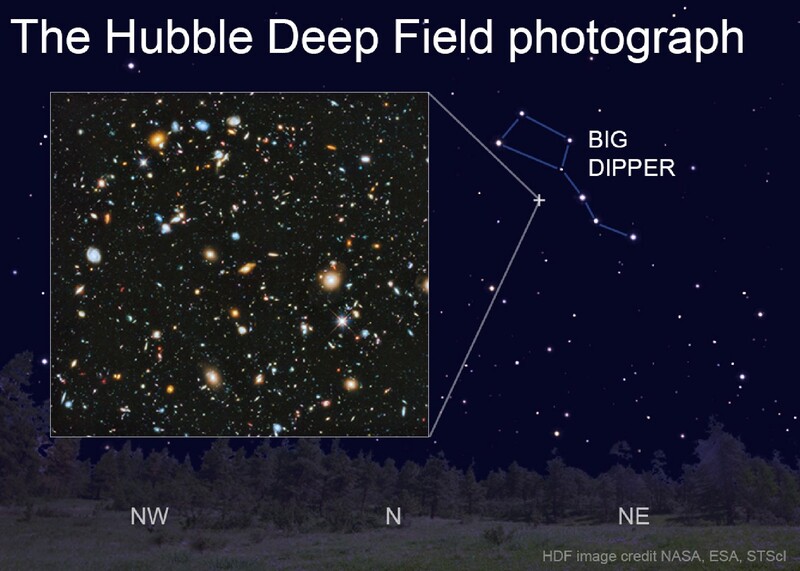
One of its earliest and greatest discoveries — and there are countless — was the number of galaxies that exist out there in the universe. In 1995, scientists aimed HST toward a tiny area of the heavens not far from the Big Dipper where they had found nothing except a black, empty section of the sky.
After taking a photograph equivalent to a 10-day long exposure — now known as the Hubble Deep Field — they found thousands of galaxies in an area of the sky about the width of a pinhead held at arm's length. If that's how many exist in such a tiny region, there must be hundreds of billions throughout the cosmos.
Hubble continues to revolutionize our concepts of the universe as it orbits our planet, and on a good clear night, you can see it with your own eyes. How does one know when and where to look?
My favorite website to predict passes of HST is heavens-above.com. Once there, take a few minutes to register. It's free and it'll make your future visits more productive and enjoyable.
Once you tell the program your location, you can see details of upcoming HST passes (as well as those of other satellites). And when you click the time of HST's maximum altitude, a full sky map opens and shows the satellite's path through the familiar constellation outlines.
Be sure to go outdoors a few minutes early and keep watch along the satellite's projected path for a "star" that appears to be drifting slowly in the correct direction.
To watch HST fly over is to see with your own eyes the amazing telescope that has helped usher in our current golden age of astronomy. And what a great way to celebrate its 35th anniversary!
Visit Dennis Mammana at dennismammana.com. To read features by other Creators Syndicate writers and cartoonists, visit the Creators Syndicate website at creators.com.
Photo courtesy of Dennis Mammana







View Comments