Week of October 4-10, 2026
Anyone wishing to see the moon this week needs to set the alarm early because it now shines in the predawn sky, where it passes by two bright planets on Monday and Tuesday.
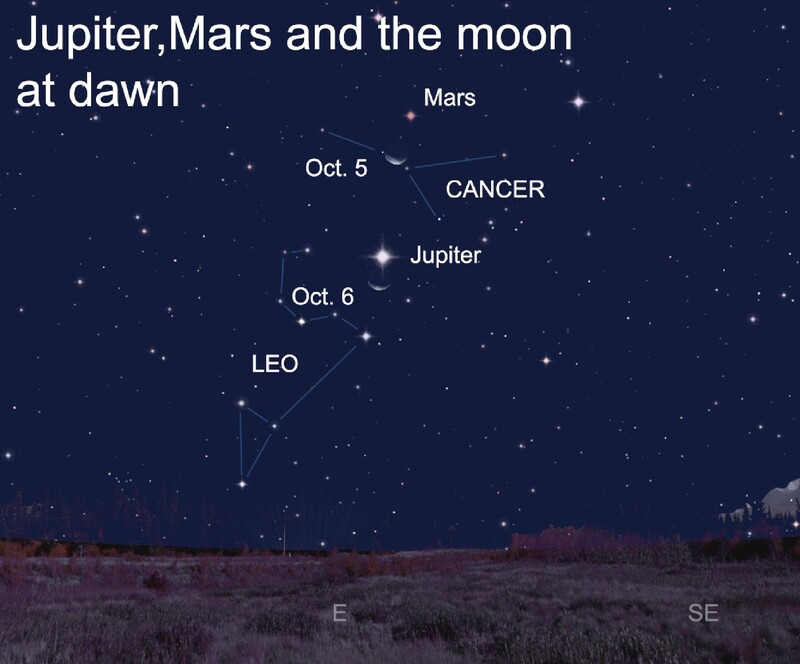
If you head outdoors before dawn on the morning of Sunday, Oct. 4, you'll see the waning crescent moon above ruddy Mars and brilliant Jupiter. By Monday, Oct. 5, it will have drifted along its orbit far enough that it'll appear between the two. And on the morning of Tuesday, Oct. 6, some early-morning stargazers will see it pass directly in front of Jupiter!
This unusual event is called an "occultation," and it happens occasionally because the moon and planets orbit nearly in the same geometric plane. Unfortunately, how it appears (or even if it appears) depends on your viewing location. In any case, the pair will lie quite low in the eastern sky, so seeing them requires an unobstructed horizon in that direction.
Except for stargazers in the western part, most in North America will see the occultation. Skywatchers on the East Coast, for example, will see Jupiter vanish behind the moon's crescent around 4:20 a.m. and reappear about an hour later. From the Midwest, the disappearance will take place about 3:20 a.m., and the reappearance will be around 4:18 a.m. In the Mountain time zone, Jupiter vanishes around 2:20 a.m. and reemerges on the other side of the moon around 3:10. a.m.
From the West Coast, however, the entire event will occur while both Jupiter and the moon lie below the eastern horizon. When they rise, they'll still appear close enough to be able to be viewed together with binoculars or a low-power telescope.
The occultation will be visible to the unaided eye, but you'll find it more exciting if you can watch it with binoculars or a small telescope. That way you'll be able to watch as Jupiter and its Galilean satellites slip behind our moon's rocky limb and reemerge on the other side about an hour later.
To find the exact times of the event in your area, visit lunar-occultations.com/iota/bstar/1006jupiter.htm. The times you see there are tabulated in Universal Time that astronomers use, and you must convert them to your local time. Simply subtract seven hours from UT to get PDT, six hours for MDT, five hours for CDT, and four hours for EDT. So, for example, in New York City, 8:23 UT converts to 4:23 a.m. EDT.
The event will be visible to the naked eye, but you'll find it even more interesting if you can view it with binoculars or a low-powered telescope. That way you'll be able to not only watch the planet drift behind the moon's disk and reemerge but also see its four Galilean moons.
Begin your watch for the reappearance at least 15-20 minutes early as well. Spotting the planet's reappearance from behind the dark limb, however, will be a little more challenging since it's tough to know exactly where it will emerge.
If you forget to set an alarm, or if clouds interfere, the next Jupiter occultation visible from North America won't occur until 2034. So I wish you clear skies on Oct. 6!
Visit Dennis Mammana at dennismammana.com. To read features by other Creators Syndicate writers and cartoonists, visit the Creators Syndicate website at www.creators.com.
The next lunar occultation of Jupiter occurs on Tuesday, Oct. 6.







View Comments