Dear James: We need more privacy and security, so I plan to build a board and batten fence on my level yard. Is this a good choice, and what are some construction tips? — Randy P.
Dear Randy: With a level yard, building a board and batten fence is not difficult and can be very attractive while providing the benefits of privacy, security and a windbreak. The most difficult part of the job will be just handling the heavy pressure-treated lumber and sacks of concrete mix.
Before you start laying out your fence and buying materials, make sure the path for the fence is actually fairly flat. Stretch a line and check it with a level. Sometimes a slight grade will appear to be level. If you have to rake the fence so it follows a slope, the construction may be beyond your skills.
There are many styles of board fences, but the most common ones have the vertical infill lumber laid out as stockade, board on board, board and batten, and slat patterns. A stockade fence has the boards placed flush against one another to form a solid fence. This is effective for the above three benefits, but it is not the most decorative.
A board-on-board fence has the infill lumber nailed on to each side of the fence with a gap between each piece. The side-to-side location is staggered so that the board on one side covers the gap on the other. This style of fence provides privacy and security, but it still allows diffused air to flow through.
A board and batten style is the same as a stockade fence with narrow battens nailed over the joints for a more finished appearance. A slat fence uses narrower vertical infill boards that are spaced apart. This provides partial privacy and allows the breezes to flow directly through.
You can find do-it-yourself instructions for building a fence at any home center store, but there are some tips and steps to which you should pay particular attention. Even for a simple fence, always lay out the fence plan on a piece of graph paper first. This will help with the spacing of the posts and serve as a material buying guide.
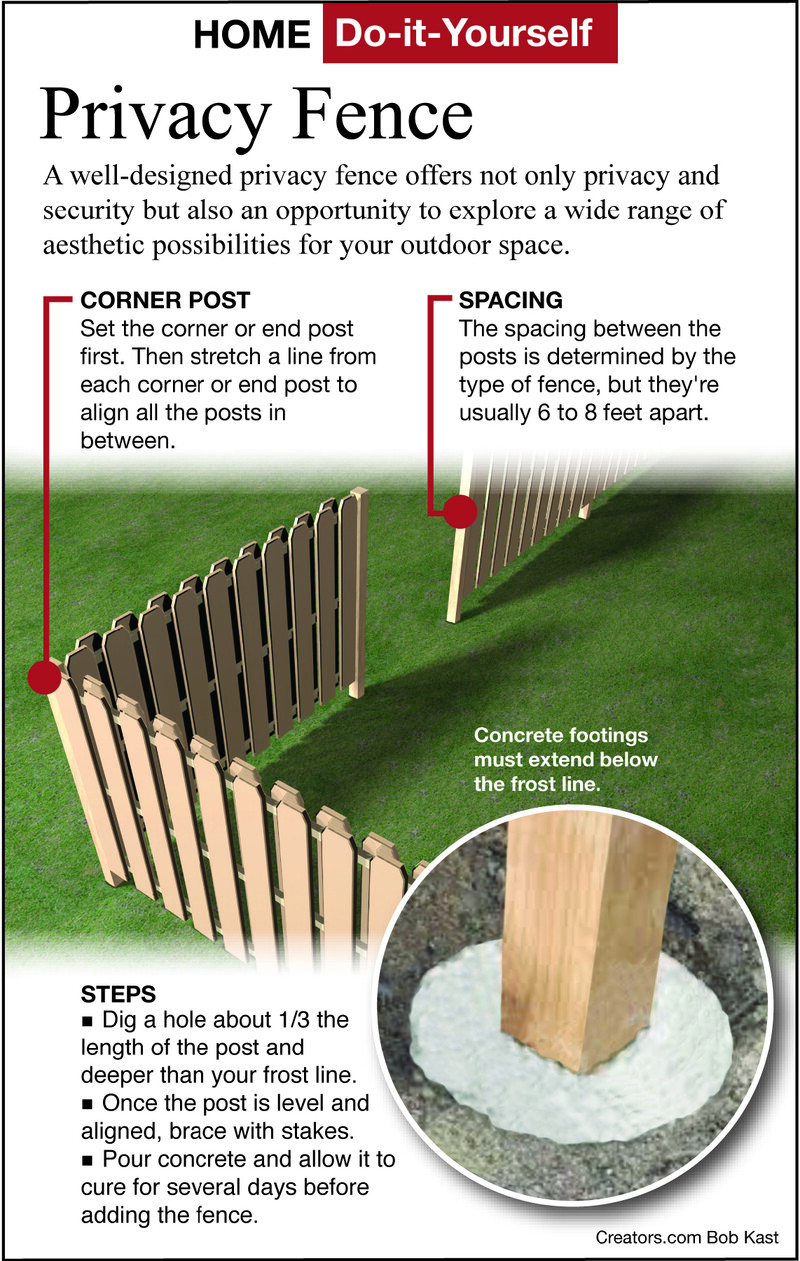
The vertical posts are the heart of any fence. You should use pressure-treated square four-by-four lumber spaced on 8-foot centers. If you are planning to use more decorative round posts, choose four-by-six-inch ones.
They should be placed in concrete with the top mounded up to cause rainwater to flow away from the post. The depth of the hole should be below the frost line in your area or at least 2 feet deep for a 5-foot fence, 3 feet deep for a 6-foot fence and 4 feet deep for an 4-foot fence.
Always use galvanized, aluminum or stainless steel nails to eliminate rust stains. Since you are building it yourself, you will find it much easier to use galvanized metal hangers than to try to nail the pieces directly together. The hangers will allow you to put the piece in place for support and then nail it.






View Comments