By Jim Farber
In 1923, filled with political zeal following the victory of the Mexican Revolution, Diego Rivera took on a project that might have daunted even Michelangelo — to depict (in fresco) the entire history of the Mexican peoples.
The first of two sites allocated for this grand panorama was the former convent of Santa Maria de la Encarnacion del Divino Verbo. Founded in 1594, it was secularized in 1911. But after the revolution it became the Secretariat of Public Education Main Headquarters at the corner of San Ildefonso and Republica de Argentina streets at heart of Mexico City's Zocalo district.
With a goal of providing free public education to the country's vast illiterate peasant population, great mural projects could serve as illustrated teaching guides to the country's history. And just as they were during the years of their creation, Rivera's murals at the secretariat are always free to the public.
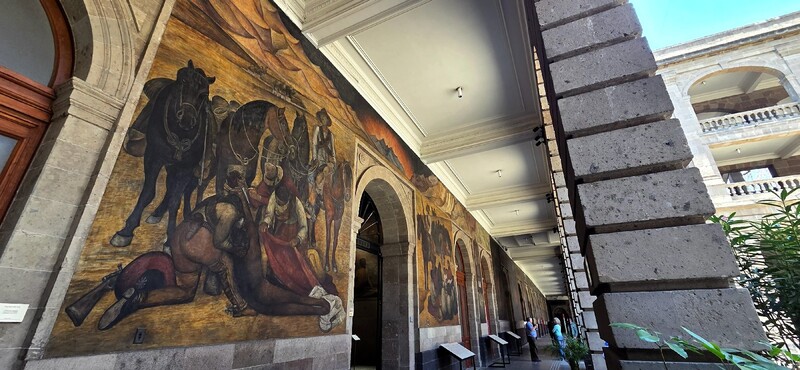
Entering through a grand Grecian facade, visitors discover a pair of three-story interior courtyards. It is here, between 1923 and 1928, that Rivera produced his first major series of murals. Designated "The Labor Courtyard" and "The Fiesta Courtyard," every wall, arch and stairway — 235 frescoed panels in all —abound with vibrant illustrations: "Tehuantepec Bath," "Market Scene," "The Weavers," "The Liberation of the Rural Worker" and "Day of the Dead."
For years I had hoped to visit Mexico City with a particular goal of experiencing Rivera's murals, but what began as a bucket-list item turned out to be a pilgrimage. Like beholding the glory of the Sistine Chapel, the sheer magnitude and emotional impact of Rivera's creation is overwhelming.
The imagery reflects the dedication of "los tres grandes": Diego Rivera, Jose Clemente Orozco and David Siqueiros to a unifying force — the concept of indigenismo — art was dedicated to celebrating Mexico's deep and diverse cultural roots, to shining a light on the devastation and subjugation of native peoples as a result of the conquest by Spain, and, ultimately, to recall the emancipating power of a people's revolution.
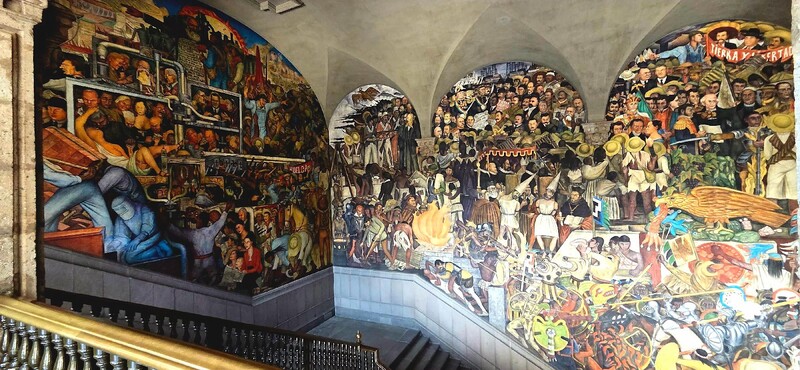
A few blocks from the Secretariat of Public Education is Mexico City's grand plaza, anchored by the Metropolitan Cathedral and imposing facade of the National Palace. Here pilgrims can experience Rivera's second great mural project — "The History of Mexico." Also immense in scale, it fills the walls of the second-floor arcade and (most famously) the palace's grand stairway. The process of painting the murals began in 1929 and was not completed until 1935.
Viewing the immensely complex murals, however, is challenging. Admission is not free. Visitors are required to register beforehand for time-designated tours with presentation of detailed identification required. Escorted tours then must pass through a security checkpoint. These measures are in place, however, because the palacio is the administrative center of the Mexican government.
The process involved with seeing the mural is, unquestionably, worth the effort. Unfortunately, because of the limited time allotted, it's almost impossible to absorb the historical scope, cultural depictions and myriad figures that populate Rivera's creations. And, inexplicably, neither the Secretariat of Public Education nor the National Palace offers the sale of detailed, multilanguage guidebooks.
The murals of Mexico are a national treasure, and the murals of Diego Rivera are the jewel in the crown. No pictures can do them justice. You have to stand before them to appreciate the power and the glory.
WHEN YOU GO
Mexico City guide information: mexicocity.cdmx.gob.mx/?lang=en
The National Palace: mexicocity.cdmx.gob.mx/venues/national-palace/?lang=en
Jim Farber is a freelance writer. To read features by other Creators Syndicate writers and cartoonists, visit the Creators Syndicate website at www.creators.com.
Diego Rivera's "History of Mexico" adorns the walls of the National Palace in Mexico City. Photo courtesy of Jim Farber.







View Comments