Week of December 28, 2025 - January 3, 2026
It's hard to believe that a full quarter of the 21st century is already in the history books! "The time always flees; it will wait for no man," wrote Geoffrey Chaucer, and he couldn't be more correct.
With this in mind, I hope you'll make some time this upcoming year to enjoy the nighttime sky. I promise it will be well worth your effort!
The year begins with bright Jupiter dominating the eastern sky after dark. It will remain in our early evening sky throughout the spring months, though it'll be receding from Earth.
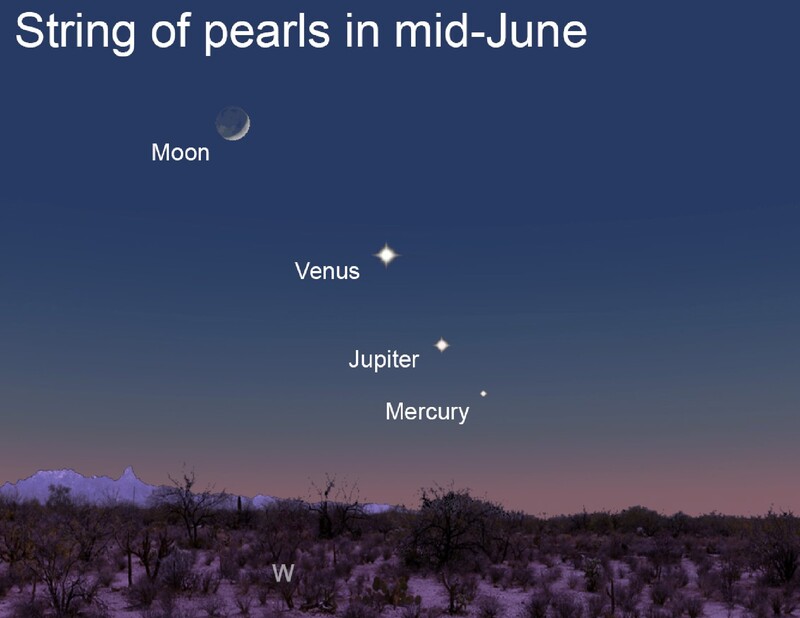
The brilliant planet Venus also returns to our evening sky during the first half of 2026. I don't know about you, but I've missed seeing it glistening in the west at dusk, especially on those evenings each month when the delicate crescent moon passes nearby. This coming year has quite a few good such near passes; one of the nicest will come in June, when the crescent moon, Venus, Jupiter and Mercury will appear together at dusk.
Once Jupiter leaves the evening sky by July, it'll round the opposite side of the sun and reappear in our dawn sky in August, where it will join its planetary neighbors Mars and Saturn.
Meteor shower fans will be delighted to learn that, in 2026, both the Perseid and the Geminid meteor showers will occur with no interfering moonlight at all. The Perseids will peak on the night of Aug. 12/13 but begin to show some good activity a few nights before. The prolific and brilliant Geminids are expected to reach their peak on the night of Dec. 13/14. If you enjoy watching meteor showers — and who doesn't? — be sure to schedule your vacation days now while you're thinking of it!
Perhaps the most exciting celestial events of the year will be eclipses. Four occur during 2026 — two solar and two lunar — but only the lunar eclipses will appear over North America. The first will be a total eclipse of the moon during the pre-dawn hours of March 3, when viewers in the western half of North America will see the entire eclipse. Six months later, on the night of Aug. 27/28, a partial lunar eclipse will be visible from most of North America.
And, of course, the magical and colorful aurora borealis — the northern lights — will likely be dancing across arctic skies, powered by electrically charged particles blasted from the sun. Since we'll still remain near the height of solar activity (aka "solar max"), these may descend far enough south for those in Southern Canada and the Lower 48 to get a rare glimpse.
If you'd like to join me in March for my popular Alaska Aurora Borealis tour, or on a cruise ship in Iceland for the Aug. 12 total solar eclipse, please email me at [email protected], and I'll send details.
For now, though, as our tiny blue world completes one more journey around its life-giving star, I would like to wish all my readers a happy, healthy and star-filled new year. I truly hope your stars shine ever more brightly in 2026, and that our paths cross many times!
Visit Dennis Mammana at dennismammana.com. To read features by other Creators Syndicate writers and cartoonists, visit the Creators Syndicate website at www.creators.com.
The appearance of the crescent moon, Venus, Jupiter and Mercury together in the night sky in June 2026 is one of many sights stargazers have to look forward to next year.







View Comments