Week of November 15-21, 2026
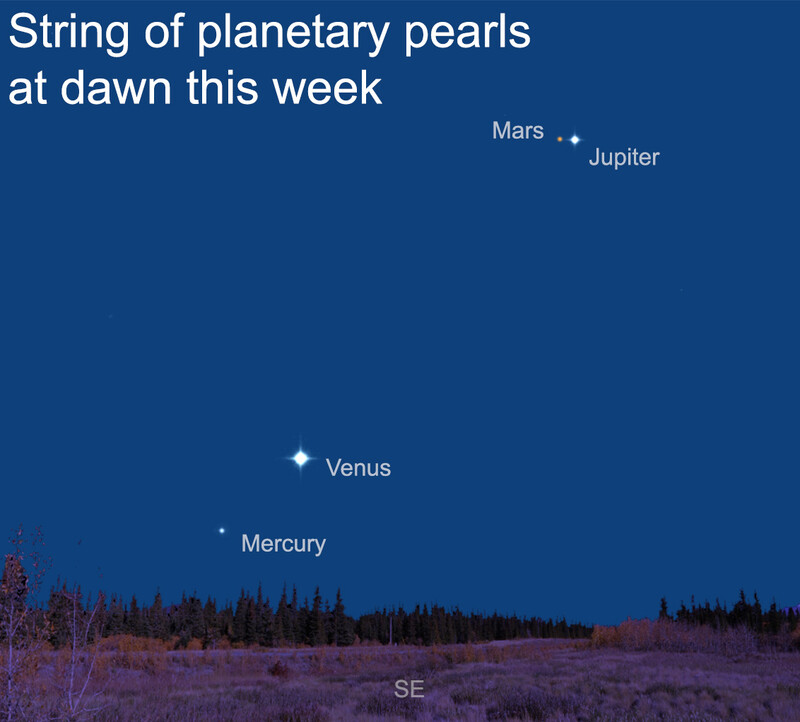
Set your alarms early this week. I know the time change has pushed back our sunrise time, but if you get outdoors during dawn, you'll be able to enjoy seeing a beautiful string of planetary pearls arching in a nearly straight line across the eastern sky. These are the worlds Jupiter, Mars, Venus and Mercury.
Why should they appear in such nearly perfect alignment? This is the product of our planetary system's birth from a rapidly spinning disk billions of years ago. From within, we see this disk as a relatively thin arc across our sky; it represents the general paths that solar system bodies take on their journeys across the starry heavens.
The ancients also recognized this arc but, of course, did not understand its significance. So they devised 12 star groupings to mark its position, and they knew it as the zodiac along which their gods (the planets, sun and moon) appeared to wander. This week, the zodiac constellations that appear before sunrise are (from west to east): Taurus, Gemini, Cancer, Leo and Virgo.
At dawn this week, gaze toward the southeastern sky, and you'll see the brilliant planet Venus, with the much fainter planet Mercury to its lower left. Higher in the sky — and also along the line formed by Mercury and Venus — lie Jupiter and Mars.
Trace a line through these four planets and you will outline the "ecliptic." This arc also represents the general path that the moon takes as it orbits the Earth each month and while the moon won't appear in the early morning sky this week, it will by the end of the month.
In fact, on Nov. 30, look for the waning gibbous moon appearing not far from Mars and Jupiter (which will have separated slightly by then). On the morning of Dec. 4, the thinning crescent moon will lie not far from brilliant Venus. Three mornings later, it will appear right next to Mercury, though by then, the planet Mercury will have dropped so low in the sky that it'll be tough to see unless you've got a very low horizon and binoculars.
Of course, the moon isn't physically near these planets; it just appears that way because it lies roughly along the same line of sight. The moon orbits our Earth a quarter of a million miles away — right next door, in cosmic terms — and even the nearest of planets this week (this week it's Venus) lies more than 150 times farther.
This would be a great time to aim a small backyard telescope toward Venus. You may be surprised to see that the planet appears in a crescent phase. I'll never forget my first look at this one early morning 60-plus years ago; I had no idea what I was seeing at the time, but that sight remains quite a vivid memory!
I hope your skies are clear this week and that you can rise early enough to enjoy this celestial scene. Just remember: What appears as an "alignment" is caused simply by the positions and movements of these solar system bodies, as well as our lack of depth perception when viewing the heavens.
Visit Dennis Mammana at dennismammana.com. To read features by other Creators Syndicate writers and cartoonists, visit the Creators Syndicate website at www.creators.com.







View Comments