Week of November 1-7, 2026
If you're an early riser and have been paying attention to the dawn sky recently, you've most likely spotted two prominent "stars" in the southeast; perhaps you've even noticed that they appear to be closing in on one another over the past month or so.
Though they look like stars, they're not. They're planets. The lower and much brighter of the pair is Jupiter, and the upper (and significantly fainter) is the "red planet" Mars.
Mars and Jupiter appear to be approaching one another in the sky because they, along with our Earth, orbit the sun, and our constantly changing viewpoint makes them appear to drift against the more distant and "fixed" stars.
Mars is a world only slightly larger than North America and, right now, lies nearly as far from us as it ever gets — about 132 million miles. Jupiter, however, is some 509 million miles away, but it's a huge planet (some 11 times the diameter of the Earth) and is quite reflective. As a result, it appears nearly 14.5 times brighter than the "red planet."
They seem near each other in the sky because both appear along roughly the same line of sight. And over the next few weeks, that line of sight will become even tighter as these two planets gear up for a close pass (a "conjunction") on Nov. 15.
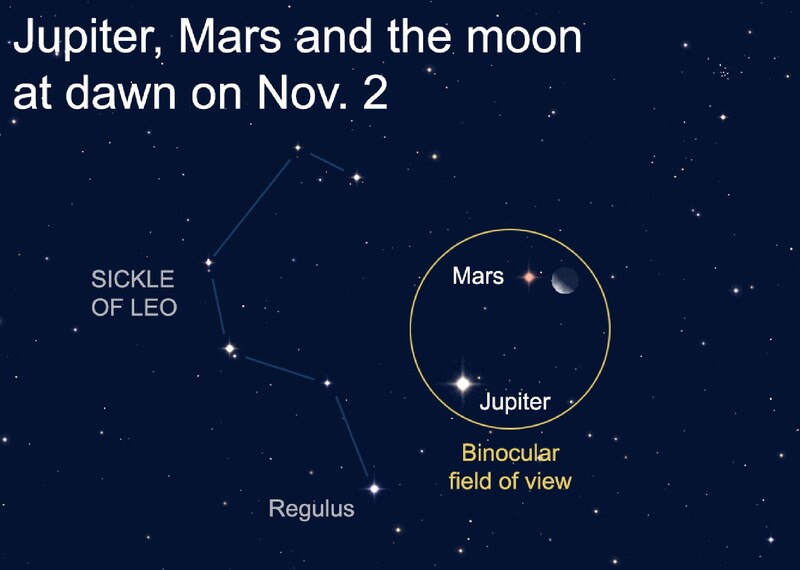
In the meantime, however, this is a great time to begin viewing their daily wanderings. And, on the morning of Nov. 2, another solar system body will enter the picture: the moon.
Now in its waning phases, the moon will appear quite close to the planet Mars on that morning. Again, this is purely an optical illusion; the moon lies only 229,000 miles from us on that morning. Stargazers in parts of Polynesia and southwestern Antarctica — mostly penguins, I presume — will see an occultation of Mars, in which the moon drifts in front of the planet and blocks its light from view.
As the moon continues along its orbit over the next few hours, viewers in parts of Southeast Asia and Australia will see it pass in front of Jupiter.
Those of us in mid-northern latitudes like North America will see none of this, but we'll still have quite a treat. On the morning of Nov 2, the moon, Mars and Jupiter will lie so close in the sky that they'll all appear in the same binocular field of view.
Now if you're not a morning person and are waiting for these celestial bodies to grace our evening skies before checking them out, you'll have to be patient. Because the moon orbits the Earth once every month, we can expect it back in our early evening sky next week. Mars and Jupiter will take a bit longer.
Jupiter will reach its opposition point (at which it rises in the east at sunset) on Feb. 11, 2027, with Mars reaching its opposition only eight days later. In other words, both will appear even brighter in our early evening sky during the late winter and early spring months of next year.
Until then, however, you'll have to be an early riser!
Visit Dennis Mammana at dennismammana.com. To read features by other Creators Syndicate writers and cartoonists, visit the Creators Syndicate website at www.creators.com.
Mars and Jupiter currently appear near each other in the night sky.







View Comments