Week of October 11-17, 2026
I don't know about you, but when I was a kid in school, I learned that folks in the 17th and 18th centuries thought the world was flat and that explorers might sail right off the edge.
Spoiler alert: That was (and still is) complete nonsense.
Now I don't doubt that some at the time believed the world was flat — it's kind of hard to imagine otherwise from standing outdoors and looking around a flat horizon — but the spherical nature of our planet had been known for thousands of years. You read that right: thousands!
It goes way back to about 240 B.C., when the Greek mathematician Eratosthenes (276 B.C. - c.195/194 B.C.) noticed that, on the summer solstice, shadow lengths were different in Alexandria and Syene in Egypt. From the lengths of these shadows, he used simple geometry to not only show that the Earth is spherical but also to calculate its circumference to within only a few percent of its actual value.
Even before the time of Eratosthenes, the philosopher Aristotle (384 B.C. - 322 B.C.) offered visual evidence to support the round Earth idea. He learned that sailors traveling far to the south reported seeing stars that were below the southern horizon of Greece. In other words, the farther south they traveled, the more the stars in that direction appeared higher in the sky. He concluded that this could happen only if the world on which they sailed was a sphere.
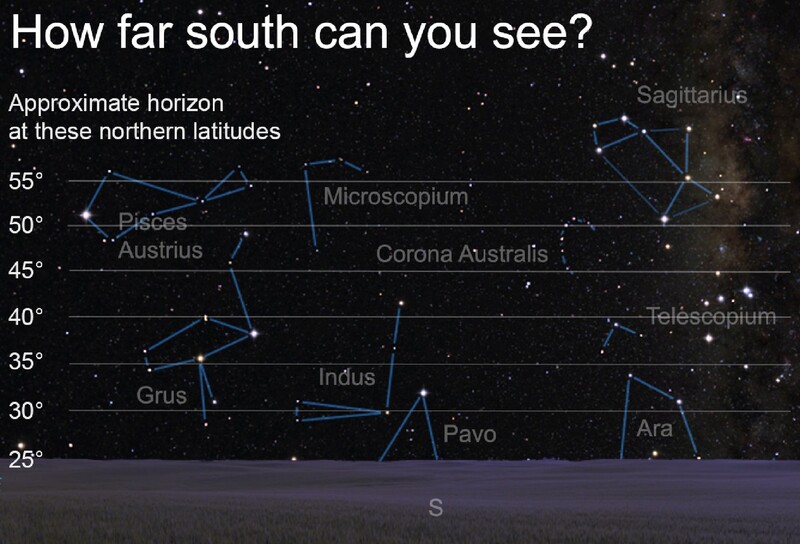
He suggested a simple demonstration of our planet's roundness that we can still perform today. The farther south one lives or travels, the higher the southernmost stars appear. Tonight after dark, take the accompanying sky map outdoors and see if you can find these southern star groupings.
The highest, and easiest to spot, is the ancient constellation of Piscis Austrinus, the southern fishes, marked by Fomalhaut, the brightest star in the area.
To its right lies Microscopium, the microscope, one of several constellations introduced by Abbe Nicolas-Louis de Lacaille, who mapped the stars of the Southern Hemisphere from the Cape of Good Hope from 1751 through 1753.
More to the southwest lies the Teapot of Sagittarius, along with Corona Australis (the Southern Crown), which appears as a prominent arc of stars.
Depending on how dark your skies are and how far south you live, you might even spot the constellation Grus, the crane, a Southern Hemisphere constellation introduced by German astronomer Johann Bayer in his 1603 star atlas "Uranometria."
To its right are the groupings Indus, first mapped by Petrus Plancius in the late 1500s, and today thought to represent an Indian from Madagascar or the East Indies, and Telescopium, the telescope, also named by Lacaille.
If your latitude is even lower, you might spot some stars of the far-southern constellations of Pavo, the peacock, and Ara, the altar.
While these may be tough to find for many Northern Hemisphere stargazers, the next time you take a long trip south or north, pay close attention to the stars of the southern (and northern) sky. Noticing their changing elevations will demonstrate what people have known for millennia: The Earth is indeed round!
Visit Dennis Mammana at dennismammana.com. To read features by other Creators Syndicate writers and cartoonists, visit the Creators Syndicate website at www.creators.com.
The farther south one travels, the higher the stars in that direction appear in the sky.







View Comments