Week of Sept. 20-26, 2026
This summer wasn't unusually hot here in the deserts of Southern California, but I know that elsewhere it was pretty scorching. As we turn the calendar page to autumn this week, however, I'm sure we're all glad to know that cooler temperatures are not too far off. And I'm just as certain that, before you know it, many of us will be complaining about the cold and snow, and wishing for those long hot days of summer!
While winter is still more than three months away in the Earth's Northern Hemisphere, the night sky of that time is now making an early appearance. To get a sneak preview, all you've got to do is set your alarm for zero dark thirty and head outdoors before sunrise. There, in that predawn sky, you'll find all the magnificent stars of winter.
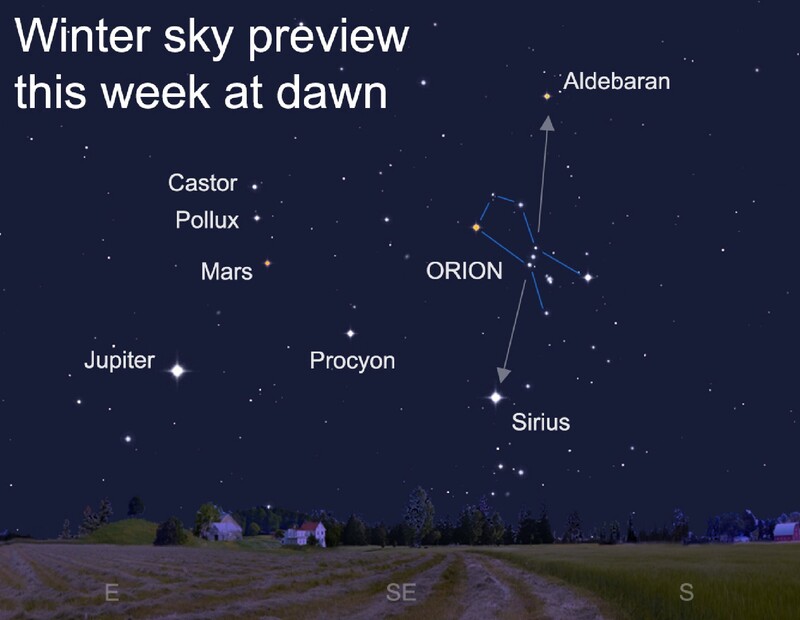
The most brilliant of them outline a grouping of stars known as Orion. In the southeastern sky, look for four stars that form a vertical rectangle and, at its center, three nearly equally bright stars that form a nearly straight line. In classical mythology, Orion represented a hunter, but seeing such a character in the heavens takes some imagination. More than likely, however, you'll recognize the shape of an hourglass or even a bowtie.
Below Orion you'll find bluish-white Sirius, the brightest star in our sky (other than the sun, of course). It appears so brilliant not only because it's relatively nearby — "only" 51 trillion miles, or 8.6 lightyears, away — it produces some 25 times more radiation than the sun. You can confirm that you've found it by following the three central stars of Orion downward until they point to Sirius. This glistening star marks the collar of Orion's large hunting dog, Canis Major.
Those three stars also point upward toward a more yellowish-orange star known as Aldebaran. This star represents the fiery red eye of Taurus, the bull, glaring down toward the hunter.
To the east of Orion, you'll find the two "twin stars" named Castor and Pollux. They form the heads of Gemini, the twin brothers from ancient Greek mythology.
Between them and Sirius lies the star Procyon, which, along with Sirius, is one of the nearest stars in our night sky. At a distance of only about 11 lightyears, it represents the brightest star in Canis Minor, the smaller hunting dog.
You'll also notice that two planets now appear in this part of the sky: Jupiter, shining slightly brighter than Sirius, and Mars, appearing only as bright as the star Pollux but with a distinctly orange hue.
Both of these worlds lie on the opposite sides of the sun right now, about as far from Earth as they ever get, and will appear to brighten as they approach the Earth. Both will reach their closest to our planet around mid-February, when Jupiter will become nearly twice as bright, and Mars will swell to nearly nine times its current brightness!
Now, if you would prefer to sleep in on September mornings, I certainly understand. In just a few months, you'll be able to enjoy this magnificent winter sky during early evening hours.
Visit Dennis Mammana at dennismammana.com. To read features by other Creators Syndicate writers and cartoonists, visit the Creators Syndicate website at www.creators.com.
Winter stars will make an early appearance in the night sky this week.






View Comments