Week of June 8-14, 2025
We astronomers have a habit of throwing around terms that we consider to be obvious, only to watch the eyes of normal people glaze over.
For example, albedo, analemma, aphelion, air mass ... and that's just the A's! Or we nonchalantly toss around gargantuan sizes or time scales that make novices wonder why they can't grasp this stuff on a gut level. Spoiler alert: We astronomers can't either. If anyone tells you they can comprehend billions of years or trillions of miles, just smile and slowly back away!
Some of the most common terms we use may seem understandable, until you realize that there's more to them than you might realize. Take the simple word "sunset," for example. Seems obvious, right? But what exactly does it mean?
Well, those at the U.S. Naval Observatory in charge of calculating such celestial matters define "sunset" (and "sunrise") as the time when the upper edge of the sun's disk appears right on an unobstructed horizon. An exact time for this is tough to determine because it depends on atmospheric conditions, your elevation, the terrain of the landscape over which you view, and more.
The terms we use for after sunset (and before sunrise) can be equally befuddling. Twilight seems perfectly straightforward; most of us understand this to mean the period after sunset when the sky darkens, or in the morning, the time before sunrise when the sky brightens.
Astronomers, though, need to be more precise and have developed several
practical definitions over the years.
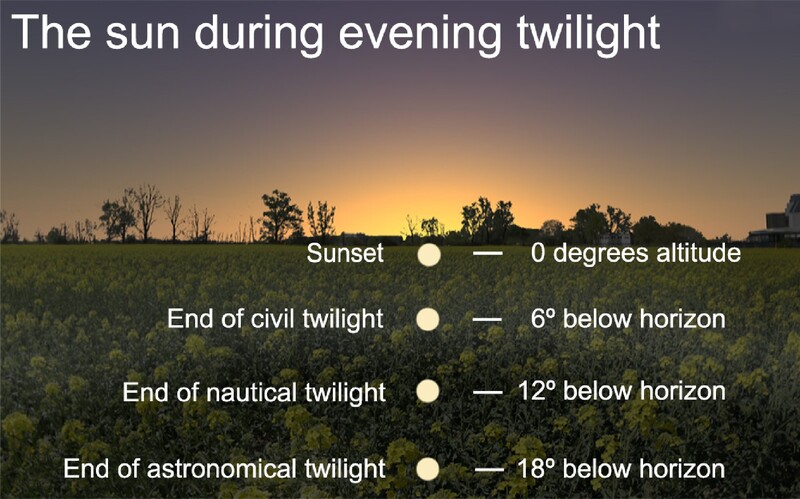
"Civil twilight" is said to begin in the morning — and to end in the evening — when the center of the sun lies six degrees below the horizon. During civil twilight in the evening, the sky is beginning to darken, and you might need some light to find your way around and carry on outdoor (civil) activities. This is the time when the sky can take on quite beautiful colors.
"Nautical twilight" is defined to begin in the morning — and to end in the evening — when the center of the sun lies 12 degrees below the horizon. Now is when the sky takes on a uniform, deep blue color — my favorite time of evening — and bright stars begin to appear. Landscapes are pretty tough to distinguish during this time, and sailors will notice that the horizon appears rather indistinct — hence the term "nautical" twilight.
And, finally, "astronomical twilight" begins in the morning — and ends in the evening — when the center of the sun lies 18 degrees below the horizon. As this period begins in the morning or ends in the evening, the sun's light contributes nothing to the sky's brightness. In other words, it's officially dark.
How long each of these three periods lasts depends on one's location on Earth and the season, but we can expect each to last between 20 and 30 minutes in mid-northern latitudes.
You can calculate your sunset/sunrise times, as well as various twilight times for your location — as well as many other kinds of astronomical data — at the USNO website: aa.usno.navy.mil. Just click on "Data Services," choose the link you want, and fill in the data requested.
Visit Dennis Mammana at dennismammana.com. To read features by other Creators Syndicate writers and cartoonists, visit the Creators Syndicate website at creators.com.
Photo courtesy of Dennis Mammana







View Comments