Week of February 1-7, 2026
The moon is our nearest neighbor in space, at an average distance of about 238,000 miles. As it orbits our Earth every month or so, it appears to pass by stars and planets in our night sky ... or, at least, so it seems. This is only an illusion, however, since the planets and stars are considerably farther away.
On occasion, however, the moon drifts in front of one of these more distant celestial bodies, blocking it from view for an hour or so. Such an "occultation" is important because it allows us to refine our knowledge of the moon's orbit, and even to discover companion objects orbiting distant stars. In fact, it was a faint companion star orbiting the red supergiant Antares that first showed up during a lunar occultation in the early 19th century.
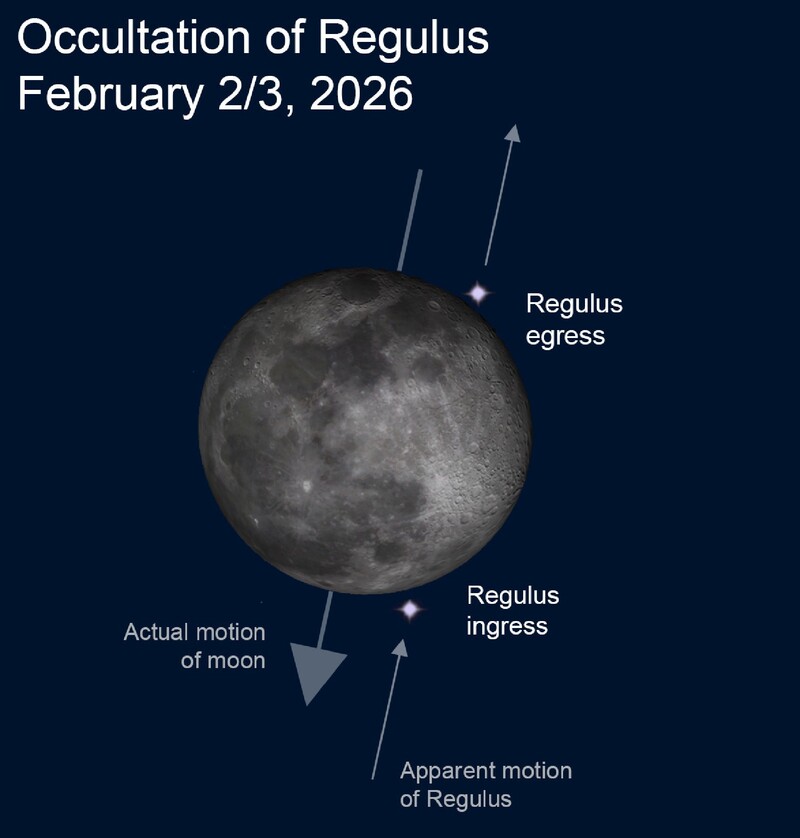
These lunar occultations are not uncommon, but for the moon to occult a bright star is. That's why on Monday night, Feb. 2, stargazers throughout much of North America should plan to watch as the moon passes in front of the bright star Regulus.
On that night, the moon will approach the star from its upper right. Keep a watchful eye on Regulus until it winks out instantly behind the moon's bright edge. This quick disappearance occurs for two reasons. The first is that the star is so distant that it appears as only a point of light in our sky. The second is because the moon has no atmosphere to dim the star's light before blocking it completely.
Watching the star disappear and reappear might be a challenge, however, since the moon will be so bright. You will find that binoculars will help you see Regulus wink out, and a small telescope will give you the best view of all.
Skywatchers around the country will view the event from different angles, so the times will differ from place to place. From the U.S. East Coast, for example, Regulus will disappear (its ingress) at around 8:52 p.m. EST and reappear (its egress) at around 9:52 a.m. EST.
In the Midwest, the occultation will occur with the moon much lower in the eastern sky. The moon covers Regulus around 7:44 p.m. CST and uncovers it around 8:41 p.m. CST.
Farther to the west, in the Mountain time zone, the moon will appear quite low in the east. Regulus will disappear before it and the moon rise over the horizon, but the pair will lie about 10 degrees above the landscape by the time Regulus reappears from behind the moon around 7:31 p.m. MST.
Viewers on the West Coast, I'm afraid, will have to sit this one out. The entire event occurs while the moon and Regulus are still below the horizon.
Wherever you're located, make sure you begin your watch at least 10 or 15 minutes early, and don't turn away as the star appears to close in on the moon. To get more precise timings, call your local planetarium, science museum or observatory.
If the weather should interfere, or if you miss the star's split-second disappearance or reappearance, don't worry. There will be other occultations during the coming months.
Visit Dennis Mammana at dennismammana.com. To read features by other Creators Syndicate writers and cartoonists, visit the Creators Syndicate website at www.creators.com.
On Feb. 2, the moon will pass in front of the bright star Regulus.







View Comments