Week of January 18-24, 2026
The giant planet Jupiter is back in our evening sky this week. Fresh from its opposition with the sun on Jan. 10, it now lies as close to the Earth as it ever comes, and shines at its most brilliant. I guarantee that if you go outdoors after dark and look low in the east-northeastern sky, you won't miss it!
Seeing Jupiter from one's backyard is pretty cool, but knowing something about it makes it even more special, so I thought I'd let you in on a few amazing Jovian facts that you may not know.
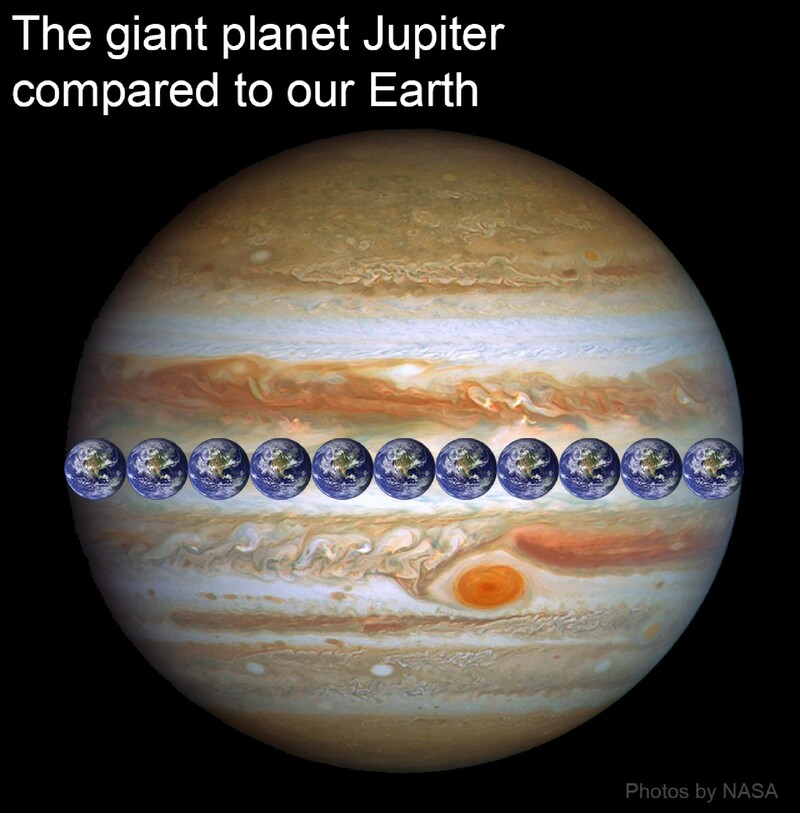
First, Jupiter is the largest of all planets and would completely dwarf the Earth. In fact, you would need 11 Earths side by side just to span its diameter. And, if you were to open up Jupiter like a gumball machine and pour Earths inside, you would need more than a thousand. Now that's a big planet!
As massive as Jupiter is, it's not a solid world. It's the largest of the four gas giant planets (Jupiter, Saturn, Uranus and Neptune) and, as its moniker suggests, it's made mostly of gases such as hydrogen and helium. In other words, it is almost entirely atmosphere with no surface on which a hypothetical astronaut could land.
Anyone foolish enough to try would simply plunge deeper into its ever-thickening atmosphere until being destroyed by its enormous weight and heat. You'd never even make it deep enough to find Jupiter's ocean of liquid hydrogen, or its core of weird metallic hydrogen. If you're ever invited to join a Jovian landing party, I think you should respectfully decline!
If you have a small telescope and aim it toward Jupiter, you can frequently see a few of its parallel cloud bands. These "stripes" are upper atmospheric weather systems that are stretched into parallel cloud bands by Jupiter's 10-hour rotation. This is so fast that if you view Jupiter early in the evening and then return to check it out around midnight, the planet will have turned halfway around, and you'd then be seeing the opposite side of the planet!
You might also spot a reddish smudge in the atmosphere of Jupiter. Since its discovery centuries ago, the Great Red Spot is no longer great nor red. Appearing now as more of a salmon color, this swirling anti-cyclonic storm was once three times the size of the Earth, but in recent decades has shrunk considerably. Today, it's "only" slightly larger than our planet!
A small backyard telescope will also reveal Jupiter's largest moons that drift in orbit around the planet from night to night. Discovered by Galileo Galilei in January of 1610, Io, Europa, Ganymede and Callisto are just four of the 95-plus moons now known to be orbiting the giant planet.
Armed with these remarkable bits of knowledge, I hope you'll never again think of Jupiter as just another bright light in our sky. And if you can't view Jupiter through your own telescope, contact your local amateur astronomy club, observatory or science museum to learn when they'll be hosting a "star party" so you can get a close-up look at this truly amazing world.
Visit Dennis Mammana at dennismammana.com. To read features by other Creators Syndicate writers and cartoonists, visit the Creators Syndicate website at www.creators.com.
Jupiter's diameter is approximately 11 times wider than Earth's. Photo courtesy of Dennis Mammana.







View Comments