A lot of people make New Year's Resolutions to lose weight. The birds that come to your yard have the opposite problem. They can lose 15% of their body weight in just one cold winter's night trying to stay warm. Even though they can lose weight fast, they can gain it fast too.
Bird feeders filled with seeds will help some birds make it through the coldest nights. To find out an approximate number of the birds that have survived over the winter, and before many migrant birds start arriving from the tropics, the Cornell Lab of Ornithology operates the Great Backyard Bird Count. This year, it will take place February 13-16.
You can do it from the comfort of your living room if you want to. It is an annual four-day period when bird watchers create a snapshot of where the birds are across the continent. Anyone can be a bird watcher for those four days. A"backyard" can be anywhere you happen to be, a schoolyard, a local park, an apartment balcony, or a wildlife refuge. It is a great way to get kids interested in the outdoors and off their scrolling screens.
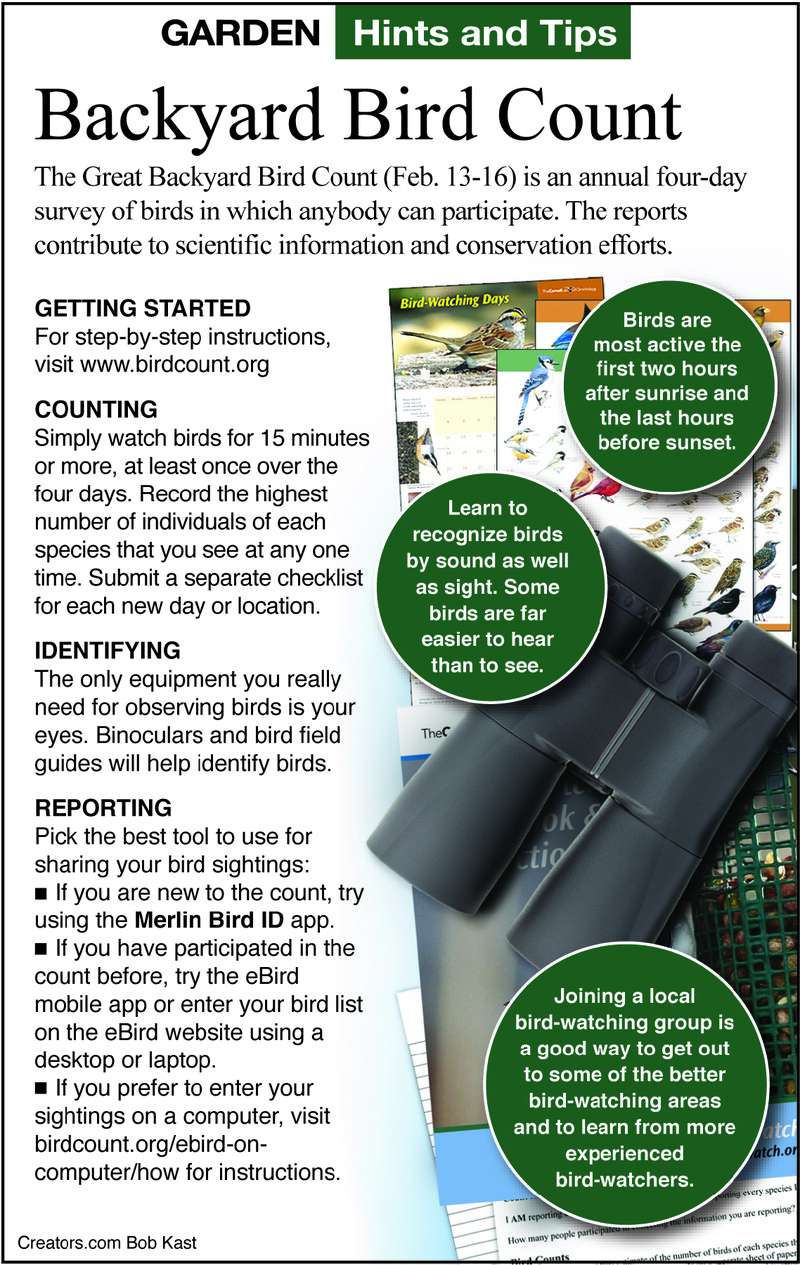
Doing the count is easy: All you do is count the birds you see at any location and record the highest number of each species you see on any of the days. Then you go to www.birdcount.org to record your list online. You can also add your list on your phone if you have the Merlin Bird ID app or the eBird Mobile app, both of which are available to download at birdcount.org. There is a photo contest for those interested.
The GBBC helps everyone prepare for their trip to the backyard, whether they choose to watch birds only around their home or make the effort to see which birds are using public lands.
The results of each survey are displayed on a variety of maps on the ebird.org website. Click on the explore button and go to the species or bar chart menus.
Every year, more people do the count, and more people do more than one count. I do a backyard count, and I count a 2-mile-long section of river near my home. Make sure the birds from your community are well represented in the count. It doesn't matter whether you report the five species coming to your backyard feeder or the 75 species you see during a day's outing to a wildlife refuge.
This event was developed and managed by the Cornell Lab of Ornithology and the National Audubon Society beginning in 1998. The latest final report posted on the birdcount.org website is from 2024. More than 600,000 people participated from over 200 countries. Almost 8,000 bird species were identified. This is the largest community science project in the world.
To see the results for your local area, go to birdcount.org/explore-local-results. The results of past counts have helped researchers see the effects of the West Nile virus on crows. This year, it will be interesting to see what effect the cold and snow have had on bird populations in the Eastern and Southern areas of the country.
I have videos about bird feeding on the Greener View YouTube channel. They cover the best seed types to feed birds, the best types of bird feeders to use and a taste test I ran to determine the best ingredient to fake suet. Check them out in the playlist for Chapter 13, Gardening for Wildlife. The chapter matches the chapter in the Greener View Gardening book that is available on Amazon.
DIST. BY CREATORS.COM







View Comments