Here's an interesting thing to ponder — if you're in the market for a full-size pickup: You could buy a half-ton F-150 regular cab and opt for the 5.0-liter V8 (in lieu of the otherwise standard 2.7-liter twin-turbo'd V6), or you could buy a three-quarter-ton F-250 regular cab — which comes standard with a 7.3-liter V8 — and pay only slightly more ($1,740) for the latter.
The F-250 also comes standard with an 18,200-pound tow rating (about 5,000 pounds higher than the F-150's max).
Hence Super Duty.
So, what's the catch?
What It Is
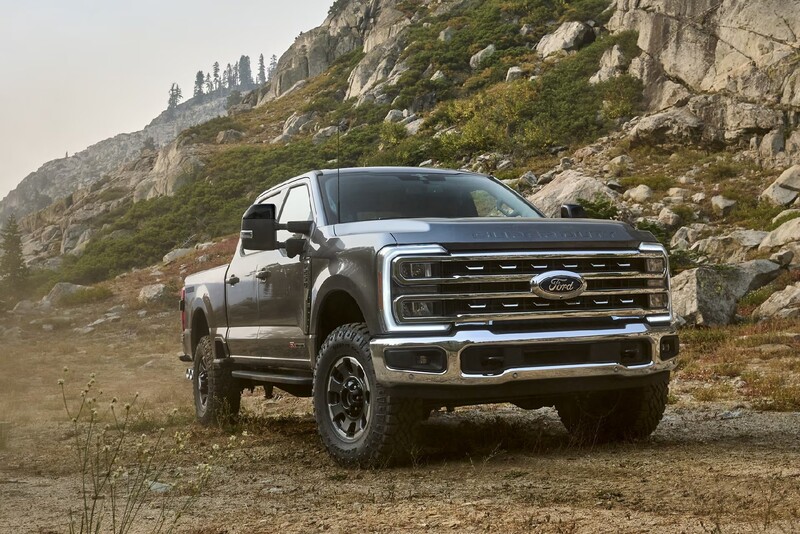
The F-250 is Ford's 2500 series (or three-quarter-ton) pickup. It has a beefier frame and is rated for heavier-duty work (such as towing up to 22,000 pounds) than the half-ton F-150, but the latter has gotten so big — so wide and tall and long — that it is dimensionally about as big as a three-quarter-ton pickup was back in the early-to-mid-2000s. Thus the main difference between an F-150 and an F-250 is capability more so than size.
The price is remarkably close too.
F-250s start at $45,975 for the base XL two-door regular cab with an 8-foot bed. The XL also comes standard with a 7.3-liter V8 engine. The F-150 XL regular cab's base price (with a 2.7-liter V6 and a short bed) is $37,290 — but if you opt for the optional 8-foot bed and the optional 5.0-liter V8, the MSRP goes up to $44,345 — which puts it very close to the base price of the F-250 XL with the 7.3-liter V8 (which comes standard with an 8-foot bed).
The F-250 is also available in XLT trim ($49,275), which upgrades to chrome (rather than black-painted) bumpers, 18-inch wheels (in lieu of the otherwise standard 17-inch wheels, a power driver's seat and carpet in lieu of the otherwise standard rubber flooring. Both the XL and the XLT come standard with AC, a trailer sway damping system and an 8-inch LCD touch screen plus Wi-Fi hotspot.
These are your only trim options for the regular cab as well as the extended cab Super Cab ($48,535 for the XL and $52,345 for the XLT). These trims and cabs come standard with rear-wheel drive; four-wheel drive with Low range gearing is available as a standalone option.
Super Crew cabs — with four full-size doors — are also available in XL ($50,190) and XLT ($54,100) trims as well as Lariat ($62,975), King Ranch ($78,575) and Platinum ($79,465 trims). Lariats come standard with synthetic leather seats covers, seat heaters for both rows, a heated steering wheel, a premium B&O eight speaker audio system, rain sensing wipers and dual-zone climate control, as well as a digital main instrument cluster and a larger (12-inch) secondary touch screen and a surround view exterior camera system. King Ranch trims get power-deployable running boards, 20-inch wheels, power up/down rear tailgate, massaging front seats, real leather seat covers and a 14-speaker B&O audio system. The King Ranch also comes standard with 4WD.
The top-of-the-line Platinum trim is similarly equipped but with different exterior/interior styling. It also gets a dual-pane panorama sunroof, six prewired auxiliary switches and a 2 kWh electrical outlet for powering high-draw appliances.
What's New for 2027
The big news for the new model year is that the F-250 now comes standard with the previously extra-cost 7.3-liter V8 (the previously standard 6.8-liter V8 has been retired). Also, the optional 6.7-liter turbodiesel V8 now comes only in the high-output version that touts 500 horsepower and 1,200 foot-pounds of torque.
There's a new Carhartt trim option as well.
What's Good
— Base XL F-250 offers massively upgraded power and capability for only slightly more than the price of a V8-equipped F-150 XL.
— Big V8s for a big truck.
— Minimally intrusive "safety" and "assistance" tech.
What's Not So Good
— Big trucks need big open spaces. In Texas, this truck has room to maneuver. In suburbia, it's another story.
— The nicer amenities such as the seat massagers and upgraded B&O audio system are not available with regular or extended (Super Cab) F-250s.
— Cost to fill the 34-gallon tank at the current national average — about $4.10 per gallon as of early September 2026 — is about $140. The cost to fill it with diesel — currently about $5.50 per gallon — is closer to $200.
Under the Hood
The 2027 F-250 comes standard with a V8 engine. Your pick is gas or diesel.
The gas V8 is a 7.3-liter unit that touts 430 horsepower and 485 foot-pounds of torque. This engine was last year's optional V8. (The previously standard 6.8-liter, 405-horsepower V8 has been dropped).
The 7.3-liter V8 is a V8 like they used to make 'em in that — in the first place — it is big, and so the right size for a big truck. This isn't just for strutting. A big V8 generally makes big torque, which is what you want in a big truck that you buy to haul and pull. A smaller engine with turbos — like the 3.5-liter twin-turbo V6 that's the top-dog engine in the F-150 — can also make big torque, but then you have the turbos (and the pressure). A big V8 may not get great gas mileage — but it is also less likely to cost you big money down the road, because there are no turbos to fail, and the engine is under less pressure.
This engine is also an overhead valve (or pushrod) engine, which means just one camshaft, two valves per cylinder, and a timing chain that will almost certainly never have to be replaced. The sum is, it's a simple, burly engine ideally suited for a truck that's going to be used for truck stuff.
The optional V8 is a 6.7-liter turbodiesel V8 that makes 500 horsepower and 1,200 foot-pounds of torque. Yes, this engine is also under pressure, but it is a diesel engine. These engines are low-revving by nature, which entails less stress on the internals — and they usually have stronger blocks, heads and so on than gas engines, and they also use a fuel (diesel) that is a lubricant as well as a fuel.
Gasoline is a fuel and a solvent.
Equipped with the turbodiesel V8, an F-250 is rated to pull as much as 22,000 pounds, but even with the gas V8, Ford says you can pull up to 18,200 pounds. You'll also have a fully fueled highway driving range of more than 600 miles.
A heavy-duty 10-speed automatic is standard with either V8. Most trims are RWD, with 4WD (with Low range gearing) available optionally.
On the Road
Once you are actually out on the road, driving the F-250 is a pleasant experience. Just starting it up and hearing the big V8 is a very pleasant experience. If you get the diesel, you'll hear that manly rumble a diesel makes — as well as the big rig-like sound of the exhaust brake, which uses backpressure to lessen the need to apply the actual brakes to control speed when driving downhill. The sound of both has been muted to a mere background burble, though — which is perhaps necessary for compliance reasons and also probably because there are buyers who like a quiet big rig.
If you'd like to hear more from the burly diesel, the fix is easy enough.
What doesn't need any fixing is the astounding pull — 1,200 foot-pounds' worth — you've got at your beck and call. Floor it and it feels like you got air under the wheels; it's almost like a sport bike in that respect. But it's when you don't floor it that the virtues of all that torque — twice as much torque as advertised by the hairiest big-bock V8s of the '60s — becomes apparent. The effortless thrust is its own reward. You'll hardly feel the trailer hitched to rear. The gas V8 is no slouch, either — but the diesel is Thunder Lips to Rocky Balboa.
The turning radius of this thing is, of course, oceanic. It is also so tall that reaching down to open the mailbox — or get at the tube at a drive-thru bank — can be a stretch.
Literally.
At the Curb
The F-250 is — to use Trump's favorite word — yuge.
But then so is the current F-150. The latter — with the crew cab and the short (5.5-foot) bed is 232 inches long, which is actually just slightly longer than an F-250 regular cab with an 8-foot bed (231.8 inches). Both trucks are so tall that they have little step ladders built into their flanks so that you can climb up like a mountaineer to get at stuff in the bed. The tailgates of both have their own little foldout ladders too — along with a pop-up pole to grab hold of as you ascend.
Good luck even seeing the engine unless you stand on a bucket.
What's happened over the past roughly 20 years is that half-ton trucks like the F-150 have been super-sized such that they are dimensionally very close to three-quarter-ton trucks like the F-250. The half-tons have also been lifted to heights even higher than the three-quarter-ton trucks of 20 years ago. And they have been styled to emulate the — literally, in the case of the Fords — Super Duty appearance of the actual Super Duty F-250 trucks.
The F-150 is oriented more toward the passenger service it's generally used for. It is offered in more configurations — especially the cosmetic ones — than the F-250, especially as regards the regular and extended cab trims. You can outfit the F-250 with luxuriousness too. And Ford also offers enhanced (FX4) extreme (Tremor) off-road stuff too — though something this yuge is not exactly the ticket for trying to pick your way through narrow rutted trails.
It is surely a magnifico in the open spaces, though.
The Rest
A 34-gallon fuel tank is standard with either engine. Diesel F-250s have an additional tank for the diesel exhaust fluid that has to be topped off — roughly — every couple of months, depending on how many miles you drive. DEF is an emissions control thing; the fluid — which you can buy in jugs at Walmart and other retailers — gets sprayed into the exhaust stream to reduce the emissions of oxides of nitrogen. Having to buy the DEF adds a slight but not insignificant cost — about $4 per gallon. The 250's DEF tank holds about 7 gallons, so about $30 to fill the tank once every couple of months.
The main hassle is having to fill the tank — and you pretty much have to, because if you let the tank run empty, the truck will go into a "limp" mode that renders it effectively useless — until you give in and top up the DEF tank.
The Bottom Line
If you don't mind the size — and you dig the uprated capability — you might want to cross-shop an F-250 against the almost-as-yuge (but not nearly as capable) half-ton competition.
Eric's latest book, "Doomed: Good Cars Gone Wrong!" will be available soon. To find out more about Eric and read his past columns, please visit the Creators Syndicate webpage at www.creators.com.
View the Ford F-250 this week.







View Comments