The Subaru Outback Wilderness begs a question that deserves an answer: Do you need a four-wheel-drive SUV to have the capability to go off-roading?
Not just off onto the grass.
If all you need is to be able to do that — and to keep your wheels from slipping when you're on-road — then a regular Outback with all-wheel drive will more than serve.
The Outback Wilderness serves more. More finely put, it serves more than enough.
What It Is
The Outback is Subaru's midsize crossover, one notch up in size from the compact Forester and one notch below the full-size Ascent. The Wilderness Outback is effectively a separate model within the Outback lineup. It's something along the lines of the old Pontiac GTO, which was based on the Tempest but equipped with high-performance upgrades that made a muscle car out of a Tempest.
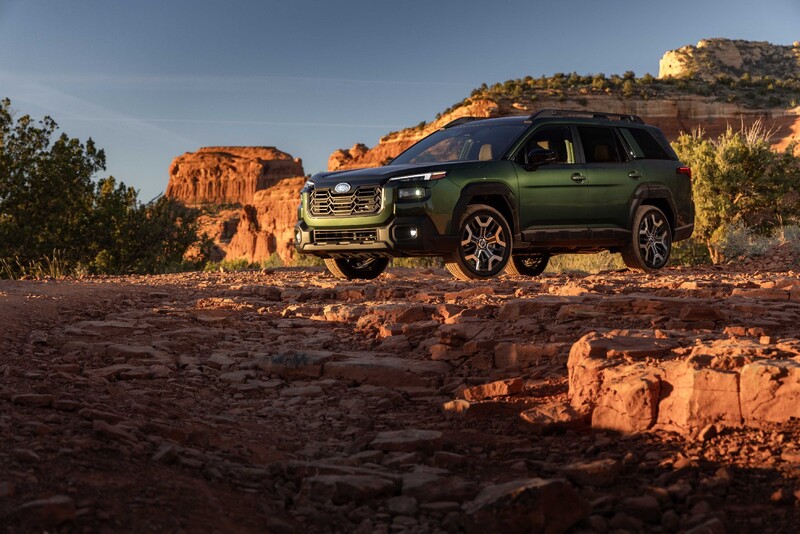
Off-road upgrades are what make an Outback Wilderness something more than an Outback. These include almost 10 inches of ground clearance — comparable to the clearance offered by 4WD SUVs and pickups — a set of all-terrain tires mounted on 17-inch wheels, modified front and rear clips (to increase angle of approach and departure clearance), plus a beefed up transmission with increased low-speed leverage (similar to a 4WD system's Low range gearing) and a much stronger (turbocharged) engine than the one that is otherwise standard in the regular Outback.
The price is another point of difference.
You can get an Outback without the Wilderness upgrades for $34,995 to start. The Wilderness — with all the upgrades — stickers for $44,995 to start.
People used to say — about muscle cars — that speed is just a question of money. How fast do you want to go? When it comes to off-road capability, it's a similar question: How far (off-road) do you want to be able to go?
What's New for 2026
The Outback — not just the Wilderness Outback — is completely restyled. It used to be a wagon. Now it looks more like an SUV. The new look — the boxier shape and taller roofline — increases interior space too.
What's Good
— Wilderness offers as much real-world (for most of us) off-road capabilities as a 4WD SUV — without actually being a 4WD SUV.
— Standard (in the Wilderness) turbocharged engine delivers almost-muscle-car-like acceleration.
— More room for heads (and cargo) than before.
What's Not So Good
— Wilderness equipment adds about $10,000 to the price of an Outback.
— Standard (and only available) continuously variable transmission.
— The previous wagon body was distinctive since everything else (just about) looks like an SUV.
Under the Hood
Regular Outbacks comes standard with a 2.5-liter horizontally opposed (boxer) four that touts 180 horsepower and 178 foot-pounds of torque. It's an adequately powerful engine. The Outback Wilderness comes standard with a turbocharged 2.4-liter boxer four that is more than adequate. It touts 260 horsepower and 277 foot-pounds of torque. It's enough power to get the Outback Wilderness to 60 mph in 5.8 seconds — which is about as quick (or even quicker) than an old Pontiac GTO muscle car.
Or a Soobie WRX,
The Wilderness, like other Outbacks, comes with a CVT automatic, but it's a different (beefed-up) CVT automatic, and you also get a more aggressive final drive ratio, which is both a leverage and a performance advantage. Wilderness Outbacks are also rated to tow 3,500 pounds. Outbacks with the standard 2.5-liter engine come with a lower (2,700-pound) max tow rating.
There's not much of a gas mileage difference, though — which is remarkable given that the Wilderness' engine makes 80 more horsepower. Nevertheless, the window stickers says 21 mpg city, 27 mpg highway (for the Wilderness) versus 25 mpg city, 33 mpg highway for the regular Outback. Both engines are also regular unleaded engines. You don't have to pump premium into the tank to get the 260 horsepower — or the 5.8-seconds-to-60-mph performance.
And it's also a lot better — in terms of gas mileage — than a 4WD SUV.
Subaru's "symmetric" AWD is standard. This isn't just marketing. The idea — the fact — is that the weight of the Soobie's AWD drivetrain is exactly split down the centerline of the vehicle; half on one side, half on the other. This is made possible by the Soobie's horizontally opposed engine, which lies flat — with two cylinders facing the other two across that centerline. This layout also gets the weight of the engine and transaxle lower to the ground than would be the case with an upright (in-line) four. Subaru's AWD system also torque-vectors, meaning that in addition to routing power front to rear, it can also route power side to side, to correct for understeer or oversteer during high-speed cornering and on slippery roads when cornering.
On the Road
The Outback Wilderness combines the on-road acceleration of Subaru's WRX sport sedan (which has basically the same 2.4-liter engine, just advertising 10 more horsepower) with off-road capability approaching that of a 4WD SUV. With nearly 10 inches of standard ground clearance, the Wilderness can ford through standing water that would risk drowning a WRX and bully its way through deep snow and mud too. It doesn't corner with the slot-car tenacity of the WRX (which sits much lower to the ground), but the 17-inch Bridgestone all-terrain tires — which have taller sidewalls and so more "give" than the WRX's 18-inch short-sidewall summer tires — give the Wilderness a much more easygoing ride. The adaptive dampers help too. They mute the reverbs of potholes and washboards, even when you're not inching along.
The WRX is like a sport bike. It's huge fun when you're really going at it — and for about an hour. The less forgiving ride gets old on longer trips, though.
So, what you have here is a more versatile — and more discreet — WRX disguised to look like something that does not have the power or the ability to accelerate like a WRX.
But does.
At the Curb
The Outback used to be the wagon; the word's in italics to reflect the near synonymity. As in Outback wagon. You used to hear it said that way routinely. The Outback wagon was also different because it was a wagon ... relative to the profusion of crossovers.
Now it's different again.
Subaru has redesigned it to look more like an SUV — especially the Wilderness version, which not only sits high off the ground like a 4WD SUV but also has blocky/rugged styling, including what look like beefy cow-pusher bars on either side of the grille. Just don't try actually pushing a cow with these.
The new look serves a functional purpose too. There's about five more cubic feet of total cargo space (80.5 cubic feet versus 75.6 cubic feet for the old wagon) and about an inch and a half more headroom in the backseat (40.5 inches now versus 39.1 inches previously). That said, the new look is less distinctive — in part because it looks so much like the new Forester that it's hard to tell the difference unless you park them side-by-side. Then you can tell the Outback's larger.
Whether it was a good move to make the Outback look more like an SUV than leave it looking like a wagon is something only time (and sales figures) will be able to tell.
The new 12.1-inch LCD screen is a big improvement over the old Outback's screen, which was taller than it was wide and mounted low, forcing you to look down to use it. The new screen is wide and mounted up high and forward, in line with your sight and within easy reach of your hand. It responds quickly and accurately to your inputs. The menus are large-icon'd and coherent. It is one of the "cleanest" LCD interfaces on the market.
The Rest
In addition to being the most capable iteration of the Outback, the Wilderness is also luxurious. It comes with heaters for both rows of seats, coolers for the front seats, a heated steering wheel, a very good Harman Kardon audio system, synthetic leather upholstery, navigation and a 360-degree camera system. It is, in other words, loaded — and the sticker price reflects this. It's a $10,000 jump to go from the base Premium Outback to the Wilderness; Subaru might sell more of the latter if a version were available with just the off-road extras and maybe even with the non-turbo boxer engine. Actually, you can get something like that — in the Forester Wilderness — for $36,995. It's a little smaller — and a lot less powerful.
A very handy thing about Subaru engines is that the oil filter is mounted under the hood — not under the engine. It's right there, on top of the engine, where it can be easily reached without special tools or contortions.
The Bottom Line
The Wilderness isn't just a rugged-sounding name. It's a rugged fact.
Eric's latest book, "Doomed: Good Cars Gone Wrong!" will be available soon. To find out more about Eric and read his past columns, please visit the Creators Syndicate webpage at www.creators.com.
View the Subaru Outback Wilderness this week.







View Comments