Lots of people decide to buy a nicer Chevy Tahoe — in the form of the GMC Yukon. It's a similar thing as regards the GMC Terrain — which is basically a nicer Chevy Equinox. You pay more for the GMC-badged version of the same basic thing, of course. But it's worth the extra to some.
What It Is
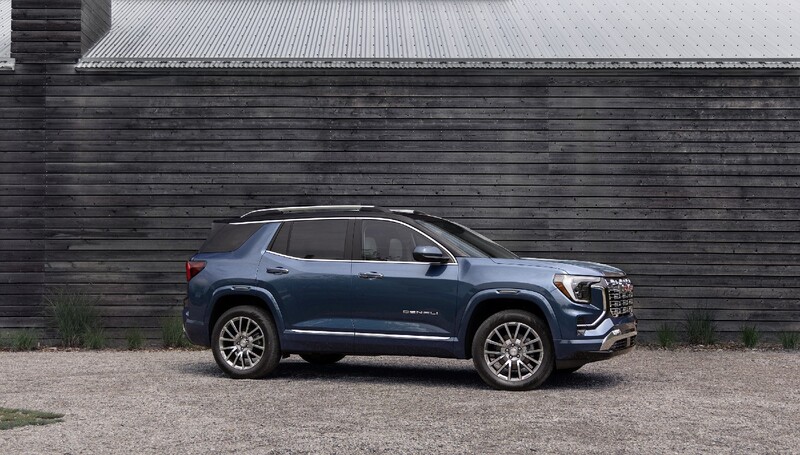
The Terrain is a compact crossover related to the Chevy Equinox. Both are mechanically identical but have slightly different exterior and interior styling. The Terrain — being a GMC and so a notch up the brand-prestige ladder in the GM hierarchy — costs a bit more ($30,200 to start for the base Elevation trim versus $28,900 for the base LT Equinox), but in addition to the different looks and the GMC badge, you also get more standard equipment, such as a larger (15-inch) tablet-style LCD touch screen versus the smaller (11.3-inch) screen that comes standard in the Chevy, as well as a better six-speaker audio system, standard heated front seats, four USB ports, remote start and navigation with Google apps.
There are two other Terrain trims.
The $39,400 AT4 adds all-wheel drive plus all-terrain tires, an off-road-tuned suspension, skid plates and roof rack. The Equinox offers a similar package of off-road upgrades in the Activ trim ($33,600) but without some of the extras that come standard with the Terrain AT4, such as the skid plates and off-road suspension turning.
The top-of-the-line Terrain trim is the Denali ($41,900), which is luxury-themed and bundles a softer, comfort-tuned suspension, heated rear seats (and ventilated front seats), LED foglights and Denali-specific interior/exterior trim. AWD is also standard.
Chevy does not offer a Denali-equivalent (or similar) iteration of the Equinox.
What's New for 2026
The AT4 and Denali trims are new additions to the Terrain trim/equipment lineup.
What's Good
— An upgraded iteration of the Chevy Equinox, available with equipment and features that aren't available with the Equinox.
— Exceptionally roomy up front (44 inches of legroom) and still pretty roomy in back (39.7 inches of legroom).
— Base price is only slightly higher than Equinox's base price.
What's Not So Good
— Standard 1.5-liter engine is the only available engine.
— Standard continuously variable transmission is the only available transmission.
— Max tow rating is only 1,500 pounds — and you have to buy AWD to get that. Front-wheel-drive versions of the Terrain are only rated to pull up to 800 pounds.
Under the Hood
Like its Chevy-badged counterpart, the Terrain — every trim — comes with a turbocharged 1.5-liter four-cylinder engine that touts 175 horsepower and 184 foot-pounds of torque. That is not a lot of engine (or horsepower) to move a 3,446-pound vehicle — and it shows. It takes this GMC almost nine seconds to get to 60 mph.
The Terrain's standard (and only) transmission is a CVT automatic, leaving the only drivetrain choice the decision to stick with the standard FWD layout or spring for the available AWD system. The AWD system will improve traction but comes at the cost of hauling. FWD iterations of the Terrain are rated to pull up to 1,500 pounds, which is the weight (plus a small load) of a small trailer. You can hook up and haul a riding mower or a couple of dirt bikes.
If you get the AWD, the tow rating goes down by almost half to just 800 pounds.
On the Road
In stop-and-go, slow-pokey traffic, the Terrain does not feel (or sound) underpowered. But when you need it to move out smartly, it does. Even with turbo boost, the 1.5-liter's 175 horsepower isn't enough to overcome close to two tons of dead weight — 3,400-ish pounds of Terrain plus a couple hundred pounds more of you and maybe a passenger or two. The CVT automatic doesn't help. Floor the accelerator pedal and the CVT lets the engine spin close to its redline, and — if you keep your foot down — the CVT will keep the engine spinning fast (and loud).
This is normal.
This is what CVTs are supposed to do; i.e., they are designed to get the engine spinning to the RPM where it makes power — which for this engine is 5,600 RPM. A conventional automatic would let the engine speed decrease as the transmission shifts up through its forward gears, but the CVT holds the revs until the driver backs off the pedal. If the engine makes more than enough power to get the vehicle going reasonably quickly, the driver will only rarely need to put his foot all the way down, and in that case, the CVT is smooth and quiet — no "shift shock" during the 1-2, 2-3, 3-4 gear changes as the vehicle accelerates, as would be the case with a transmission that shifts. But when the engine makes just barely enough power and the driver demands all the power there is, the CVT enhances the feeling (as well as the sound) of under-poweredness, and that is the case here.
This is unfortunate because if this little GMC had a little more engine, it'd be otherwise appealing. Its weight makes it feel beefy — in a good way. As in, not flimsy. The doors close solidly, and once they are closed, you don't feel like you're driving something small, even though the Terrain is just 181 inches long (a smaller footprint than a Honda Civic sedan, which us 184.8 inches long). GMC's intention was to make the Terrain look — and feel — like larger GMCs, such as the midsize Acadia, and the effort is 90% successful. If the Terrain at least offered the Acadia's standard 2.5-liter four as an option, it'd be hard to fault this smallest GMC. A torquey diesel would solve the power problem too. Unfortunately, federal regs have gotten so onerous that it is very difficult to get a diesel through the pipeline anymore (which is why there are almost no diesel engines available in anything besides a 2500/3500 series heavy-duty truck or cargo van).
The gas mileage is an upside — but only in slow-pokey, stop-and-go traffic. On the highway, if you keep up with the traffic that's typically going at least 70 mph, you'll probably find you're averaging around 26 mpg (as I did during my weeklong test drive). That's not terrible, but it's also about what you'd get out of a similar vehicle with a larger engine that didn't have to work so hard to keep up.
This is the dirty little secret of today's little-engine'd but heavy vehicles: The little engine doesn't use much gas when it's not on boost. But it needs the boost to get you going faster than slow-pokey, and that burns more gas than you may have been led to believe would be the case.
At the Curb
As mentioned, the Terrain is pretty small but doesn't look it. And by the numbers, it's actually pretty big — on the inside.
The driver and front-seat passenger have 44 inches of legroom, and the backseat occupants get nearly 40 inches. That's a neat trick. Sometimes a small vehicle will advertise generous legroom up front, which it has because there's much less room in back. What that ends up meaning is that for people — adults — to be able to ride in the back, the people up front have to scooch their seats several inches forward. So much for all that legroom. But that's not the case here. Though it is small — on the outside, four full-size adults can ride comfortably in the Terrain; five (three in back) can ride reasonably comfortably.
It's also pretty comfortable on your wallet: $30,000 to start — sticker, before you dicker — for what amounts to a nicer iteration of the Equinox, one with standard heated front seats and steering wheel, heated exterior mirrors, all the power options and the new dual-LCD main instrument (11 inches) and oversize (15-inch) tablet-style secondary LCD screen that you can't get (yet) in the Equinox is a pretty decent deal in today's new vehicle market.
The AT4 offers a degree of off-road capability that's also unusual in the class — and for the price.
The Rest
The huge, Tesla-emulating LCD touch screen will appeal to those who like touch screens, just as the standard array of "assistance" technologies — including one that "assists" those who have difficulty noticing bicyclists on the road — will appeal to those who like being "assisted." If you don't like these things, you are in the same basic position as people who don't like seatbelt buzzers and airbags in that they are becoming inescapable in new vehicles generally.
The Bottom Line
The Terrain can be seen as a nicer Equinox, which is pretty much how GMC wants buyers to see it.
Eric's latest book, "Doomed: Good Cars Gone Wrong!" will be available soon. To find out more about Eric and read his past columns, please visit the Creators Syndicate webpage at www.creators.com.
View the GMC Terrain this week.







View Comments