Would you pay $8,800 more to get a Honda HR-V with less engine but more power? What if it were badged as an Acura — and came standard with a larger touch screen than you'd get in the Honda?
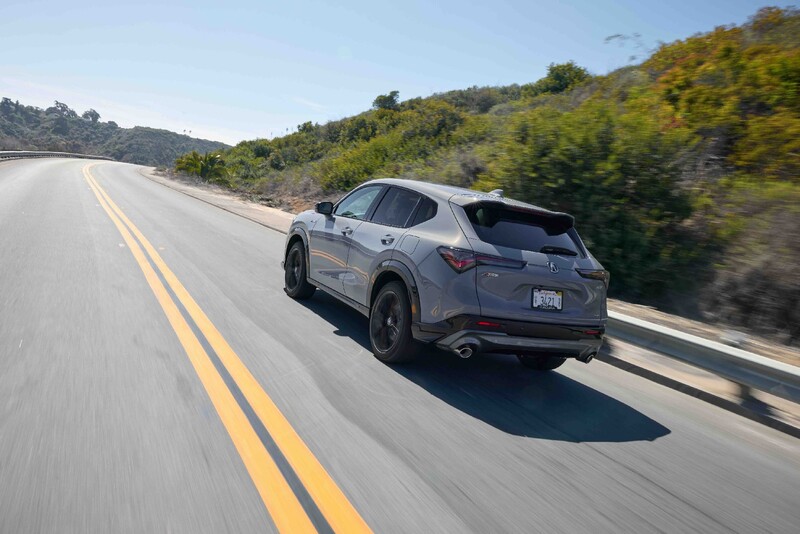
Behold, the Acura ADX!
But is it worth almost $9,000 more than an HR-V?
What It Is
The ADX is Acura's smallest, least expensive model. It's a subcompact crossover based on the Honda HR-V, with the main differences being that the Acura comes standard with a smaller — but stronger — 1.5-liter turbocharged engine (the same engine used in the Integra as well as the Honda Accord sedan) instead of the HR-V's 2.0-liter four, which isn't turbocharged — and so offers less power.
There are some styling and standard/available amenities differences as well.
And — of course — pricing differences.
The base trim ADX (with front-wheel drive) stickers for $35,000 — versus $26,200 for the base trim HR-V. Opting for the optional all-wheel-drive system boosts the base price of the ADX to $37,000. The base trim ADX comes standard with heated front seats, a sunroof, faux leather seat covers, an eight-speaker audio system, wireless charging, dual-zone climate control, 9-inch touch screen and 18-inch wheels. The base trim HR-V comes standard with a smaller touch screen, 17-inch wheels, regular AC and a less powerful stereo.
The $38,000 ADX A-Spec comes standard with 19-inch wheels, a larger/panorama sunroof, seat coolers, fog lights and a flat-bottomed steering wheel. FWD is standard, but AWD is available as a standalone option; so equipped, the MSRP rises to $40,000.
The $42,000 A-Spec with the Advance package comes with real leather set covers, a 15-speaker B&O premium audio system, heated steering wheel, rain sensing wipes, power-folding exterior mirrors and Amazon Alexa connectivity. As with the other ADX trims, FWD is standard. AWD can be added as a standalone option. So equipped, the ADX's price tops out at $44,000.
What's New for 2026
2025 was the first year of availability for this newest/smallest Acura, so the changes for 2026 are minimal.
What's Good
— Relatively inexpensive.
— Stronger standard engine than is available in its HR-V sibling.
— Everyday secondary systems such as AC and seat heaters don't require tapping a touch screen.
What's Not So Good
— Gets expensive, quickly — if you move up the trim roster.
— Standard continuously variable transmission is shared with the HR-V.
— It's basically a nicer (and pricier) HR-V.
Under the Hood
It's usually — it used to be usually — the case that the more prestigious-brand car came with the bigger engine. Cadillacs, for instance, came with the biggest engines you could get in a GM vehicle.
But in this case, you get a smaller engine. On the upside, it's considerably stronger.
The ADX comes standard with a 1.5-liter, turbocharged four that touts 190 horsepower — which easily out-muscles the larger 2.0-liter four that is standard in the HR-V. It only makes 158 horsepower — because it isn't turbocharged. Both engines are paired with a CVT and either FWD or (optionally) AWD.
Zero to 80 mph takes about 8.7 seconds, which isn't much quicker than the HR-V's 9.4 seconds to 60 mph time. Neither car is exactly quick, but that's less a problem for the Honda than it is for the Acura, which touts sportiness while the HR-V touts practicality and value.
Interestingly, the gas mileage touted by both cars — 25 mpg city, 30 mpg highway — is identical, despite their different engines and different outputs. The more interesting thing, arguably, is that neither gets particularly good gas mileage. As a point of comparison/reference, back in 2012, Toyota's RAV4 was still available with a 3.5-liter V6 engine and still managed to deliver 19 mpg city, 26 mpg highway. In other words, only about 5 mpg less than the smaller (compact versus subcompact) ADX and HR-V equipped with much smaller and far less powerful engines. The Toyota's V6 also offered 269 horsepower and got to 60 mph two full seconds sooner than the ADX.
The ADX also weighs almost exactly the same as the 2012 RAV4 — each being about 3,600 pounds. So it's not that the ADX is weighed down.
So why is the mileage of this four-cylinder-powered subcompact crossover not much better than the mileage you got with a larger (compact) crossover equipped with a larger and much more powerful V6 engine?
Probably for exactly that reason.
Meaning, the ADX's little engine has to work harder to get the ADX moving, especially quickly (well, as quickly as it can), while the V6 engines that used to be commonly available in crossovers didn't have to work as hard to move them — and were also able to move them more quickly.
It still raises a question, though: Why have the V6 engines been disappeared if there's no meaningful mileage advantage and a performance disadvantage? Probably because there is a compliance advantage. These smaller fours generate less CO2 — because they have smaller (and fewer) cylinders — and that is a big thing in terms of compliance with federal "emissions" requirements, now that CO2 is considered an "emission," even though it has nothing to do with air pollution.
On the Road
Do you know the story about the German battleship Scharnhorst? It was under-gunned for a battleship, having 11-inch main batteries. Most battleships of the era had 15- or 16-inch main guns and were designed to absorb hits from 15- or 16-inch shells. The Scharnhorst's armament wasn't adequate to go toe-to-toe with bigger-gunned battleships; instead, she relied on speed to get away from them.
The ADX has neither the guns nor the speed.
It is disappointing to floor the accelerator pedal of an Acura and have it accelerate like a Honda. Not that there is anything wrong with Hondas — or their acceleration. The point is they are generally sold on practical/utilitarian grounds, not how sporty and speedy they are (with some exceptions, of course — but that's beside the point because we're talking crossovers). The CVT is the weaker point than the engine, which would probably deliver much better performance were it paired with a smartly shifting five- or six-speed automatic. This Acura would be even sportier with a manual transmission, which Acura used to offer in many models.
So why the CVT? Well, because compliance — again. The CVT ekes out small mileage gains, and that translates into "emissions" gains, since an engine that burns a little less gas "emits" a little less CO2.
On the upside, the ADX has that snappy handling feel — especially in corners — that Acura has a deserved reputation for delivering. Much more so than the HR-V, which feels softer and not nearly as snappy. This difference is due, of course, to different suspension tuning and also to different wheels/tires. The ADX comes standard with 18-inch wheels and shorter sidewall tires that flex less and so impart shaper steering feel. You can get 19-inch wheels (A-Spec trims) and even sportier, shirt sidewall tires.
The HR-V comes standard with 17-inch wheels (18s are optional).
At the Curb
The ADX is styled to not look like the HR-V it basically is, under the skin. It looks like a mini-me version of Acura's MDX, in fact. It has crisper rather than rounder lines, and it looks a little larger overall than the HR-V because, as it turns out, it is.
Both of these little crossovers are subcompacts, but the ADX is a little less so — at least visually. It is 185.5 inches long versus 179.8 inches for the HR-V. Most of the difference in length is ahead of and behind the front and rear axles, as both have the same 104.5-inch wheelbase. The end result is that the ADX looks like a more substantial vehicle, as well as a sportier-looking one.
But it isn't roomier inside than the HR-V.
Both have identical space for cargo — 24.4 cubic feet behind their second rows, and 55.1 cubic feet with the second rows folded. Both of these crossovers also have identical first- and second-row legroom: 41.9 inches and 37.7 inches, respectively. This can be looked at positively in the sense that the sportier-looking Acura is just as practical as the Honda.
The ADX is also equipped with a higher cut of standard equipment, including a standard sunroof and power liftgate as well as a nicer standard audio system and a larger (10.2-inch) digital display main gauge cluster and a 9-inch secondary touch screen. There are also amenities not available in the Honda, such as the excellent 15-speaker B&O premium audio system that is standard in the A-Spec Advance trim.
The Rest
Oddly, this Acura is not available with a hybrid drivetrain. It's odd, not so much because it would up the ADX's so-so mileage but because it would (or at least could) up this Acura's so-so performance without hurting its mileage — and without risking compliance problems, either.
A hybrid-augmented drivetrain could get the 0-60 mph time under eight seconds, which would put sufficient distance between the ADX and its HR-V sibling to justify the Acura price.
The Bottom Line
The ADX isn't a bad little crossover — but it could be better.
Eric's latest book, "Doomed: Good Cars Gone Wrong!" will be available soon. To find out more about Eric and read his past columns, please visit the Creators Syndicate webpage at www.creators.com.
View the Acura ADX this week.







View Comments