My sister Erica and I returned to Montana just a few days after the Bureau of Land Management revoked grazing permits for bison. American Prairie, a nonprofit working to create one of the largest nature reserves in the United States, was the target of that decision.
Erica and I bounced along two-track roads in our Toyota RAV4 rental, hoping to get close to the American Prairie bison herd. It wasn't as easy as one might think. When I said as much on social media, someone commented: "Visit Land Between the Lakes in Kentucky. They surround your car." As wonderful as that might sound, the bison herd of about 125 at Land Between the Lakes is kept to 700 acres. I can also visit bison at the zoo, but that misses the point.
What makes American Prairie different is scale. American Prairie has roughly 1,000 bison total. On the Sun Prairie section where we visited, approximately 500 bison have about 27,000 acres in which to roam.
That breadth allows them to live more like wild bison, and that's the beauty of it.
I've been following this story since December, when Trump administration Secretary of the Interior Doug Burgum directed the BLM to reconsider a grazing authorization the Biden administration approved after a lengthy environmental review. The BLM now argues the 1934 Taylor Grazing Act limits grazing on federal lands to domestic livestock used for "production-oriented purposes."
The BLM manages 155 million acres of public lands for livestock grazing, according to their website. American Prairie leases approximately 63,000 acres of that public land. It's also important to note that privately owned bison are explicitly classified as livestock in the state of Montana. Bison are required to be fenced in and tested for disease, all of which American Prairie does.
"Production-oriented purposes" is the three-word phrase the BLM is hanging its hat on. BLM determined that bison managed by American Prairie do not meet the requirements, However, the BLM has not defined or clarified what is considered "production-oriented."
American Prairie does in fact harvest bison from their herd every year. They donate meat to food banks and manage a carefully organized lottery allowing the general public to harvest a certain amount of bison as well. For the BLM to get into the slaughter metrics of livestock grazed on its public lands in order to quantify what "production-oriented" means would add a layer of bureaucracy that is cumbersome and nobody wants.
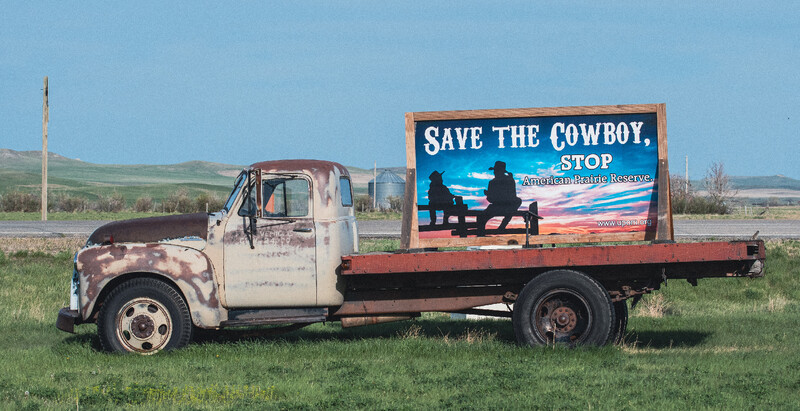
Bison hold deep historic and cultural significance, and American Prairie has a clear understanding of the ecosystem benefits of conservation-minded livestock management. The organization grazes eight times as many cattle as bison on their leased lands. The BLM decision did not strip American Prairie of their grazing leases entirely; it simply requires the organization to manage those leases as cattle-only and keep their bison from accessing the leased land. For those who are celebrating this as a win for the cattle-ranching cowboy, what exactly was won?
Bison were systematically slaughtered in early America as part of a military and political strategy to force Indigenous tribes onto reservations by destroying a vital food source. A decade ago, President Barack Obama formally acknowledged that history when he signed the National Bison Legacy Act into law, officially naming the North American bison our national mammal. Now bison are being targeted once again while being used as political pawns in an effort to pit cattle ranchers against conservationists. But that framing ignores reality. Many cattle ranchers are conservationists themselves, and their livelihoods depend on maintaining healthy grasslands.
I can't help but think of this decision from the bison's point of view. In the spring, bison gravitate to the creek bottoms where vegetation first starts turning green. Then, they move to the uplands as the greening spreads across the landscape. No wonder Erica and I had a hard time locating the herd. We soon learned that during calving season, they like to stay near Indian Lake in the uplands, which is what led us down that rugged two-track road. Indian Lake was dry when we got there, but that's exactly where we found them.
The lake is on BLM-leased property, and we could see bison calves through our binoculars, but as soon as the herd could hear the engine of our vehicle, they bolted with their young — as they should. The bulls were unbothered and just stared at us when we got closer.
Once the heat of the summer takes hold, the bison will stay in the uplands where it's drier and they'll get a nice breeze to help ward off pestering bugs. The herd will come together again for breeding before dispersing into smaller groups for winter.
The bison suffer the most with BLM's decision. They'll be restricted to deeded lands, which in Sun Prairie is about 5,000 acres. American Prairie has until fall to relocate the herd unless they are successful in challenging the decision in court. They are preparing to file appeals in both federal district court in Montana and in the administrative courts of the Department of the Interior.
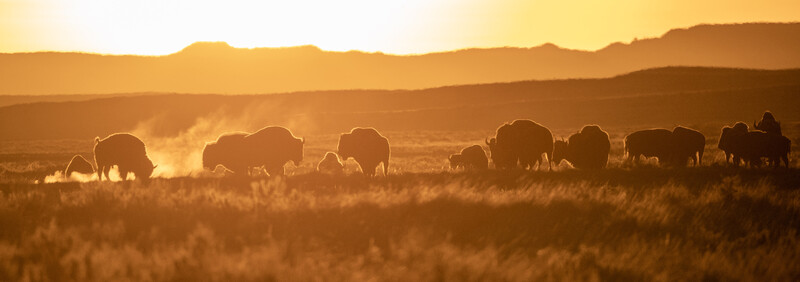
Erica and I left the prairie at dawn to catch our flights home. As we drove down the gravel road, bison galloped alongside us like burning silhouettes in the sunrise. This fight is about more than grazing permits and using bison as political pawns. It is about whether we still believe there is room in America for wildness. We almost erased bison from this continent once before. They should never be forced off the prairie again.
Do you know anyone who's doing cool things to make the world a better place? I want to know. Send me an email at [email protected]. Also, stay in the loop by signing up for her weekly newsletter at WriterBonnie.com. To find out more about Bonnie Jean Feldkamp and read features by other Creators Syndicate writers and cartoonists, visit the Creators Syndicate website at www.creators.com.







View Comments