Q: We are remodeling this spring and planning to sell and move in a couple of years.
So I have been researching smart resale moves and read that the great majority of kitchens in the U.S. are white. My wife says white is "too sterile" for her. What's our next best bet? And what about the center island: should it be white/light, too?
A: Your research holds water: White kitchens are a convention that dates back to the movement for more efficient housekeeping — think early women's lib — that is often credited to Catharine Beecher, the scientific-minded sister of abolitionist Harriet Beecher Stowe. In l869, Catharine wrote "The American Woman's Home," a blow-by-blow description on what and how things should be done under the roofs of the still-young nation.
No polemic, this: Catharine's book was as serious about emancipating housewives as her sister's "Uncle Tom's Cabin" was about freeing slaves. Among her suggestions was to streamline the kitchen: make a place for everything, including the flour barrel and molasses keg. Keep things neat, organized and clean — read: furnishings painted white. White was always equated with cleanliness and sterility.
The white-is-right thinking has hung in. Although today's kitchen has relaxed enough to accommodate comfortable furnishings and decorative accessories, white still totally tops the charts of kitchen colors.
But here's the question: which white? There are more whites than Eskimos have words for snow. Among them is bound to be a white or a "white" that pleases both your wife's psyche and your eye for future resale values.
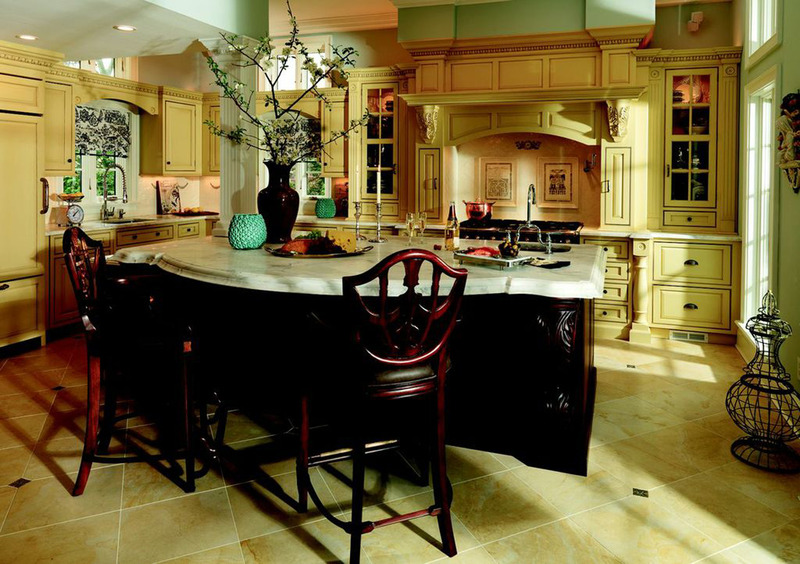
Relax into the warm, cosseting, sophisticated kitchen we show here. Designer Kathy Frederich (lakevilleindustries.com) created it for a man who entertains more often than he cooks and wanted an inviting place for his guests. Kathy gave him traditional, lovingly detailed wall and base cabinets painted the color of candles' glow (custom built by Plain and Fancy, plainfancycabinetry.com)
About that center island: Take the advice of Plain and Fancy's Brian Yahn: Make the center the centerpiece of the kitchen by using a dark, contrasting color. Here, it's stained traditionally dark, topped with a gracefully curved and carved stone countertop.
Q: Guess who's coming to dinner?
A: Maybe not, but whoever they are, dinner will be probably be served on a round table.
Round is the place for square meals, judging from last month's "Dining by Design" extravaganza, the highlight of Architectural Digest magazine's annual Home Design Show in New York. Most of the 40-plus designer displays were set on round tables (with a few ovals thrown in). All shared the same main ingredient — wild imagination.
There were tables (and dining stools and wallcovering) made of wire hangers, tables of poured concrete surrounded by tree stump stools, tables set beside running waterfalls in front of a wall of sparkling LEDs under enormous hanging drum lights as large as the table itself.
Most were round; one charming exception was Benjamin Moore's wildly multi-colored setting, a rectangular table with nothing that matched, including chairs, plates and utensils on the table and the chandeliers hanging above.
Ultimate conclusion: not to be round is to be square.
Rose Bennett Gilbert is the co-author of "Manhattan Style" and six other books on interior design. To find out more about Rose Bennett Gilbert and read features by Creators Syndicate writers and cartoonists, visit the Creators Syndicate website at www.Creators.com.







View Comments