It is Thanksgiving week. Please take time out of all the rushing around preparing for the Thanksgiving meal, rooting for your favorite football teams and shopping for Black Friday deals to step out into your garden and actually think about all that you are thankful for. Besides my family, health, church friends and 100 other things, I am thankful for you. Many of you have taken the time over the years to ask me questions. I enjoy helping people. I especially like questions that I don't know the answer to, so that I have to research and learn about a new topic.
This week, I posted my 500th video on the Greener View YouTube channel. I enjoy helping people with the videos. Please go to the video and comment on what topics you would like me to cover in the next 500 videos.
Q: I have a boxwood hedge that needs to be pruned. I was busy all summer and fall, and I didn't get to it. Is it still OK to prune at this time of year? I really don't want it to look bad all winter.
A: If you live in a climate that doesn't get very cold all winter, you can prune it, but if you are in a cold climate with freezing weather, it is better to wait.
There are several things going on here. First, in the fall, even on evergreens, the plants move sugars and other chemicals into the branches, trunks and roots for storage. Evergreens such as boxwoods store some of the sugars in the leaves to act as antifreeze. A light pruning of a wayward branch here or there would be fine, but a heavy pruning, cutting all the branches back, would be a problem. You would be reducing the plant's ability to protect itself from severe weather.
Second, the plant must react to any pruning by trying to heal the wounded, cut-off ends of the branches, and in this case, the damaged leaves remaining on the plant. Healing requires energy and chemicals stored in the plant to heal the wounds. These chemicals are now consumed and not available to help the plant survive winter weather.
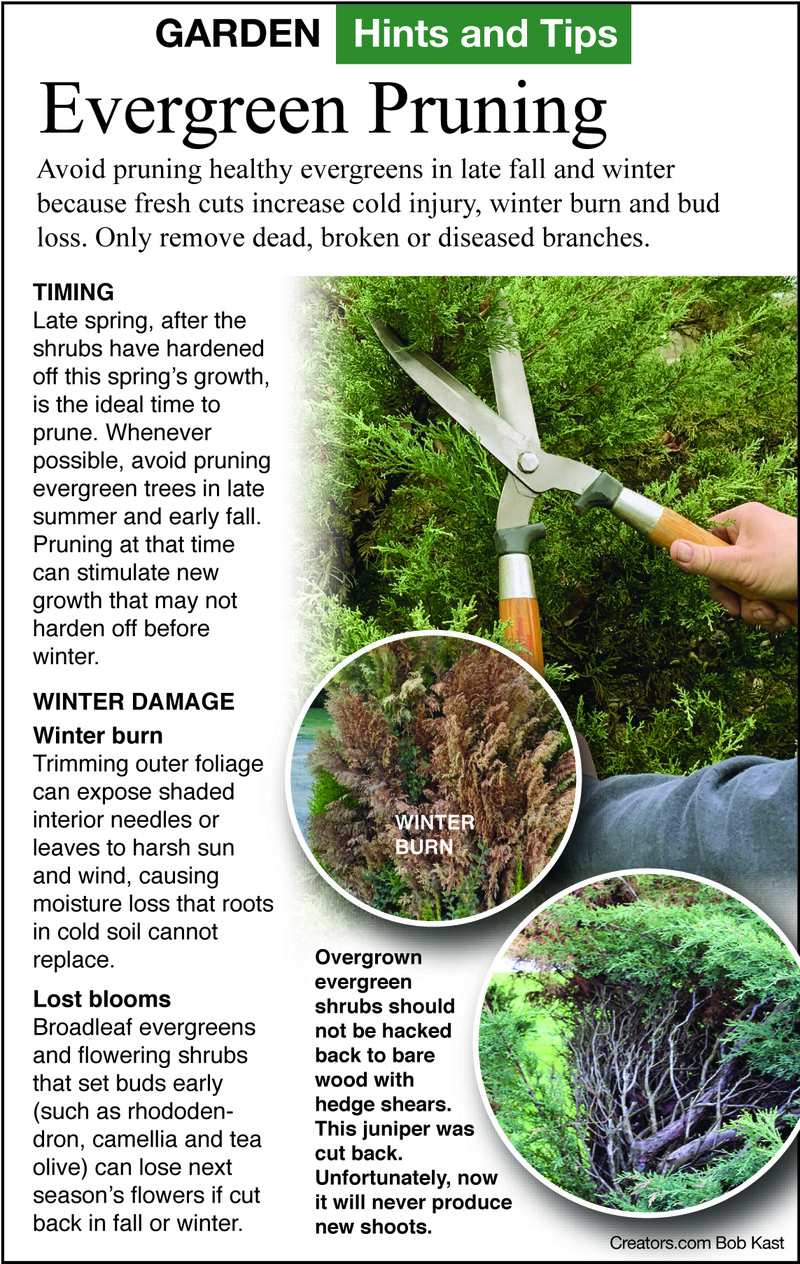
Third, there isn't enough time for the wounds to heal before freezing weather comes. The open wounds expose cells to the cold and to drying winds. These open wounds will cause the stems to die back, creating what we call winter burn.
Fourth, if the plant is pruned in early fall or there is a warm spell immediately after pruning, the plant may start to send out new growth. This is the normal response to pruning, but doing so in the fall will just get the new tender shoots killed when the freezing weather comes. The buds that grow were supposed to grow next spring, so new growth in the spring will be set back.
Fifth, the entire plant is now much less hardy than it would have been. The plant may have more than winter burn; it could die completely.
Late winter into early spring, is a much better time to prune trees and shrubs that are not spring bloomers. Prune them in one to two months before they would normally leaf out in the spring. The plants will have survived most of the winter and consumed most of the carbohydrates. They will begin leafing out soon afterward and growing new leaves to create more sugars. If the tree or shrub blooms in the spring, prune it in the one to two months after it blooms for the best display of flowers and to get the most fruit.
DIST. BY CREATORS






View Comments