Q: I have a long arborvitae hedge, and I just noticed that something has shredded the branches on a couple of the trees at the far end of the hedge. It doesn't look like anything was eaten. Low branches are broken off, and the bark looks like someone took a cheese grater to it. How do I protect the plants?
A: You are seeing the typical damage done by a male antlered deer, moose or elk. The damage was probably done a month or so ago, but it may also be ongoing. The antlers on these mammals go through a velvet stage in the spring and summer. In late summer, the skin of the antler needs to dry up and be scraped off to reveal the bone underneath.
The deer scrape and rub their antlers on small trees and shrub, and the resulting damage is called a deer scrape or deer rub. Sometimes a small tree is attacked, and sometimes it is a multitrunk shrub. The plant may be deciduous or evergreen. Junipers and spruce are common victims. Some plants are attacked for several years in a row.
The damage may only be skin-deep; in other words, just the bark is damaged. The plant will survive this damage just fine. Other trees may have the bark ripped off all the way around the trunk, and the plant dies from there up. It may send out new trunks from the roots.
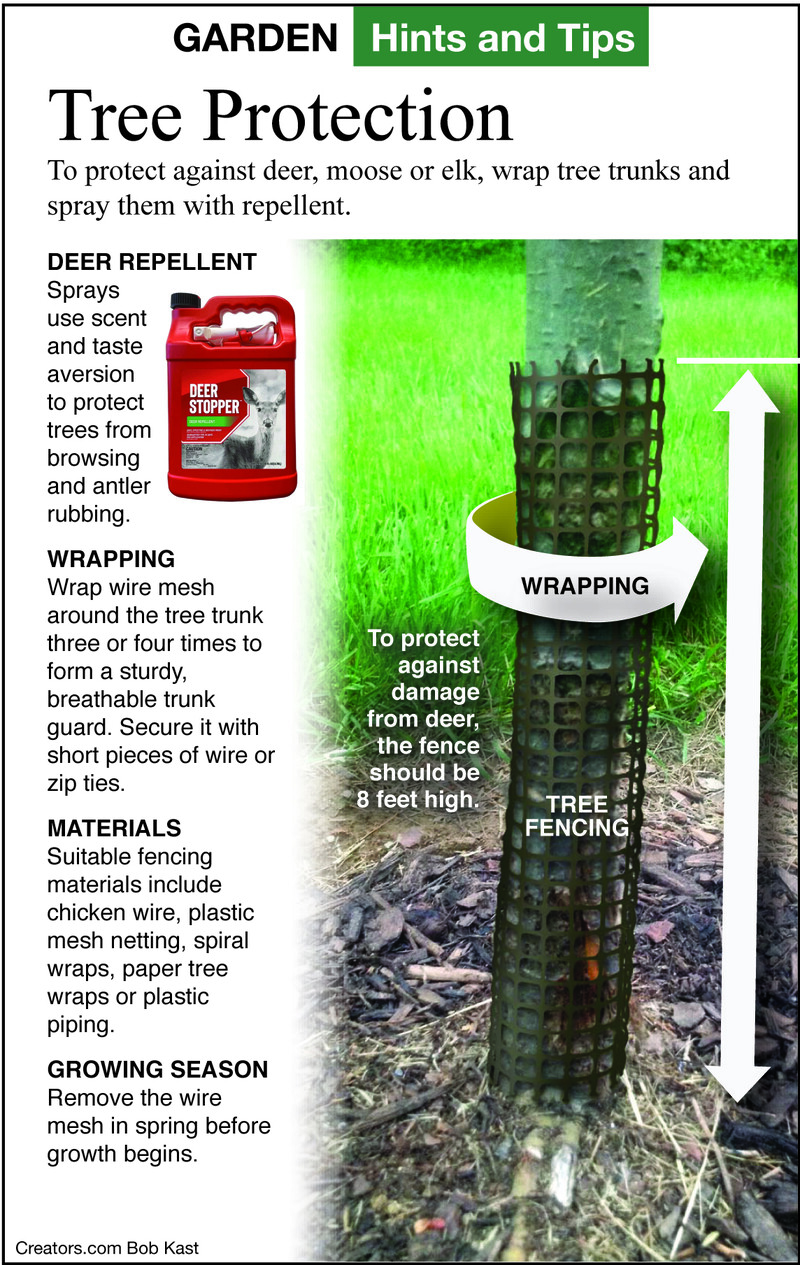
Whenever you start seeing this damage, fence off the plant. If it is a small tree, you can wrap the trunk in a plastic pipe or chicken wire. For larger, multitrunk plants, you will need to fence off a larger area. In the case of a hedge, thinner bird netting comes in long rolls that can be stretched across the length of the hedge.
Arborvitae are actually a favored winter food for deer and other animals, so fencing may also be required to prevent them being eaten. The problem with leaving any netting up for the winter is that it will collect a lot of leaves that come off other trees.
The damaged plants need to be cleaned up. Prune off the broken branches that are still hanging on. Don't leave stubs. Use a knife or pruner to cut off any ripped-up bark. Clean up the edges of the wounds so the bark can grow smoothly across the open areas.
Spraying the plant with deer repellent sprays can help prevent them from eating the plant and can help stop them from using it for a scrape. The repellent sprays work on smell and taste, so there may still be a little damage as they figure out that they shouldn't eat the plant. I have found that even though the sprays say they work for months, it is often better to spray weekly. I have used several products and have found that alternating each spray weekly is better than using only one kind.
Many of the sprays are available in a ready-to-use container and as a concentrate. If there are a lot of deer, the concentrate formula will be more economical, even though a bottle costs a lot to begin with.
I have also found that when the deer undergo a really bad weather event, such as heavy snow followed by a bitter cold spell, no spray will stop deer that are really hungry, and the fencing works better.
DIST. BY CREATORS.COM






View Comments