Q: There are a bunch of slimy, disgusting orange growths all over my junipers next to my patio. Please tell me they are not going to kill my junipers as they are shielding us from a bad neighbor's view.
A: There are more than 7,000 rust fungus species affecting plants. Many of the species are very host-specific and can't be transmitted to non-host plants. At the same time, many rust species infect two different kinds of plants during their life cycle. The spores produced while on one host can only affect the one other specific host plant species. In the cedar-apple rust group, several species of junipers may be infected, and then plants in the rose family, such as apples, pears, hawthorns, quince and a few other species, may be infected.
Unlike many fungi, the rust fungi do not live on dead plant material; they can only grow on live plants. The fungal cells live between the plant cells, where they block nutrients from getting to the plant cells. They can persist inside a perennial or woody plant for many years. On the other hand, the rust that grows on lawn grasses may grow slowly enough and the lawn grass may grow quickly enough that the infected grass leaves can be mowed off to remove the rust. Rust diseases are serious economic pests on crops as diverse as coffee, corn, oats, rye, soybeans, sugarcane, wheat and white pine trees. They are common on native wildflowers such as mayapples and jack-in-the-pulpit. Ornamental plants affected by rust diseases include apple, barberry, crabapple, daylily, hawthorn, juniper, Kentucky bluegrass, pear, rose and serviceberry.
Cedar-apple rust, cedar-hawthorn rust and cedar-quince rust all have junipers as one host. Junipers are in the cedar family, which is where the "cedar" part of the name comes from. Most information about these three diseases is the same, with a few different identifying characteristics. This group of rust species spends the winter in juniper plants. In wet spring weather, they release spores that infect rose family plants. Apples and other fruit tree leaves that are under two weeks old are very susceptible. The infected rose family plant leaves and fruit release spores in mid to late summer that reinfest junipers. The spores can travel over a mile to infect the plants, but the closer the plants are together, the heavier the infestation will be.
The spore-producing stage on the rose family plants is usually small yellow, orange or red dots on the leaves or fruit. If a tree is heavily infected, the spores from this stage may blow or wash off onto the ground, and plants below the affected trees are covered in orange dust. Cedar quince rust forms 1/4-inch-long tubes that release the spores.
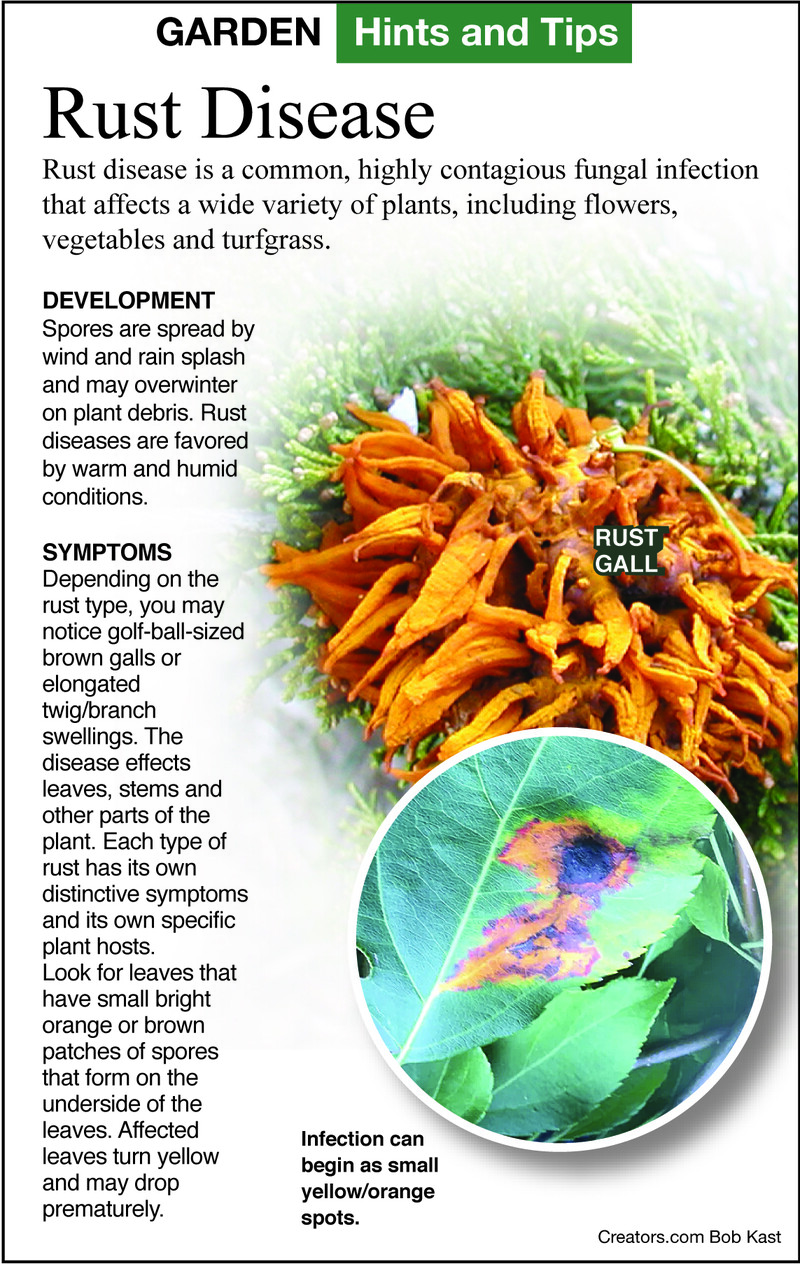
The spore-producing bodies that grow on junipers are embedded in the branches. Cedar-quince rust forms long orange blisters that release the spores from the branch. Cedar-hawthorn rust forms 1/2-inch-long galls that produce short telial horns that release spores. Cedar-apple rust grows galls as large as golf balls. The brown gall lasts two years on the juniper branch. During wet weather, the galls grow long telial horns that look like they are made of an orange marmalade octopus. The horns dry up in dry weather but can come back several times in a spring when the weather is wet.
How and when do you treat rust if your garden or landscape plants have a rust disease problem? If possible, use plant varieties that are resistant to rust. Don't water the plants with overhead watering when the weather is going to allow the spores to infect leaves. Remove infected plant debris and clean your tools after using them on infected plants.
Apply fungicides at the proper time to prevent infection on the plants you have in your landscape. Protect rose family plants when redbud trees are in bloom. Use a fungicide that says on the label that it treats rust fungi on the type of plant that you have.
I just released a video on rust diseases on the Greener View YouTube channel.
DIST. BY CREATORS.COM







View Comments