Jaguar has the same problem that Chrysler's dealing with. Both of these brands currently have just one new model to sell. For Chrysler, it's the Pacifica minivan. For Jaguar, it's the F-Pace, which is an SUV.
Both brands haven't got anything else to sell at the moment because they intended to be selling something different — electric vehicles — by now. The problem is that EVs aren't selling well, especially the high-end ones. Mercedes, BMW and Porsche have all walked back their prior "commitment" to electrify their entire lineups — in order to avoid EVs stacking up unsold on their dealers' lots. They are going back to selling vehicles with engines — because those do sell.
Jaguar's problem is that it hasn't got anything else to send its dealers, to fill the spaces on the showroom floor that were supposed to be filled with new Jaguar EVs that aren't coming anytime soon.
For now, at least, the F-Pace must carry the flag all by itself.
What It Is
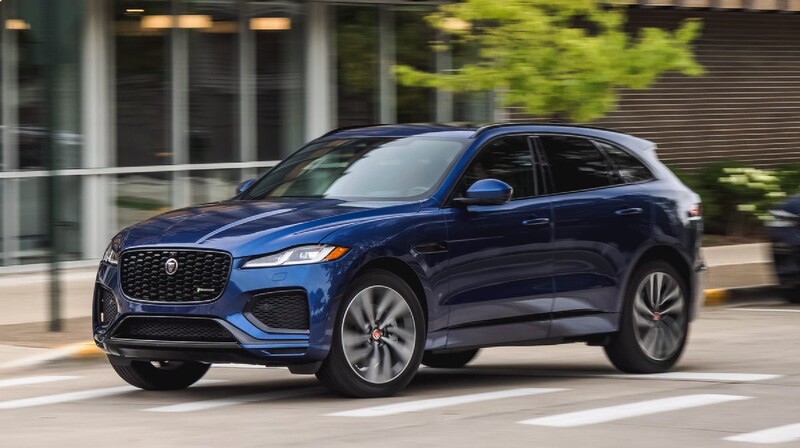
The F-Pace is a luxury-performance SUV sold by Jaguar. It is not a crossover. These terms are often used interchangeably, which creates confusion about what a given SUV — or crossover — actually is.
An SUV can also be made to look like a crossover — and a crossover can be made to look like an SUV, adding to the confusion.
So — what are the differences between them that define them?
An SUV is based on a rear-wheel-drive layout, as most big luxury cars are. Even if the SUV has all-wheel drive, most of the engine's power usually goes to the rear rather than the front wheels, unless the rear wheels lose grip (and then the system routes power to the front wheels). Crossovers are based on the front-wheel-drive layout common to lower-priced cars. If the crossover has AWD, it is usually the case that most of the time, most of the engine's power is routed to the front wheels, unless they begin to lose grip (at which point the system routes some of the power to the rear wheels).
This difference in power flow results in a different driving feel — which is further differentiated by the fact that in a crossover, more of the drivetrain's weight is over the front wheels, because the transmission and axle are packaged into a single transaxle snugged up close to the side of the sideways-mounted engine while SUVs have the weight of their drivetrain more evenly spread out from front to rear, because the transmission is bolted behind the engine and there's a driveshaft that connects it to the rear axle, which is a separate component located at the rear of the vehicle.
SUVs also have beefier/heavier-duty frames and bigger available engines; for these reasons they can usually pull more weight than a crossover of the same size.
The F-Pace may look like a sporty crossover, but it is a sporty SUV.
Prices start at $57,000 for the P250R Dynamic S. It comes with an excellent Meridian audio system, panorama sunroof, partially synthetic leather upholstery and a 2.0-liter, turbocharged four-cylinder engine paired with an eight-speed automatic and full-time AWD.
The $66,500 P400 R-Dynamic S gets a much more powerful 3.0-liter six, augmented with "mild hybrid" tech and an electrically powered supercharger. This version of the F-Pace also comes standard with an adaptive suspension, configurable drive modes and bigger brakes.
The heaviest-hitting F-Pace is the $92,400 SVR 575 Edition — which comes with a mechanically supercharged 5.0-liter V8 engine, plus a torque-vectoring differential, even bigger brakes (with red powder-coated calipers), 21-inch wheels with "summer" tires and an even more excellent 17-speaker Meridian surround-sound audio system.
This model most similar to this Jag is arguably a Porsche — the $62,900-to-start Macan. Other possible cross-shops include the Mercedes GLC and the BMW X3, which are both just a little bit smaller than the Jag and less expensive — but don't offer more engine than small fours and sixes. In the case of the GLC, there's nothing more than a small four available.
What's New for 2026
Every '26 F-Pace (irrespective of trim) gets "90th Anniversary" (for Jaguar) badges.
What's Good
— It looks like a crossover, but this SUV runs like a Jaguar.
— Available V8 engine.
— Superb Meridian sound systems.
What's Not So Good
— Base trim's four-cylinder engine is underwhelming — for almost $60,000 to start.
— Current design is pushing 10 years old (first year was 2017).
— Jaguar may not be around to support this vehicle 10 years from now.
Under the Hood
The F-Pace is available with three different kinds of engines — as opposed to the usual variations of one or two.
Each defines the trim.
The P250 comes standard with a 2.0-liter turbocharged four that touts 246 horsepower; it is paired with an eight-speed automatic and full-time AWD.
Next up (in the P400) is an unusual engine. Not just because it's an inline six. BMW offers this same type of engine in the X3 (and X5). What's unusual is that the Jag's 3.0-liter inline six has both a mechanical turbocharger and an electrically driven supercharger. The latter is added to eliminate the slight but inevitable moment before a turbocharged engine responds to a floored accelerator pedal. It takes a moment for exhaust gas pressure to build up (this is what the turbo uses to build boost) before the turbo-boost builds power. The electrically driven supercharger eliminates that moment of hesitation because it does not rely on exhaust to build boost. Total output of the combined effort is 395 horsepower and 406 foot-pounds of torque. This engine is also paired with the eight-speed automatic and the full-time AWD system.
The Jag's ultimate engine — in the SVR — is a 5.0-liter turbocharged V8 that touts 567 horsepower and 516 foot-pounds of torque. This engine outclasses the highest-output version of the 2.0-liter turbo four that's available in the AMG version of the Benz GLC (which touts 416 horsepower out of those 2.0 liters) as well as the BMW X3's top-gun 3.0-liter six, which maxes out at 393 horsepower.
One of the things the Jag also has over its rivals is stout (and standard) towing capacity. Even with the 2.0-liter four, the F-Pace is rated to pull 5,300 pounds. The Benz GLC's standard tow rating is 3,500 pounds. The BMW X3 is rated to tow 4,000 pounds with its standard 2.0-liter engine and 4,850 pounds with the 3.0-liter six.
The Porsche Macan — which also comes standard with a 2.0-liter turbo four — is rated to tow 4,400 pounds with that engine.
On the Road
This Jag does a fine job of handling like a Porsche. It can be regarded for just this reason as the bargain alternative to the Macan, which stickers for about $6,000 more to start — and which you're likely to pay even more for, because it's a Porsche and the F-Pace is an aging Jag and dealers are hungry to sell them — because they have nothing else to sell at the moment.
It is also more Porsche-like than its price-competitive rivals from Mercedes and BMW insofar as its underhood offerings, particularly as regards its available V8 engine, which neither they — nor the Macan — are available with.
The BMW X3 and Benz GLC top out at 3.0 and 2.0 liters of six and four, respectively. The Porsche's largest engine is a 2.9-liter V6.
What's particularly fun about the Jag is that it's not known to be a Porsche in Jaguar disguise, which makes it easier to make use of what it can do. When you're driving a Porsche — SUV or sports car — other drivers know what you're driving, and some of them are merciless about not giving you any room to make use of what you've got. And — of course — passing a cop running a radar trap when you are driving a Porsche (any Porsche) is like swimming in a freshly chummed shark tank.
The Jag is the shark.
Though the F-Pace has full-time AWD, it is set up to allow for a little bit of rear-wheel slip under hard acceleration; if you punch it from a dead stop and turn the wheel hard left or right — as to enter the main road from a side street — you can almost get a chirp on the 1-2 upshift (and would get one were it not for the stickiness of the Jag's standard 19-inch wheels and steamroller tires).
The Jag also comes standard with 8.4 inches of ground clearance, which is as important (arguably, even more so) than having AWD if the roads have snow on them. The Macan comes standard with 6.7 inches of ground clearance and maxes out at 7.8 inches. It leans more toward being a sport sedan that looks like a crossover.
At the Curb
The F-Pace is sized interestingly in that it is close to being midsize versus the closer-to-being-compact-sized BMW X3 and Benz GLC. While all three have comparable first and second-row legroom, the Jag has the most cargo room — 70.4 cubic feet with its second row folded versus just 56.3 cubic feet for the Benz GLC and 67.1 cubic feet for the X3. The Jag also has the most cargo space behind its backseats — 32.1 cubic feet versus 21.9 cubic feet for the Mercedes GLC and 31.5 cubic feet for the BMW X3. The Porsche Macan has the least of the three — just 17.2 cubic feet — which is a function of this one's lower/sharper roofline.
Speaking of which.
Porsche doesn't publish headroom stats, but I can tell you from personally sitting in a Macan that there's less in both rows than there is in the Jag.
Though the F-Pace is not the newest vehicle on the market it is still new-looking. No, that's not quite right. It is has enduring good looks, which is perhaps the thing it has most in common with the Jaguar cars of the past that will always look good, no matter how old they are.
The Rest
One of the subtle niceties of this Jag is that you can get the massaging seats with any trim — as opposed to just the most expensive trims, which is the case more often than not. You can also get the adaptive suspension, upgraded brakes with red powder-coated calipers and the superb 17-speaker Meridian surround-sound audio system as options with the base P250 trim.
The Bottom Line
It'll be a shame if the F-Pace turns out to be the last Jaguar. But if so, it will be an honorable end for Jaguar.
Eric's latest book, "Doomed: Good Cars Gone Wrong!" will be available soon. To find out more about Eric and read his past columns, please visit the Creators Syndicate webpage at www.creators.com.
View the Jaguar F-Pace this week.







View Comments