In case you didn't know, Mazda only sells two cars now — and one of them (the Miata) isn't exactly what you'd call a family car.
Everything else Mazda currently sells is a crossover.
Except for one other.
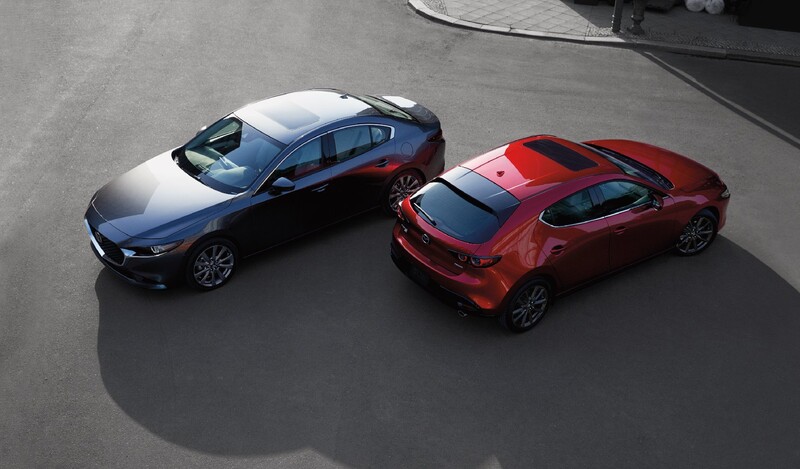
It's the 3 — still available as a sedan or a five-door hatchback. Both are alternatives to a crossover, which for some of us is worth a look on that account alone.
What It Is
As mentioned, the 3 is Mazda's last remaining car — other than the Miata, which is a sportscar. The 3 is available as a compact sedan or five-door hatchback that's also one of the most affordable new cars available. And it's also one of the very few new cars that you can still get with a manual transmission.
Prices for the sedan start at $24,500 for the base 2.5 S trim, which — as the designation suggests — comes standard with a 2.5-liter four (no turbo), a six-speed automatic and front-wheel drive. Sixteen-inch wheels and cloth covered seats are standard, along with an eight-speaker audio system. The similarly kitted out five-door hatchback lists for $25,550 to start.
The $25,440 Select Sport upgrades to 18-inch wheels, synthetic leather upholstery, rain sensing wipers and Alexa AI voice assistant.
Moving up to the $27,090 Preferred adds a sunroof, seat heaters and power driver's seat.
The $30,210 Carbon Edition comes standard with all-wheel drive, plus an upgraded red leather interior, special paint and a wireless charging pad.
If you want more power, the $36,740 gets a turbocharged version of the 2.5-liter engine, along with AWD, larger (10.25-inch) touch screen, paddle shifters, heated steering wheel and navigation.
If you want to shift your own gears, the $31,450 Premium (hatchback only) comes with a six-speed manual, along with a premium 12-speaker audio system, leather seat covers, the larger LCD touch screen and a wireless charging pad.
What's New for 2026
Automatic stop/start "technology" has been deleted — thanks due to President Donald Trump — along with cylinder deactivation. Both of these were compliance technologies designed to help Mazda (and other car companies) deal with federal regulations pertaining to CO2 "emissions" as well as gas mileage mandatory minimums. Trump's Environmental Protection Agency has throttled back on these, so Mazda and other manufacturers no longer need to equip their vehicles with these compliance technologies.
Also, even the base trim gets a standard eight-speaker audio system.
What's Good
— Two body styles — and neither's a crossover.
— Standard 2.5-liter engine doesn't need a turbo to make good power.
— Available manual transmission.
What's Not So Good
— Manual is limited to the hatchback — and to the fairly pricey Premium trim only.
— Mazda's push/rotate knob controller interface for the stereo is awkward to use.
— AWD is limited to the Carbon and Turbo Premium Plus trims.
Under the Hood
The Mazda3 stands out from the crowd not just because it's not a crossover but because it has more under its hood than a motorcycle-sized 1.5-liter (maybe 2.0-liter) engine that has to rely on a turbo to generate adequate power. The Mazda's standard 2.5-liter engine is a kind of latter-days "big block" engine — old-school muscle car reference — relative to the motorcycle-sized engines that are being put in so many new vehicles, even luxury-brand ones.
It makes 186 horsepower without relying on boost — which is literally pressure. The problem with that is engines that are under pressure are engines that — generally — do not last as long as engines that lead a less pressured life. The pressure is compounded in small engines because internal wear surfaces such as bearings are also smaller. There is less area to absorb the pressure. This is why turbos were once found mostly in high-performance cars, where even more power was wanted — even if it came at the cost of shorter engine life.
Another plus is the standard six-speed automatic. It is also unusual in that so many car companies have gone over to either continuously variable transmissions or automatics that have eight (or even nine or 10) forward speeds. Both of these kinds of transmissions are compliance transmissions — of a piece with the small, turbocharged engines that they're paired with. They are designed to help vehicle manufacturers cope with federal emissions (principally CO2) regs and also Corporate Average Fuel Economy regs that require every car company to achieve a certain "fleet average" miles-per-gallon figure. It is currently about 35 mpg. CVTs — and transmissions with more than six forward speeds — help with that but at the cost of complexity, cost and less-than-ideal driving feel. CVTs can feel like they're slipping — and transmissions with all those forward gears can sometimes feel like they're searching for the right gear.
Also, their long-term reliability is not as good as the proven track record of simpler automatics, such as the Mazda's six-speed.
You can also get a six-speed manual, which is becoming as hard to find as an engine that isn't tiny — and turbocharged to make up for it.
Something you won't find anymore — in this Mazda — is the obnoxious stop/start system, which is also a compliance technology. Mazda dropped it after Trump dialed back the compliance pressure (by rescinding fines for noncompliance). Also gone — for the same reason — is the cylinder deactivation system that Mazda used to include as standard.
If you want a turbo, you can get that. It's standard in the Turbo Premium trim, and it's not there because the 2.5-liter four needs more power to adequately propel the car. It is there to propel it more than adequately. The turbo boosts the output of the engine to 250 horsepower (and 320 foot-pounds of torque), output comparable to what a Corvette 5.7-liter V8 made in the mid-to-late 1980s. Performance is comparable too. The turbo'd Mazda3 can get to 50 mph in about 5.6 seconds.
The non-turbo'd versions can make the same run in about seven seconds.
Interestingly — impressively — there's not much difference between the mileage touted by the non-turbo'd 2.5-liter engine — 27 mpg city/36 mpg highway — and the 23 mpg city, 32 mpg highway touted by the much more powerful turbocharged version of this engine.
On the Road
It's nice to drive a car for once. The formerly ordinary becomes something special when that something is no longer ordinary.
Crossovers have numerous practical virtues, but they are generally transportation appliances, with all the driving verve the term suggests. This car is also particularly fun to drive because it's a Mazda — and Mazda tries to imbue all its models with some of the Miata spirit, that fun-to-drive quality that defines Mazda's popular little sports car. It is a kind of eagerness to go — like a horse that responds to the rider. Mazda knows there are many people who'd love to have a Miata but have to have something with more than two seats and a tiny trunk. The 3 sedan — and especially the 3 hatch, with the available six-speed stick — are designed to be the "Miatas" for people who need the extra seats (and doors).
The 2.5-liter engine is a different kind of fun.
It is bigger than the Miata's 2.0-liter four, and though it makes roughly the same horsepower as the Miata's four, it makes it sooner (at lower RPM) and it makes a lot more torque — 186 foot-pounds vs. 151 for the Miata's four — and so it feels stronger at lower RPM, which is ideal for the daily drive.
Because there is no turbo — with the standard version of the 3's 2.5-liter four — there is no sense of the engine having to gather a head of steam before the car jumps when you ask it to. The six-speed auto is also one of the best automatics currently on the market, in part because it has six speeds — which is plenty for driving (versus complying). The six-speed manual is even better, if you're wanting the Miata experience in something that can accommodate more than just you and one passenger. The shame is, Mazda has been effectively forced — by the regs — to limit the manual's availability to the hatchback and then to just one trim. The reason why is the manual-equipped 3's slightly worse gas mileage (23 mpg city, 32 mpg highway), which creates problems for Mazda as regards ... compliance.
At the Curb
The sedan is a good-looking, even sexy-looking car.
Even though it is not a rear-drive car, its looks suggest it might be. The hood is long, as if to accommodate a front-to-rear mounted engine (rather than a transversely mounted or sideways-mounted engine), and that sets the tone for the rest of the car's dimensions. The downside is the relatively small (13.2-cubic-foot) trunk — even though it is relatively large for a small sedan. As a point of comparison, the much larger Honda Accord sedan only has a 16.7-cubic-foot trunk. In both cases, this accounts for the diminished mass-market sales volume of sedans as a class. They lack the cargo-carrying space many people need. Especially people who cannot afford more than one vehicle. That's arguably the main reason why crossovers have largely replaced sedans — including Mazda's. Even a small crossover will typically have much more cargo-carrying space than a full-size car.
But it's nice that the 3 sedan is still available — for people who maybe need the extra seats but don't need the extra cargo-carrying space.
And for those who do, there's always the hatchback. It offers 20.1 cubic feet of cargo-carrying space as well as the versatility of the hatchback layout, which creates more usable space.
The Rest
If only it weren't for the awkward push/turn rotary knob interface on the center console that you have to use to access the stereo controls, it'd be difficult to find anything substantive to complain about. You have to push the knob to open various menus, then rotate it like a dial to find the thing you want to access, then push again. It's a multistep process to do what can be done far more sensibly (quickly, easily) by turning separate smaller knobs. Mazda seems to know that because there's still a dedicated small knob for the volume that does not require going through multiple menus to increase or decrease the volume — as you must do if you want to change the station you're listening to.
The Bottom Line
Sedan — or hatch — and with (or without) a turbo'd engine. It's appealing to have such options.
Now, if only there were more of them.
Eric's latest book, "Doomed: Good Cars Gone Wrong!" will be available soon. To find out more about Eric and read his past columns, please visit the Creators Syndicate webpage at www.creators.com.
View the Mazda3 this week.







View Comments