By Robert Selwitz
Toronto, Canada's largest city, is a multipurpose metropolis. Serving as the center for Canadian finance, industry and commerce, it is also user-friendly, with particular appeal for the residents who live and thrive in dozens of diverse neighborhoods.
While appeals for tourists are definitely here, they are not as evident as those in Montreal, Quebec City or Vancouver, cities where a much stronger effort is made to attract short-term visitors. Nevertheless, Toronto's museums, dining, sport, music and theater offerings are definitely worth several days of exploring. As an added bonus, within a 90-minute drive southwest, one can savor ice wines from a vibrant wine-growing region, the Shaw Theater Festival at Niagara-on-the-Lake and Niagara Falls itself.
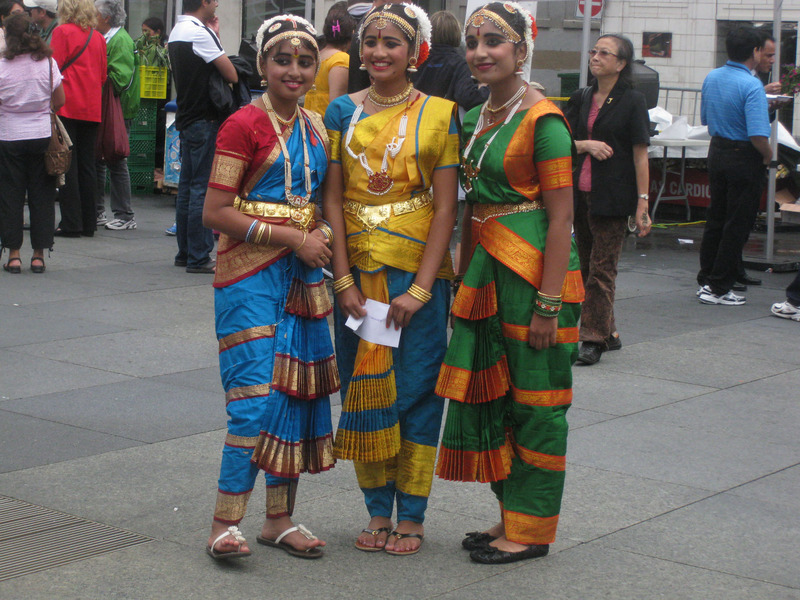
Walking is the best way to experience Toronto, and a good place to start is Dundas Square, a hugely popular gathering point at Dundas and Yonge streets where submerged fountains soar, demonstrations and events such as Hindu festivals occur, and masses gather to shop, particularly at four-tier-tall Eaton Center.
The square also boasts an AMC movie complex and a discount theater ticket booth. That's appropriate since many of the city's major playhouses are just a short walk away.
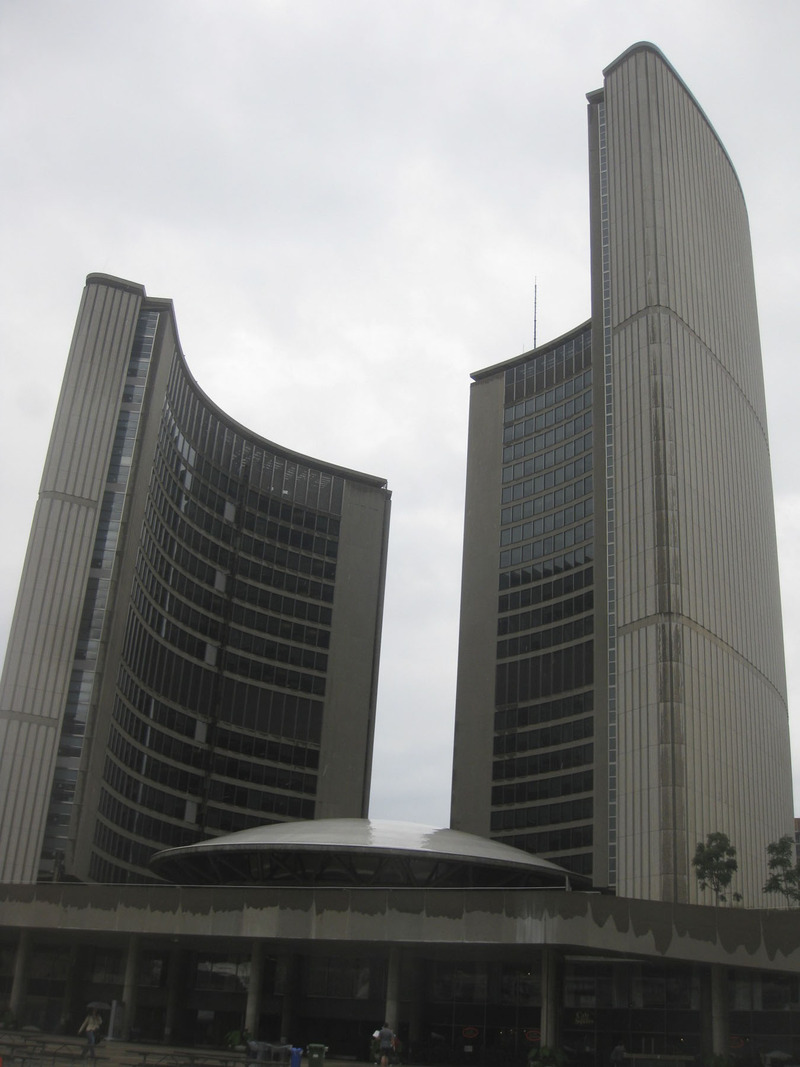
Continuing down Yonge — which Toronto tourist authorities insist is the world's longest street (actually 1,178 miles long, ending at Rain River, Ontario) —visitors soon approach the city's contrasting set of Victorian and mid-20th-century city halls. The older version, built in Romanesque revival style and opened in 1885, features an 1899 clock tower that is one of the city's landmarks. Inside, the fascinating stained-glass mural and elegant staircase are not to be missed. The windows depict the fortuitous union of commerce and industry, both watched over by a beneficial Britannia. Today the old City Hall houses the city's provincial courts. Opened in 1965 and designed by Finnish architect Viljo Revell, the newer curved complex is one of Toronto's truly signature structures. Visits are available to the public.
Shoppers will want to stroll through some of the hundreds of boutiques, galleries and trendy eateries in the Bloor-Yorkville district. There's also plenty to peruse in the more rough-hewn, revitalized cobblestoned-street Distillery district. Here a former whiskey production center has morphed into numerous boutiques and crafts shops, plus a host of stylish restaurants.
Also intriguing is Cabbage Town, a transitional area where many 19th- and early 20th-century dwellings are being brought to life. There are also interesting food and coffee shops that can provide a fine break from touring.
Similarly, serendipity-friendly Kensington Market features plenty of culinary shopping and dining options. Everything is packed into fascinating narrow streets and alleys lined with offerings that range from fresh fish and produce to funky clothing. Its approximate borders are College Street on the north, Spadina Avenue on the east, Dundas Street West to the south and Bathurst Street to the west.
Then there's the three-structure St. Lawrence Market complex at Front Street East and Jarvis Street, where some 120 vendors of fresh fish and produce sell their wares. One of the buildings served as Toronto's City Hall during the mid-1800s.
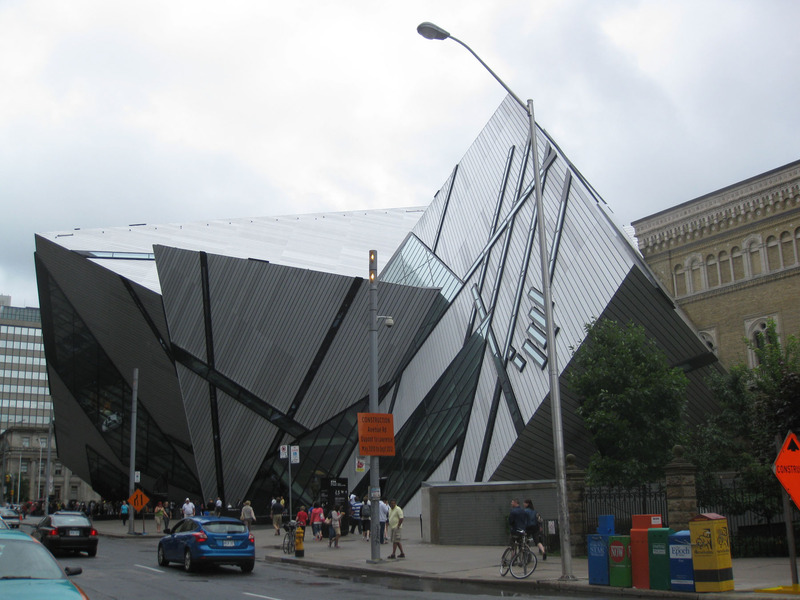
Toronto also boasts the Royal Ontario Museum and Art Gallery of Ontario, which recently underwent a major redesign by world-famous Toronto-born architect Frank Gehry. ROM permanent exhibit highlights include an intact Ming Dynasty tomb and numerous statues found in a Chinese farmer's field during 20th century explorations.
Other highlights include a vast collection of Chinese architectural artifacts such as tombs from the Han and Tang dynasties and the reconstruction of a corner of a Chinese imperial palace. A collection of statuary includes striking green and gold Tang horses and riders and wonderful evocative statues that represent people of the seventh to 10th centuries. The Art Gallery of Ontario has an extensive collection of Canadian works, a representative collection of European masters, and numerous works from Asia and Oceania.
Sports are another year-round Toronto draw. With major league teams in North America's favorite sports, exciting viewing action is never out of season. The Toronto Blue Jays are currently revving up for the baseball season, trying again to crack the top tier of American League eastern division competitors. Rogers Center, featuring a retractable dome, is their home. The Toronto Argonauts of the Canadian Football League, another Rogers tenant, are the current Grey Cup champions (equivalent to being the winner of the NFL's Super Bowl).
The stadium is right next door to the 37-year-old CN Tower, one of the city's top draws. Standing 1,815 feet high, it offers spectacular views of Lake Ontario and the surrounding city. Waiting times and lines can be quite long, sometimes requiring two hours before one reaches the top.
Also grabbing sports fans' attention and currently striving for a spot in the National Basketball Association playoffs are the Toronto Raptors. This being Canada, however, there's no doubt that hockey has the firmest grip on the devotion of Toronto's sports fans. The Toronto Maple Leafs, one of the original six founding National Hockey League teams, is also trying to gain entry into the league's playoffs. Both the Raptors and Maple Leafs play at the Air Canada Center, 40 Bay Street.
Beyond the fates of its individual teams, Toronto draws hordes to its most iconic draw, the Hockey Hall of Fame. Housed in a stately former bank building at Yonge and Front streets, it also boasts an underground exhibit area filled with vast stores of memorabilia.
The star attraction is the Stanley Cup, awarded to the NHL's championship team whose name is added to the cup each year. On display are two of the three existing cups. One, the original, was retired after being filled with names and dates of annual winners. The current cup is inscribed with the name of last season's champion, the Los Angeles Kings. And then there is a traveling cup, a replica that travels with an NHL representative.
Beyond the cups are plenty of photographs, hockey sticks, jerseys, masks, pads and related gear, and several films and videos. There are also games where visitors can pretend to be a goalie and highlights of hockey's most exciting moments. The hall is nirvana for hockey fans of all ages, and a highlight is having one's picture taken with the Stanley Cup.
WHEN YOU GO
For general information: www.toronto.ca/tapto/other.htm
I stayed at the Delta Chelsea Hotel, which was a well-located base for exploring Toronto: www.deltahotels.com.
Porter Airlines is an excellent regional airline that uses Billy Bishop Toronto City Airport. It is just 1.5 miles from downtown, which is much closer than Pearson International Airport 25 miles away: www.flyporter.com.
Hockey Hall of Fame: www.hhof.com
Royal Ontario Museum: www.rom.on.ca
The Shaw Theatre Festival from April to October is one of North America's best theater repertory companies: www.shawfest.com.
Robert Selwitz is a freelance writer. To read features by other Creators Syndicate writers and cartoonists, visit the Creators Syndicate website at www.creators.com.







View Comments