By Robert Selwitz
Unlike much of Southeast Asia, Myanmar's (formerly Burma's) post-World War II history is a sad tale of military repression, economic incompetence and ever-expanding poverty. Though established as a democracy in 1948, an army coup in 1962 put everything into reverse. Through the following half-century many travelers suppressed their wishes to experience Myanmar's alluring culture and attractions, not wanting to fund or support a rapacious dictatorship.
But today — albeit in fits and starts — democratic rule has returned. Now rapidly growing numbers of visitors are arriving to see Myanmar's sights and to support a fledgling government that essentially seems to be heading in the right direction.
But Myanmar's path to better times is not a straight line, and ethnic clashes between Buddhists and Muslims still erupt. However, to date, political unrest has occurred only in areas where tourists rarely go. And the friendliness of Myanmar's people tends to neutralize travelers' concerns once they are on the ground.
Bordered by Bangladesh, China, Laos and Thailand, Myanmar receives no trans-Pacific flights from North America. Since a prior stop is mandatory, Thailand offers the best collection of hourlong, non-stop links to Yangon, the country's commercial capital (formerly Rangoon).
Then, after spending several days there, most head for the interior, usually to start three- to-seven-day river voyages. Led by Orient Express, these cruises ply the Ayeyarwady River which connects so many of Myanmar's treasures. This is an ideal way to comfortably view fascinating, otherworldly sites such as stupa-packed Bagan and rural villages with bustling, intriguing marketplaces.
My recent six-day visit began in Yangon, where the centrally located Traders Hotel provided a great base in the midst of a vibrant neighborhood. Just blocks away is the Beyoke Ang San Market, also called Scotts Market, the city's largest. Here, clothes, jewelry, antiques, fabrics, pocketbooks, lacquer ware and silks fill hundreds of stands where bargaining is expected. Intense and colorful selling also pours out onto streets packed with shoppers and sellers, each trying to squeeze the maximum amount of action into very tight spaces.
Careful navigation is mandatory on people-packed sidewalks where merchants roast peanuts, sell all kinds of herbs and vegetables, and temp with fruits that include mangosteens, rambuton and other tropical specialties. Also on the scene are seemingly friendly folks who want to exchange money or sell bargain-priced airplane tickets. Needless to say, this would be a very bad idea. There are also families eating meals and mothers bathing babies with water from a fire hydrant.
Just outside Scotts there's an MIDB Bank's money-changing center that is hassle-free, line-free and air-conditioned. This is a great place to exchange money for the local currency — kyat — you'll need, but bills for the transaction need to be new, unmarked and unfolded. Otherwise they'll likely not be accepted.
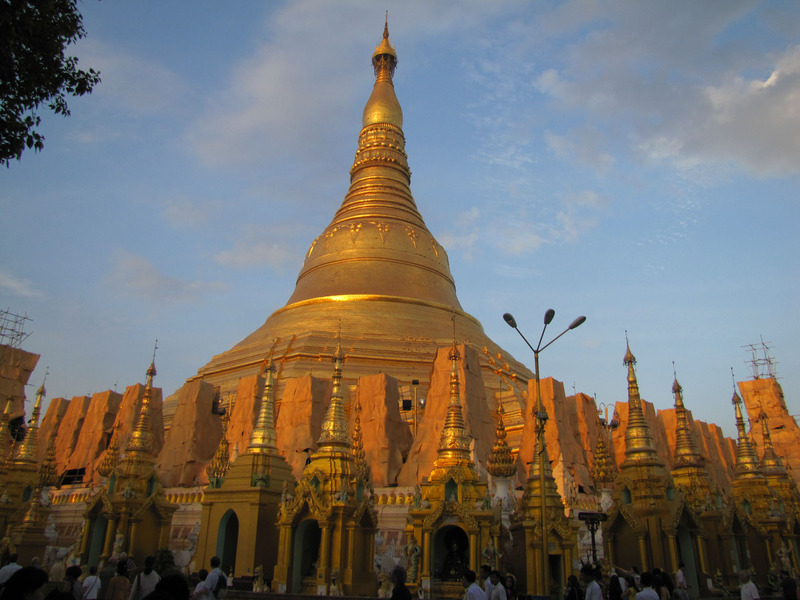
Of all of Yangon's, indeed Myanmar's, attractions, the Shwedagon Pagoda is the one not to be missed. Standing 326 feet tall, this golden stupa is Myanmar's symbol and one of Asia's greatest sights. It is thought to be 2,500 years old, and many believe it was built to house eight strands of hair that Buddha himself gave to two merchants.
Today the gleaming main stupa dominates a plaza and is surrounded by other stupas and eight temples — one for each day of the week plus separate ones for Wednesday morning and afternoon. Since all visitors must remove their shoes and socks before entering, an early morning or late-afternoon visit will minimize the chances of encountering intense heat and burned feet.
It requires at least two hours to observe and photograph this gold monument that's worth some $700 million and is regilded every year. It also takes time to savor views of the main and subsidiary stupas, as well as the seemingly perpetual communal gatherings that crowd the Shwedagon day and night.
On another morning, I sought out the octagon-shaped Sule Pagoda in central Yangon, the ornate, Victorian city hall and the Botatung Pagoda with a hollow interior where — unlike virtually all other pagodas — visitors can enter.
I spent the next three days aboard Orient Express' Road to Mandalay 82-passenger vessel. Cruising the Ayeyarwady River on this vessel was a fascinating counterpoint to navigating Yangon. Its three-, four- and seven-day trips that wend primarily between Mandalay and Bagan provide a hassle-free and practical means to travel in comfort and experience world-class attractions that would otherwise be difficult for independent travelers to reach and explore. The ship's corps of savvy guides also bring clarity to a history and culture that differs so radically from that of the West.
An hourlong early morning Yangon-Mandalay flight — with hotel transfers and passage built into the package — started my trip. When too-shallow drafts prevented our sailing immediately from Mandalay, we were more than compensated by a fascinating tour of the capital of Myanmar's former royal kingdom. One of the highlights was the wooden Shwenandaw Monastery, which was festooned with exquisite teak carvings.
This is the only remaining piece of a massive 19th-century royal palace complex that was moved from its original location following the death of its builder, King Mindon. That meant it was not in the line of fire when Japanese bombers destroyed the rest of the complex during World War II. King Mindon also created Kuthodaw Pagoda and the surrounding "world's largest book." This is actually 729 marble tablets, engraved on both sides, that contain what was assumed to be all of Buddha's writings.
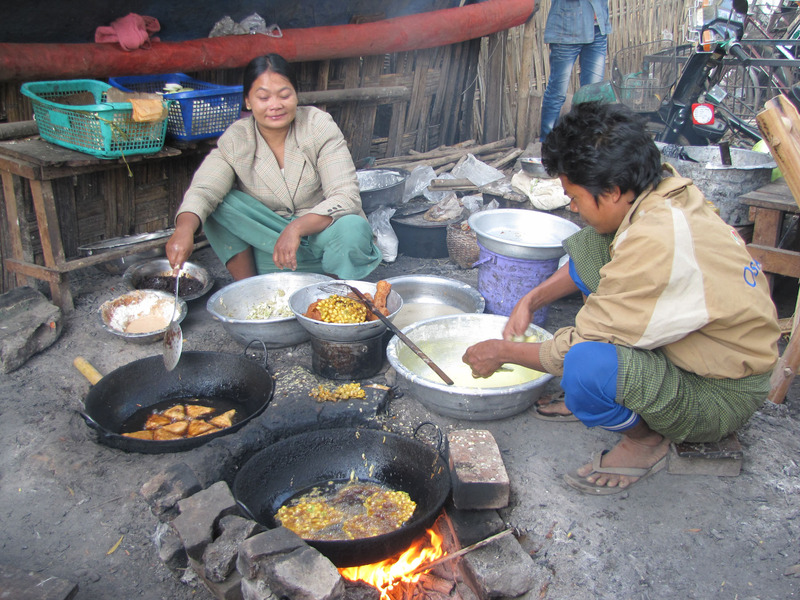
That afternoon and the following morning we visited several riverside towns, each featuring vibrant markets with friendly, eager sellers of foods, household goods and souvenirs. But the star of the cruise was Bagan, where — from 1044 to 1287 — Burmese kings built thousands of temples and pagodas. Many of the stone structures still stand, dotting the dusty fields in a surreal display of manic religiosity. It must be seen to be believed.
Along with the chance to explore and learn about Bagan, Mandalay and river market towns, the ship's comfortable accommodations, excellent food, fascinating lectures, and friendly and helpful guides are a definite plus. And even while sailing along the Ayeyarwady when nothing special seems to be happening, it's likely a great view or picture is just a moment away.
Of course, with more time available, there's much more to see. A highly popular (and favorite extension for river-ride participants) is 45-square-mile Inle Lake. Touring via powered flat-bottom boats we saw villages built on stilts, floating markets and intriguing temples. Many find several days relaxing and floating around Inle Lake to be a perfect coda for their Myanmar sojourn.
WHEN YOU GO
Orient Express: www.orient-express.com or 800-237-1236
Traders Hotel, Yangon: www.shangri-la.com. This business-focused property offers the perfect combination of great location, calm and efficient service, and very comfortable rooms.
Myanmar visas are required for all visitors. Arrangements are easiest in cities with Myanmar consulates that have specified hours and days for filing visa forms and picking up approved visas. Earlier this year in New York City this involved a two-week waiting period.
Robert Selwitz is a freelance writer. To read features by other Creators Syndicate writers and cartoonists, visit the Creators Syndicate website at www.creators.com.







View Comments