By Carl H. Larsen
You can do interesting things while traveling by train — like becoming a poet.
Inspiration was right outside the panoramic dome car my wife and I were seated in while taking a leisurely two-day rail trip though the breathtaking Canadian Rockies.
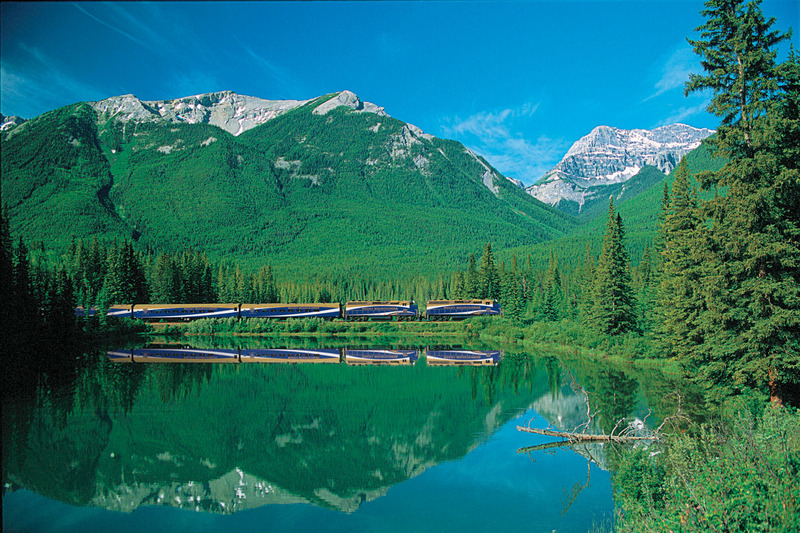
Majestic mountains, raging rivers, thick forests and desolate plateaus were all part of this overland voyage. With that tableau came an incredible assortment of wildlife: bears darting into the woods, deer scrambling to safety and bighorn sheep hidden on rocky cliffs.
No one could believe the scores of bald eagles nesting on an island in the middle of a river.
"I've never seen so many eagles - look, there's one on that tree," said a woman snapping photos from the car's open-air rear vestibule where photographers perched to capture memories of the trip. With more patience, I might have spotted moose or elk or a prowling wolf. This was untamed country, bisected by the thinnest line of human endeavor - two parallel rails.
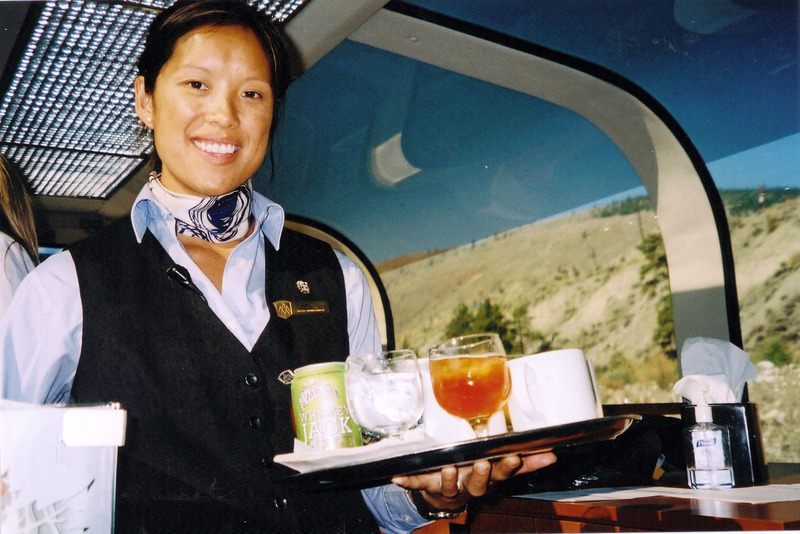
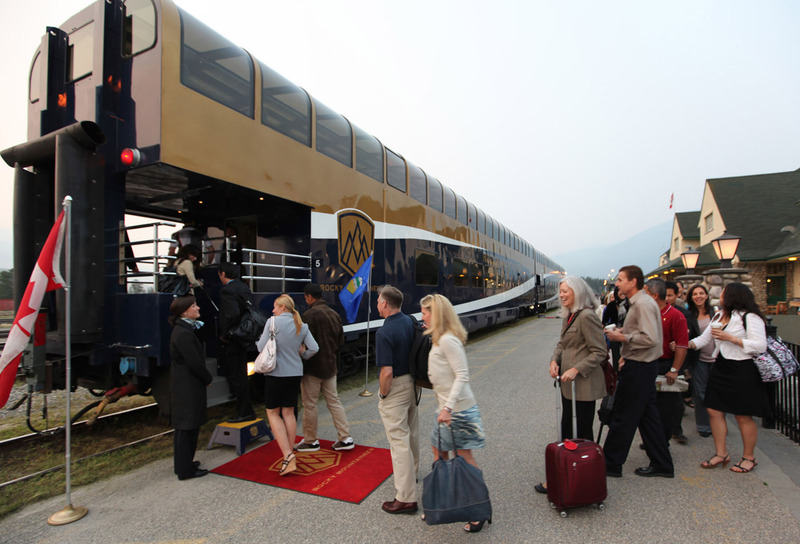
We were on the deluxe Rocky Mountaineer, a private train consistently acclaimed as among the world's 10 best rail journeys. With us was an international cast of fellow travelers who came from the United Kingdom, Germany, Australia and Japan as well as the United States and Canada. We were all treated royally and greeted with red carpets and flags upon boarding. Attendants came to our seats with snacks and a selection of drinks, including local wines. At key points, commentary was offered on the sights outside.
Our food, locally sourced and cooked to order, was prepared in a galley off the lower-level dining room. In conversations over breakfast and lunch it was clear that many of the passengers were taking the trip as a once-in-a-lifetime journey. Some were combining the rail trip with a cruise up the Inside Passage toward Alaska.
Our two-day, 594-mile excursion during daylight hours from Banff, Alberta, to Vancouver, British Columbia, followed for much of the route the Canadian Pacific line that was the first to cross Canada.
With two straining engines and a combination of 21 two-level and single-level cars, our train carrying 553 passengers made a statement as it twisted and turned through small mountain towns. Arriving at Kamloops, British Columbia, at night, the passengers were shuttled to a hotel to spend the night before starting out again the next morning. Each of us was a "through" passenger — there was no hopping off and joining another train later.
On the second day, after lunch, we had just been served cocktails when Holliday, one of the on-board GoldLeaf class "cruise directors," asked the passengers in the car to compose a poem based on the trip. The best would win a prize.
We were on a narrow ridge high above the roaring Fraser River. On the other side of the steep canyon was the trackage of the Canadian National Railroad. The Fraser is one of Canada's mightiest rivers, known for its annual salmon run. Each September fish return to their spawning grounds up the river after a grueling two and a half years in the north Pacific Ocean.
Maybe it was the scotch I was drinking, but I had no worries about writer's block as I faced a piece of paper with pen in hand. In no time, I was writing my "Ode to a Salmon": I'm going upriver without a paddle,/ the railway as my guide. / It's my once-in-a-lifetime odyssey,/ something which I can't be denied./ You guys up there in the Mountaineer/ can't imagine how far I've come/ to return to my spawning grounds unmolested/ without becoming quite digested,/ by watchful eagle or menacing bear...."
While nature takes the prize on this trip, there is a rich history along the line, as well — feats of engineering required to build the railway, tales of Indians or First Nations, folklore and the exploits of dim-witted train robbers.
To build the railroad, 10,000 Chinese laborers were brought from Canton and the United States, where they earlier had helped build the Union Pacific Railroad. They were the pioneers of today's large Chinese community in British Columbia.
A guide told stories of places along the tracks such as Jaws of Death Gorge, Boston Bar, Hell's Gate and Avalanche Alley. Some were already familiar from postcards: Lake Louise, Banff National Park and the upper Columbia River.
At Craigellachie, we passed an unremarkable place that cemented Canada's standing as a nation spanning the continent. There, a small museum and stone monument mark the spot where the last spike of the Canadian Pacific Railway was driven on Nov. 7, 1885.
Railroad buffs also can marvel as the train passes through the five-mile-long Connaught Tunnel running through Mount Macdonald and the nearby Stoney Creek Bridge. Worthy of a civil-engineering dissertation are the Spiral Tunnels, built so that the railway doubles back upon itself twice in order to reduce the steep grade that would have been required to pass through the mountains.
In 1906, outside Kamloops, the hapless train robber Billy Miner and his partner Shorty Dunn made off with a paltry $15 and some liver pills when their dreams of a big haul were scrubbed. The train they originally had hoped to rob had been delayed. Caught by the Mounties after a "Wanted Dead or Alive" flier was posted, Miner was sentenced to life but escaped from prison and died years later while in the Georgia State Penitentiary.
Late in the afternoon of the second day, the hustle and bustle of civilization returned as we were shunted through Vancouver's massive rail yards, making our way toward the Rocky Mountaineer station.
Caught up in the earlier splendor of the Fraser River canyon, I had completed my poem while thinking about the scenic, take-it-all-in journey, new friends I had made and a newfound respect gained for earlier generations who at great peril had made their way over this same route.
I ended with these lines: So, I'm bound for glory on this river/ and from me there's much to learn/ That life indeed is precious,/ and, yes, that home/ is a place to which
you indeed can return!
Like the salmon in the raging torrent below, I too had been on a course of discovery along these tracks. And that contest? I won it. My prize was a salmon pin now worn proudly on my lapel that establishes my poetic license.
WHEN YOU GO
In operation for 22 years, the Rocky Mountaineer operates over four routes and offers more than 40 tour packages, including Alaska cruise tie-ins with Holland America Line. Trains operate from the end of April to early October, depending on the route. New in August 2013 will be a fifth route, called Coastal Passage, that goes through the Canadian Rockies and arrives and departs from Seattle, the company's first U.S. presence. Rail equipment includes a combination of renovated and specially built coaches, many with upper-level panoramic viewing. Passengers can choose from three classes of service on two-day journeys. For more information, visit www.rockymountaineer.com.
Carl H. Larsen is a freelance travel writer. To read features by other Creators Syndicate writers and cartoonists, visit the Creators Syndicate website at www.creators.com.







View Comments