Q: I have a paving stone patio behind the house. Behind the patio is a man-made stone wall that you can sit on. Behind the wall is a flower bed that has an ash tree in it. And finally, behind the flower bed is a downhill slope that is covered in grass. The slope is not steep, and it can be walked on and mowed with no problem.
The ash tree has roots that are growing on top of the grass. They make it hard to walk or mow the grass. The tree's roots are also starting to shift parts of the wall. I am afraid the wall will become unstable and fall over.
I want to keep the ash tree as it is the only tree in my very small yard, and it provides all the shade for the patio. I am treating it for emerald ash borers, and it shows no signs of having any problems. I have started growing an oak tree in a better place in the grass that will eventually become a good shade tree, but it is only four feet tall and will not shade the patio in my lifetime.
I want to cut some of the roots off the tree so they won't be growing in the grass or under the wall, but I don't want to kill the tree. How can I do this? The tree is about 15 years old and about a foot in diameter. The roots are a few inches in diameter.
A: Tree roots are a problem in many landscapes. We all know that roots grow down and branches grow up, but very often the roots don't know what to do with changes in the level of the ground. The ash tree roots were growing underground out away from the trunk but then the ground begins sloping down, exposing the roots. The roots will try to stay down as much as possible, but as they enlarge in diameter, they will become more and more exposed.
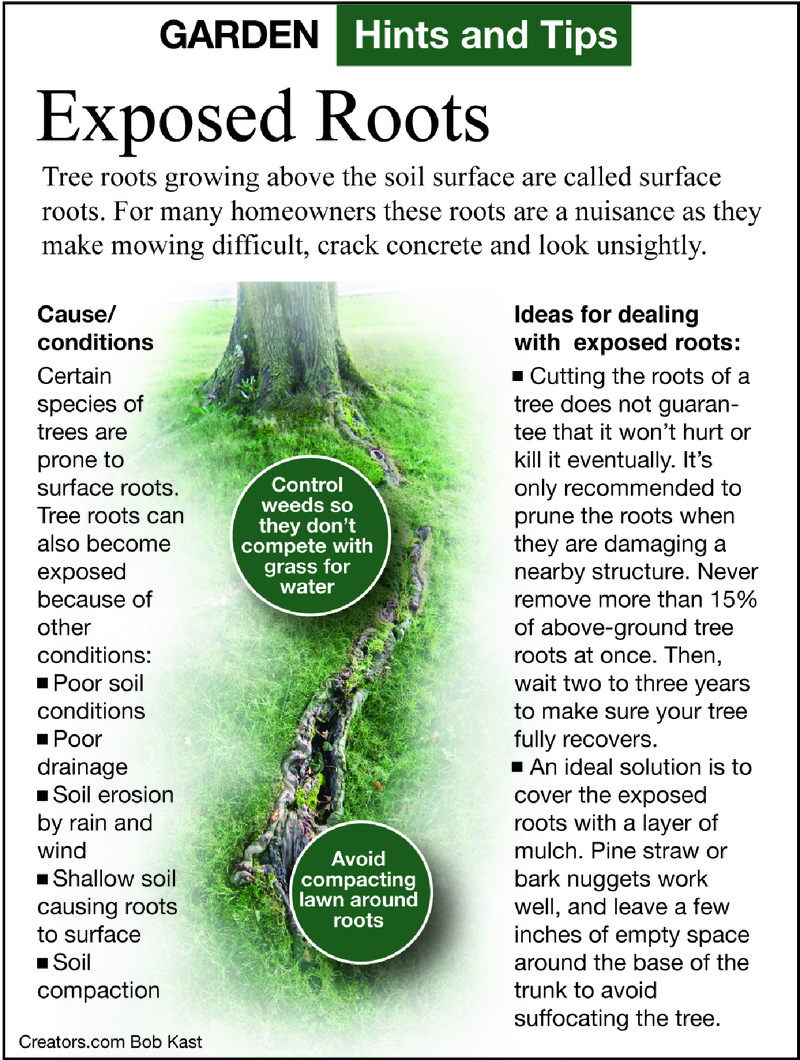
If you can add a few inches of soil to cover them and then add grass over that, the roots will be less exposed, but the effect will be that the grass slope will become steeper. Enlarging the flowerbed and mulching over the roots is another possibility.
Just cutting off a root or two that are not large will not kill the tree. If there are a lot of roots, cut a few at a time and do this process over a few years instead of all at once. It is better to do this root pruning in the fall when the top of the tree is going dormant, or in the early spring before the leaves come out. The problem is that the new roots that grow from these pruning cuts will still want to grow at the surface.
The roots growing under the wall are probably near the surface because the soil below the wall and patio is compacted and covered in gravel. The only suitable conditions for root growth are near the surface and as the roots enlarge, they begin to push on the wall. Again, cutting a few roots at a time is OK, and if you are doing both the grass side of the tree and the wall side of the tree at the same time, don't trim too many roots at once.
On the wall side, you may be able to cut the root off a few inches behind the wall and then you can place a board between the wall and root. The board can be angled downward to force the new roots down and under the wall instead of them growing back toward the wall.






View Comments